Lodi Eye
LodiEye provides additional information on trending stories / topics published by local media and shared on local social media accounts.
Lodi City Council Agenda — May 6, 2026
The May 6 meeting is a heavyweight transition night for Lodi. After more than a year of acting and interim leadership, the Council is being asked to install three permanent executives in one sitting: Kara Reddig as City Manager ($285,000 base, 3-year term, effective June 22), Jamie Bandy as Director of Administrative Services ($315,000 fully-burdened, effective May 12), and Bandy as City Treasurer. A fourth personnel item brings retired Vacaville economic development director Donald Burrus back to public service as a part-time annuitant under PEPRA's 180-day exception.
Beyond people, the agenda also delivers a first-of-its-kind revenue-share billboard partnership with Rogers Media (greater of $25,000 a year or 25% of net ad revenue), a same-week deadline question about acquiring the State-owned Lodi Armory, a placeholder asking whether the City should formally prevent data centers in Lodi, and the first of three FY 26/27 budget study sessions revealing a structural gap that has forced 37 deferred General Fund positions, a $1.5M cut to fire vehicle replacement, and $2.8M in department-wide reductions. The 22-item Consent Calendar is unusually heavy with end-of-fiscal-year contract resets totaling roughly $15 million.
Jamie Bandy Returns to City Hall as Director of Administrative Services and City Treasurer
The Lodi City Council’s May 6, 2026 agenda includes the appointment of Jamie Bandy as the city’s next Director of Administrative Services, with an effective start date of May 12, 2026 and a fully-burdened compensation package valued at approximately $315,000 per year. The same agenda action designates Bandy as the city’s City Treasurer, the statutory officer responsible for the custody and investment of public funds. The appointment closes a high-profile vacancy that has shadowed the city since the 2025 forensic-audit fallout, returns a Lodi-rooted public-finance professional to City Hall after roughly seventeen years away, and pulls together Finance, Human Resources, and Information Technology under a single executive who has run each of those functions in different forms during her career.
Six Candidates, Three Hometown Names: A Lodi Guide to the 9th Assembly District Primary
The 9th Assembly District spans five counties — from the Elk Grove suburbs through Stockton, Lodi, Manteca, Ripon, and Modesto, into the Amador and Calaveras foothills — but its political center of gravity sits in Lodi. Three of the six candidates on the June 2 primary ballot live in our immediate area: Tami Nobriga in Lodi, Jim Shoemaker in Clements, and Matthew Adams in Woodbridge. Incumbent Heath Flora's official residence is in Ripon, with Brandon Owen of Galt and Michael Perez of Waterford rounding out the largest AD-9 field since Flora first won the seat in 2016.
Lodi Taps Elk Grove's Kara Reddig as New City Manager
After more than a year of acting appointments, interim placeholders, and legal bills approaching seven figures, the City of Lodi has hired Kara Reddig, Deputy City Manager of Elk Grove, as its next City Manager. A seasoned municipal executive with more than two decades of local-government leadership, Reddig arrives to stabilize an office that has cycled through four different managers since April 2025 — and to reset a City Hall still working through the fallout of the Scott Carney removal, an estimated $600,000 in legal costs, and two independent reviews of the city's internal controls.

A Lodi Vintner's Last Hunt: Ernie Dosio, the Elephants of Gabon, and the Quiet Economics of Conservation
On April 17, 2026, 75-year-old Lodi vineyard owner Ernie Dosio was trampled to death by a herd of five forest elephants in Gabon's Lopé-Okanda rainforest while on a $40,000 guided safari. His death — covered by wire services from London to New York — offers Lodi readers a rare window into how sportsmen like Dosio quietly underwrite wetland, refuge, and big-game habitat work in California and around the world. This LodiEye report merges the accident, the man, his business and conservation contributions, and a broader comparison of hunter versus non-hunter dollars that sustain modern wildlife conservation.

Lodi's Fuel Tax Is Shrinking. Can EVs Replace It?
Three new fuel retail projects are moving through approvals in the Lodi region. One — the Maverik station being annexed at Kettleman Lane and Beckman Road — will pay into Lodi's General Fund. Two — the Dhanda project at Highway 99 and Liberty Road in unincorporated Collierville, and the Lockeford ExtraMile at Highway 12 and Highway 88 — will not. Near-term, the Maverik adds roughly $280,000 annually to Lodi's books; the two unincorporated projects migrate approximately $340,000 annually from Lodi's tax base to San Joaquin County's as Lodi residents and pass-through traffic fuel up outside the city limits.
But the larger story is structural. California's Advanced Clean Cars II rule phases out new gasoline vehicle sales by 2035; Lodi's own EV Master Plan projects the city's zero-emission fleet will grow from 1,221 vehicles at the end of 2023 to more than 24,000 by 2035. Sustained California retail gasoline prices at $5.88 per gallon and rising accelerate the transition further. Meanwhile, Lodi Electric Utility's existing 10 percent payment-in-lieu-of-taxes transfer — approximately $7 million annually to the General Fund — provides a partial offsetting mechanism that is not widely understood, and whose optimization has not been publicly discussed. This analysis examines the near-term fiscal picture, the structural decline, and the replacement revenue and EV-monetization strategies Lodi can learn from peer California municipal utilities.
How Lodi Actually Works: Congregations, Clubs, Missions, and Movements
Lodi has roughly 334 registered nonprofits operating across every cause area that shapes daily life in the city. Faith & Religious Organizations form the single largest sector by count at 76 organizations (23%), followed by Youth, Sports & Recreation at 59 (18%) and Housing & Social Services at 41 (12%).
Applying the Lodi411 taxonomy of three civic-life types — Fraternal, Mission, and Civic Movement — and splitting each by religious vs. secular status reveals the structural reason Lodi punches above its civic weight: two organizations, Love Lodi and The Salvation Army Lodi Corps, function as super-connectors between faith, secular, and municipal actors. Several other issue areas — arts, environment, recovery, heritage — remain promising areas for stronger coordination and future partnership.
The Three Types of Small-Town Civic Life
American small-town civic life runs on three distinct organizational forms. The fraternal type — Lions, Rotary, Kiwanis, Elks, American Legion — is in national decline, with membership losses of 25 to 70 percent since its mid-1960s peak. The mission type — cause-centered organizations working on specific local issues — can produce sustained decade-scale work on issues that the other two types cannot. The civic movement type — Love Lodi and its peers across the country — mobilizes volunteer participation at a scale the other two cannot reach.
Each type produces distinct civic goods. None of them can replace the others. And the two newer types only realize their full value to a community when they have the digital infrastructure — active social media presence and mailing lists — to cross-pollinate each other. A community that builds all three types, and connects the two newer ones through shared volunteer and follower flow, punches above its civic weight. Lodi, more or less by accident, is one such community.

Lodi's Food Truck Cap Hits the End of the Road
With 10 vendors stuck on a years-long waitlist and neighboring San Joaquin County cities operating cap-free, Lodi's City Council is moving to scrap its 25-truck limit. The debate over where, when, and how trucks can roll is just beginning — and the lessons from Stockton, Manteca, Lathrop, Tracy, and Galt point to a clear blueprint.
County Funds Flow to Lodi: $38,200 Across Nine Nonprofits
Nine Lodi-area nonprofits will share roughly $38,200 in one-time county funding after the San Joaquin County Board of Supervisors unanimously approved a $67,700 round of District 4 discretionary allocations on Tuesday. The awards — directed by Supervisor Steve Ding, whose district covers Lodi and surrounding communities — land at a moment when local nonprofits are navigating rising operating costs, tight municipal budgets, and shifting grant cycles. This report pairs the county data with a verified accounting of Lodi City Council nonprofit allocations for FY 2025–26 through April 16, 2026.
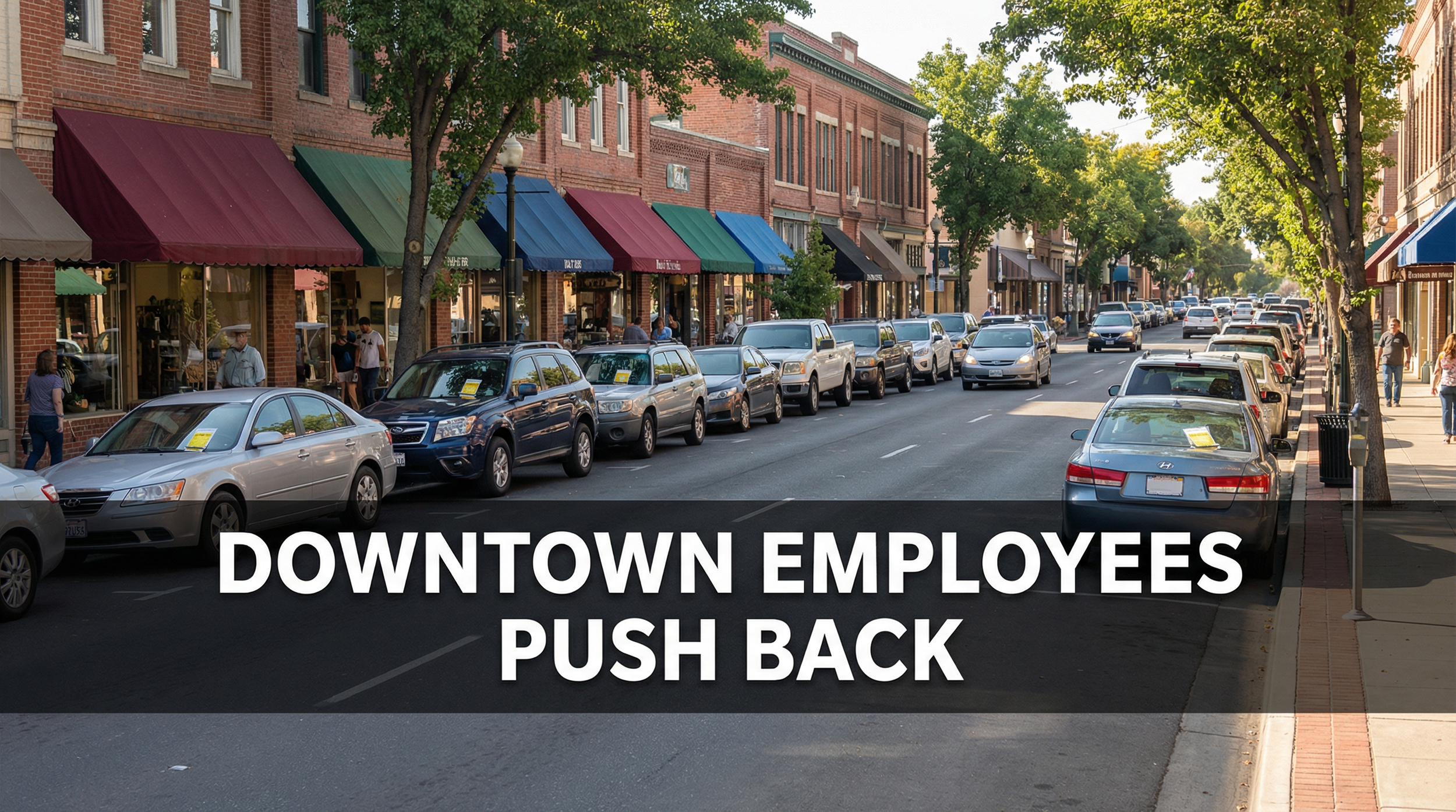
Downtown Employees Push Back
On Tuesday evening, April 14, 2026, the Lodi Improvement Committee voted unanimously—4 out of 4—in support of ending the ticketing of downtown employees during their shifts and establishing safe, dedicated employee parking. The vote comes as over 140 downtown workers have signed a petition calling on the Lodi City Council to act. A key council hearing takes place tonight—Wednesday, April 15 at 7:00 PM at Carnegie Forum. LodiEye examines the parking crisis, safety concerns at Lodi’s parking structure, how neighboring San Joaquin County cities handle employee parking, and potential solutions.

Water Infrastructure And Stormwater: What San Joaquin County’s $19 Million Federal Ask Means for Lodi
San Joaquin County submitted nearly $19 million in federal funding requests in March 2026 for the FY2027 budget, including $2.4 million for the Victor Storm Drain Retention Pond just east of Lodi and $2 million for the Acampo Innovation Drainage Project to the south. Both projects have been submitted in prior years without receiving funding. Meanwhile, aging water mains across the county — some nearly 80 years old — are causing leaks and service disruptions. This report examines the county’s federal requests, Lodi’s own water and stormwater infrastructure, and the broader landscape of state and federal funding programs that could shape the region’s water future.
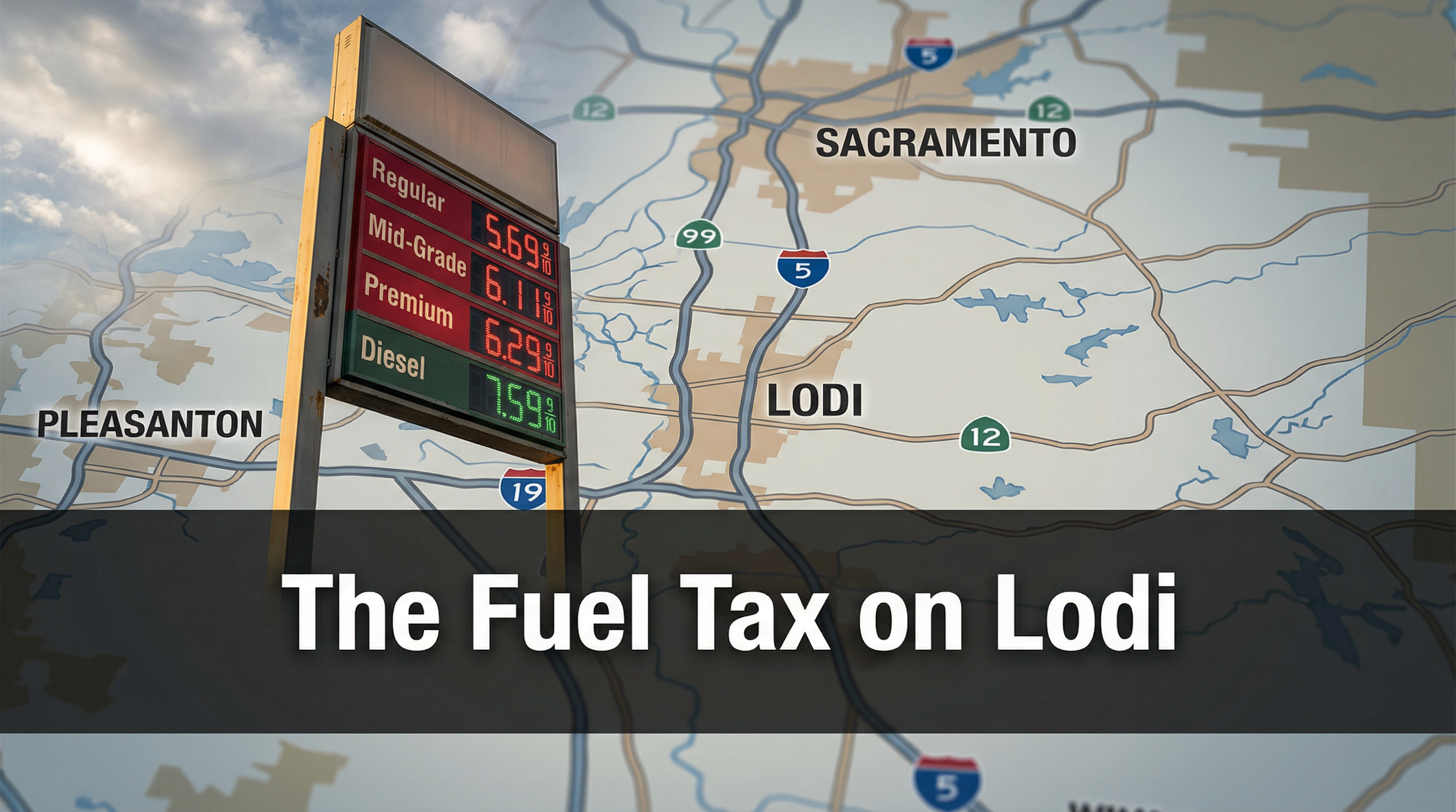
The Fuel Tax on Lodi
Lodi's economy depends on three streams of workers — an estimated 2,000 to 4,000 Bay Area commuters whose professional wages fuel local spending, thousands more commuting to Stockton and Sacramento, and the majority who live and work locally. With no BART, no light rail, and no direct commuter rail, every household's budget is priced per gallon. This analysis maps the tipping points at which elevated fuel prices trigger permanent changes: commuters pivoting from Lodi homeownership to renting near transit hubs, families cutting the discretionary spending that sustains local businesses, and the compounding revenue impact on a city already facing a $4.8 million structural deficit.
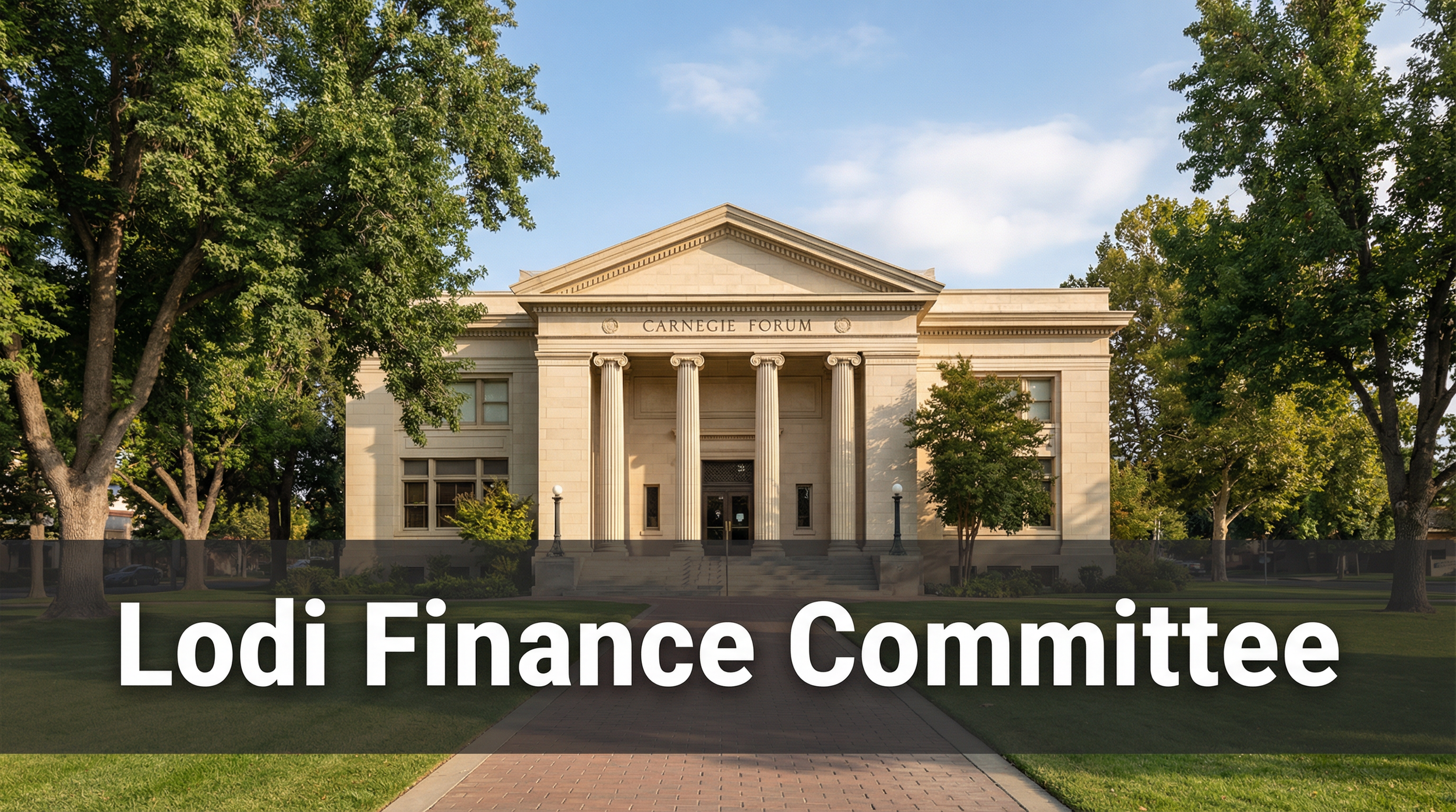
Lodi Finance Committee - April 15, 2026
This special meeting of the Lodi Finance Committee features four agenda items focused on strengthening the City's fiscal governance. The centerpiece is a comprehensive overhaul of the Purchasing Policy — last updated in May 2022 — with updated procurement thresholds, new federal compliance provisions under 2 CFR Part 200, and stronger documentation requirements. Staff also proposes raising the City Manager's purchasing authority from $60,000 to $100,000 to align with comparable Northern California cities. A new framework for accepting donations without individual Council approval rounds out the agenda, following up on discussion from the March 11 meeting.

Forensic Audit Closes the Books on Carney-Magee Fraud Allegations
After a year-long investigation involving five independent firms and costing taxpayers well over $1 million, the Hoslett Forensics final report — to be presented to the Lodi City Council on April 15, 2026 — finds no intentional fraud at City Hall. Credit card policy violations totaled $8,625 over five years, and a utility deposit discrepancy originally claimed at $1.2 million was determined to be approximately $67,000 in clerical errors. By state, national, and private-sector benchmarks, Lodi’s violation rate of 0.077% ranks at the extreme low end of the scale. The report confirms that real internal control weaknesses exist and recommends structural reforms — several of which are already underway.
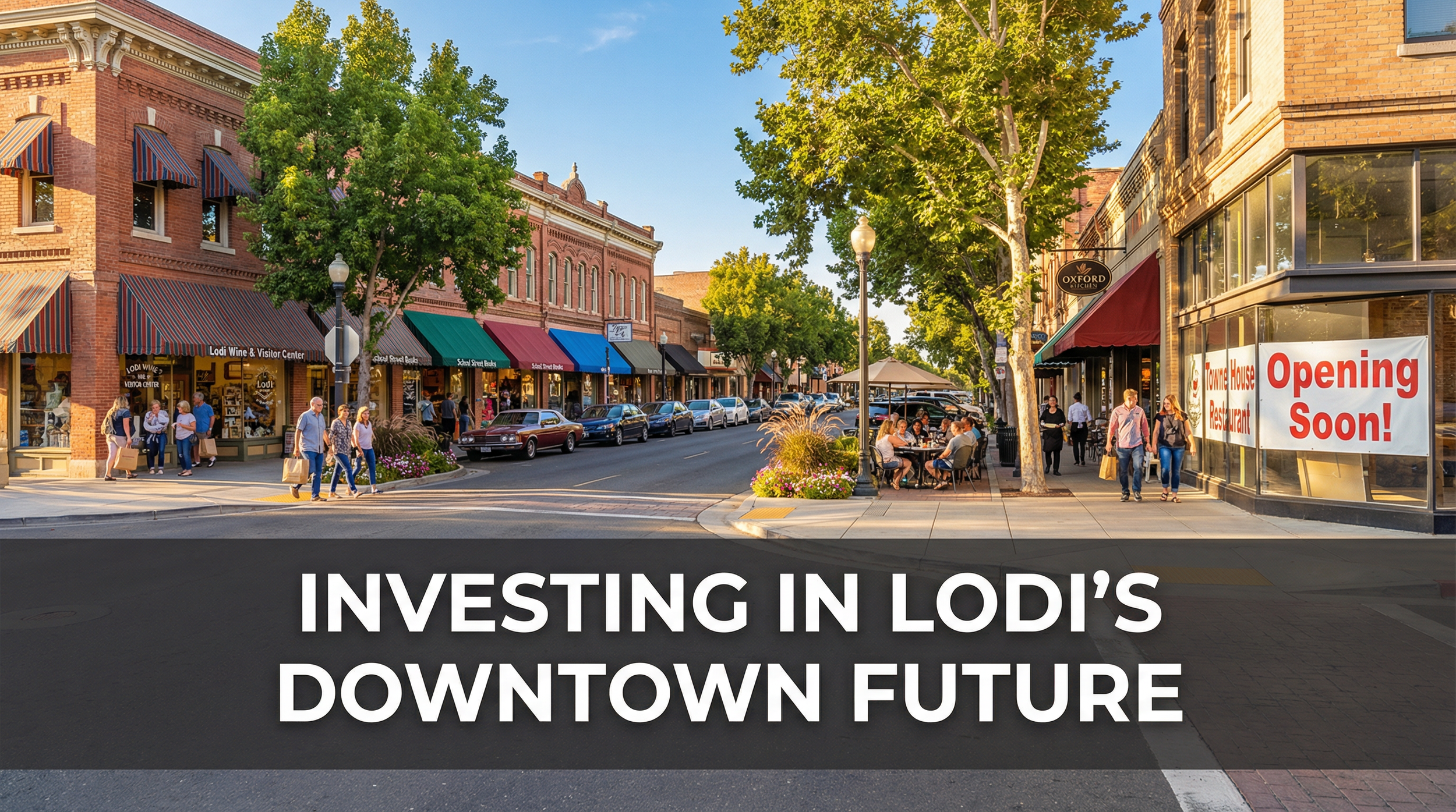
Investing in Lodi’s Downtown Future
The City of Lodi is exploring the formation of a Property-Based Business Improvement District (PBID) in the downtown area to fund enhanced services — including cleaning, safety, beautification, and marketing — above and beyond what the City's General Fund currently provides. A PBID would levy assessments on commercial property owners within a defined boundary, with funds controlled by a property-owner-governed nonprofit association. Nearly 100 PBIDs operate in California downtowns under the Property and Business Improvement District Law of 1994. This analysis explains how PBIDs work, examines comparable districts in small California cities, identifies the local conditions that make a Lodi downtown PBID timely, and outlines the key questions property owners should be asking.
Lodi Improvement Committee - April 14, 2026
The Lodi Improvement Committee convenes for its regular monthly meeting with five substantive agenda items: a Love Lodi presentation previewing the April 25 citywide volunteer day, a downtown parking discussion referred by City Council, CDBG program updates spanning three fiscal years (including a new $665,236 allocation for 2026–27), a review of the committee's 2026 annual activities and task assignments, and scheduling of future meeting topics for May and June.
All five committee members — Chair Lyndsy Davis, Mono Geralis, Dawson Hayre, Janavi Sharma, and Christine Tran — are expected to attend, along with staff members Neighborhood Services Manager Jennifer Rhyne and CDD Program Specialist Kari Chadwick. The public may participate in person, via Zoom, or by submitting comments via email to LICcomments@lodi.gov no later than three hours before the meeting.
Lodi City Council - April 15, 2026
This packed agenda features three Regular Calendar items including a forensic accounting audit report, a $1.25 million credit card convenience fee policy decision, and a vendor permit cap discussion; four presentations including three mayoral proclamations and a non-profit check presentation; and twelve Consent Calendar items totaling over $22 million in contracts and appropriations. Two Closed Session items address the ongoing City Manager recruitment and anticipated litigation.
Urban Tree Canopy And Tree Equity: How Lodi Compares
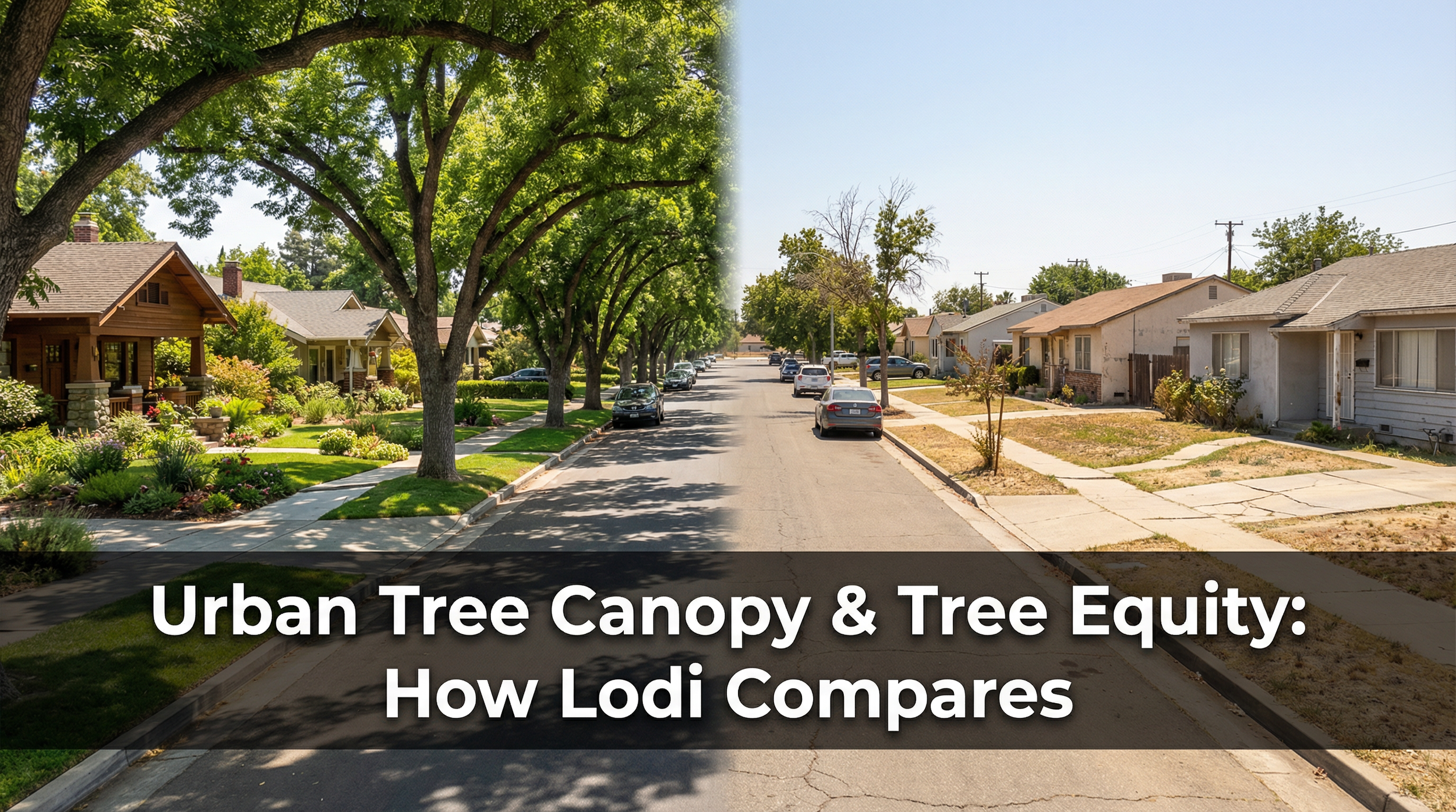
Lodi’s urban tree canopy covers an estimated 13–16% of the city — roughly at the California urban average of 14.45% but well short of the ~30% coverage recommended by American Forests for equitable urban forestry. With a Tree Equity Score of 72.3 out of 100, Lodi clusters with neighboring Stockton (72.0) and Tracy (73.7) in the low-to-mid 70s, while Davis (92.8) dramatically outperforms all three. Nine of Lodi’s 51 Census block groups score below the priority threshold of 60, indicating neighborhoods with both low canopy and high social vulnerability.
Despite holding Tree City USA status for 23 consecutive years, Lodi’s tree ordinance (Chapter 307) lacks the canopy growth mechanisms — preservation thresholds, replacement ratios, development shading standards — that have driven measurable results in Davis, Sacramento, and Fresno. This report examines the data, the policy gaps, and what it would take to close them.
The Leadership Gap
In 30 months, the City of Lodi has cycled through five people in the city manager's chair, lost key personnel in finance, human resources, and community development, spent more than $1 million on consultants and interim staffing, and endured a public rupture between its city manager and city council that made regional and statewide news.
This is not a story about one bad hire. It is a story about institutional erosion — and Lodi is far from alone. Across the Central Valley and throughout California, the machinery of local government is losing the people who know how to run it. The question is whether Lodi's elected leadership, at both the city and county level, understands the depth of the problem.