Lodi Eye
LodiEye provides additional information on trending stories / topics published by local media and shared on local social media accounts.
Heath Flora's Decade in the Assembly, and the Two Ethics Cases That Cost Him the Leadership
Assemblyman Heath Flora, the Ripon Republican who has represented Lodi and the surrounding communities in Sacramento for nearly a decade, was removed as leader of the Assembly Republican Caucus on Monday, August 3 — eleven months after he took the job and one day after national reporting revealed that he is the subject of two open enforcement cases at the Fair Political Practices Commission, the state's political ethics watchdog. Flora remains a member of the Assembly and remains on the November ballot, where he faces Woodbridge Democrat Matthew Adams in the race for the 9th Assembly District. This report lays out Flora's full history in the Legislature, his legislative record, the documented facts of both FPPC cases — including the case numbers and filing records behind them — and the leadership transition now underway. Throughout, it distinguishes between what is established in official records, what has been reported and attributed, and what remains unproven allegation.
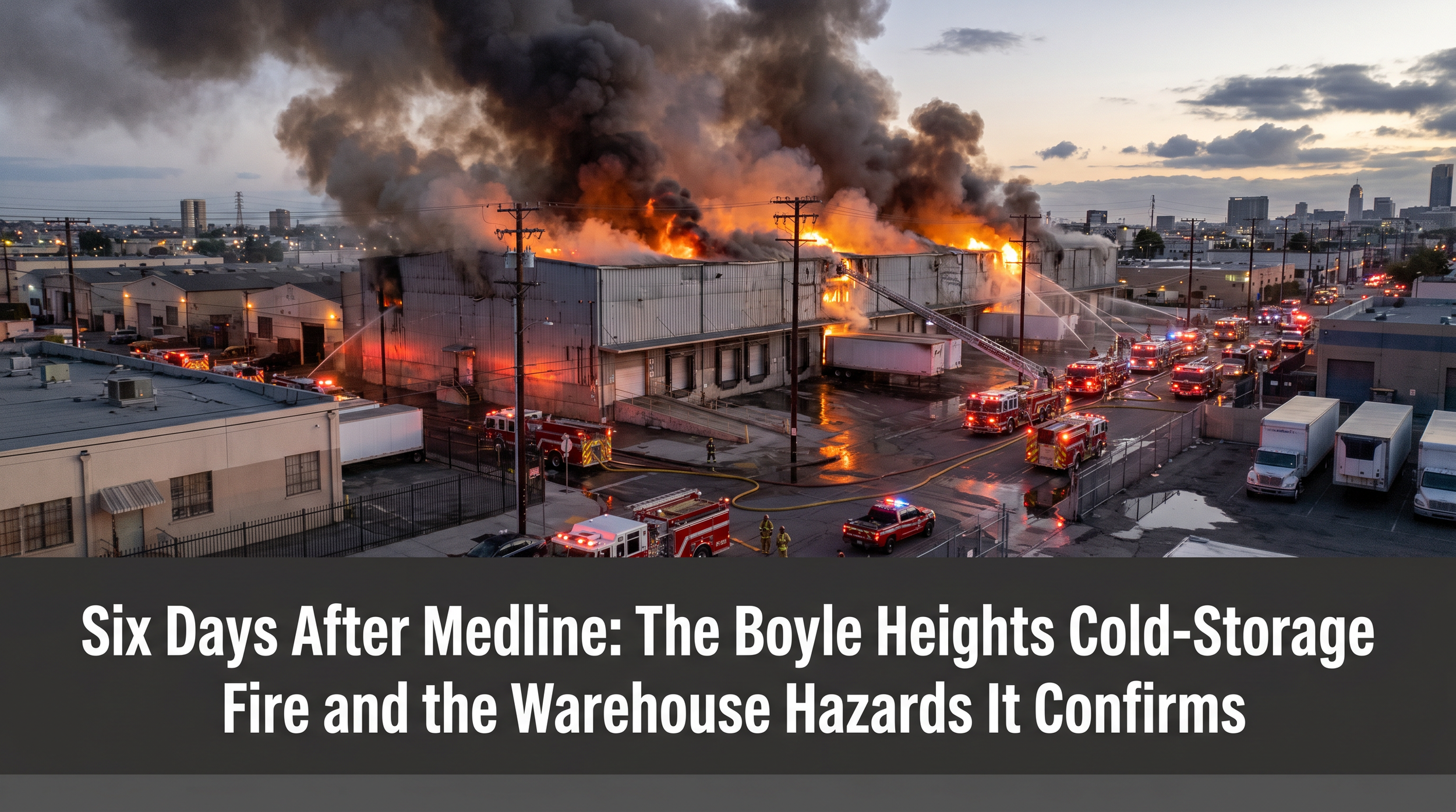
Six Days After Medline: The Boyle Heights Cold-Storage Fire and the Warehouse Hazards It Confirms
On June 17, 2026, a fire broke out at a roughly 491,000-square-foot cold-storage warehouse operated by Lineage Logistics in the Boyle Heights neighborhood of Los Angeles. Six days later it was still burning. The fire began on the building's roof, where a separate company maintains a large solar panel array, and authorities said it appears to have started while contractors were testing that equipment. The blaze proved unusually hard to fight because the building is a sealed, heavily insulated cold-storage box, because it was refrigerated with ammonia, and because roughly 85 million pounds of frozen food inside began to spoil and threatened to become a public-health problem. Smoke drifted across much of the Los Angeles basin, prompting air-quality warnings, a city emergency declaration, and a state emergency declaration from the governor.
Coming just six days after the catastrophic Medline warehouse fire in Tracy, the Boyle Heights fire is the third major California warehouse fire of 2026. This update places it alongside the earlier report on warehouse safety in San Joaquin County, and asks a specific question: which of the hazards that report identified in Tracy show up again in Los Angeles? The short answer is that most of them do. A roof-origin fire, lithium-ion batteries as fuel, industrial chemicals on site, densely packed storage, and split responsibility over fire-critical systems all reappear — while the one factor that destroyed Medline, a failed sprinkler system, is also the one factor that did not recur, which only sharpens the earlier report's central point.
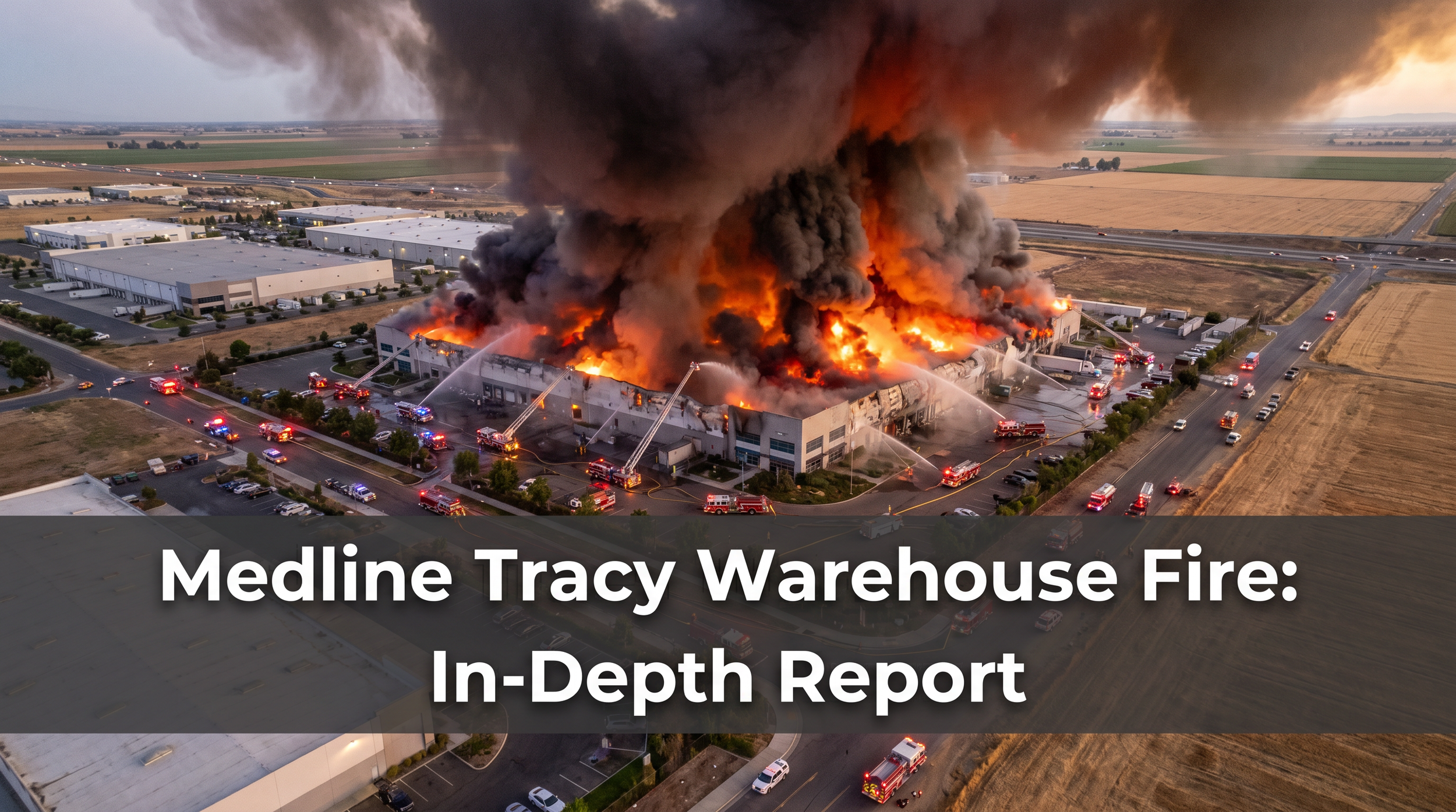
Medline Tracy Warehouse Fire: In-Depth Report
On the afternoon of June 11, 2026, a fire ignited on the roof of the Medline Industries distribution center at 5701 Promontory Parkway in Tracy, California — and within 30 to 40 minutes, the entire 1-million-square-foot facility was fully engulfed. The building was declared a total loss, ranking among only three or four warehouse fires of this scale in U.S. history. All 120 employees evacuated safely and no injuries were reported among workers or firefighters. The disaster triggered a local state of emergency, a multi-county mutual aid response, public health advisories, and immediate concern about medical supply disruptions to hospitals across Northern California — including those serving Lodi and San Joaquin County.

Newsom's 2026-27 May Revision: What It Means for San Joaquin County and Lodi
Governor Gavin Newsom released his May Revision to the 2026-27 California state budget on May 14, 2026, proposing $246.6 billion in General Fund spending and claiming a $0 structural deficit through July 2028. For San Joaquin County and the City of Lodi, the picture splits cleanly: meaningful gains for local schools through an upgraded Local Control Funding Formula (LCFF) "super COLA" of 4.31% and a record $2.4 billion special education investment, but a deepening healthcare funding crisis as state Medi-Cal policy changes compound federal H.R. 1 cuts already projected to drain $50.9 million to $76.9 million annually from county coffers. The Homeless Housing, Assistance, and Prevention (HHAP) program is held at $500 million — half its prior level — threatening the funding pipeline for Lodi's Access Center. Property tax growth in San Joaquin County is forecast to slow from 7% to 2%, and labor costs are rising by more than $22 million, leaving the County entering FY 2026-27 in a "compression" scenario heading into its June 2 budget presentation.

Spirit Airlines Bailout: What It Means for California Travelers, Taxpayers, and the Future of US Aviation
President Donald Trump is weighing a taxpayer-funded rescue of bankrupt Spirit Airlines worth up to $500 million, structured as warrants potentially giving the federal government up to 90% ownership. The proposal has drawn bipartisan criticism, pushback from Transportation Secretary Sean Duffy, and comparisons to Trump's own failed Trump Shuttle venture of 1989–1992. For Northern California travelers, Spirit already exited Sacramento, Oakland, San Jose, and San Diego in October 2025. This report examines the bailout plan, historical airline-rescue precedents, alternative uses for $500 million, worker absorption by rival carriers, and the fare impact on US travelers.

Who’s Really Leaving California
California has now posted six consecutive years as the nation’s largest net loser of residents to other states, but the pandemic-era exodus is easing, high-income households are returning in rising numbers, and San Joaquin County is quietly doing the opposite of the coastal metros — gaining domestic migrants and net adjusted gross income at a time when the state as a whole is shedding both. The newest IRS Statistics of Income (SOI) migration file, released in 2026 and covering tax year 2023, combined with the July 2025 Census and California Department of Finance estimates, tells a more nuanced story than the “California exodus” headlines suggest.

The State of Newspapers in California's Smaller Markets
California's small-market newspapers—those serving communities under 75,000 people—are in an accelerating crisis. The convergence of declining advertising revenue, rising operational costs, hedge fund consolidation, and shifting consumer behavior has left most of these publications financially fragile. Of the estimated 200+ newspapers and community publications still operating in California's smaller markets, the research paints a stark picture…
California 2025-26 Legislative Session: Impact Report for San Joaquin County and Lodi
This report analyzes California state legislation from the 2025-26 Regular Session and its specific impacts on San Joaquin County and the City of Lodi. As of mid-March 2026, the Legislature has passed and the Governor has signed dozens of bills into law during 2025, with additional measures moving through the 2026 legislative process. A small number of bills have been vetoed or had their vetoes sustained in early 2026.
California Fuel Blends: Time for a Change?
California's boutique gasoline blend—CARBOB—was designed decades ago to fight the state's severe smog crisis, and it worked. But the system built around that fuel is now breaking down. Two major refinery closures have eliminated 20% of the state's refining capacity in under a year. Prices at the pump have surged past $5.34 per gallon while neighboring states pay $1.00 to $1.80 less for gasoline refined from the same crude oil. Analysts warn of $7–8 gas by summer. This report examines how California got here, why the current system is failing, and evaluates four alternatives—from modest tweaks to a fundamental rethinking of the state's fuel policy.

California Fuel Price Projections & Analysis — 2026
California faces an unprecedented convergence of pressures on fuel prices in 2026: two major refinery closures removing 18–21% of in-state refining capacity, escalating regulatory costs from CARB's Cap-and-Invest and LCFS programs, and the ongoing U.S.–Iran conflict that has driven crude oil above $110 per barrel. The state's average regular gasoline price stood at $5.16 as of March 8, 2026 — already $1.66 above the national average — and projections range from roughly $5.50 to $8.44 per gallon by late 2026.

California Battery Storage Facilities Map
LodiEye Visual Report of Battery Storage Facilities built, under contruction and in the planning stage in California. For site, current status, battery and technology, any safety issues and environmental impact zones

Battery Plant Construction, Safety, and Funding in California
California has emerged as the undisputed national leader in battery energy storage deployment. Over the past decade, the state has transformed its energy infrastructure through an extraordinary buildout of lithium-ion battery storage systems, growing from approximately 770 megawatts of installed capacity in 2019 to nearly 17,000 megawatts by late 2025—a surge of more than 2,100 percent. This expansion encompasses over 200 utility-scale systems, more than 250,000 commercial and residential installations, and a pipeline of projects pushing toward the state’s 52,000 MW target by 2045.
California's Dangerous Driver Legislative Package
On February 2, 2026, a bipartisan group of California Assembly members announced a package of bills targeting dangerous drivers. The legislation focuses primarily on DUI accountability and closing justice system loopholes that have allowed drivers who killed people to keep clean records. This report examines the bills, compares them with demographic data on who is responsible for fatal crashes, and assesses whether the package addresses the full scope of California's traffic safety crisis.
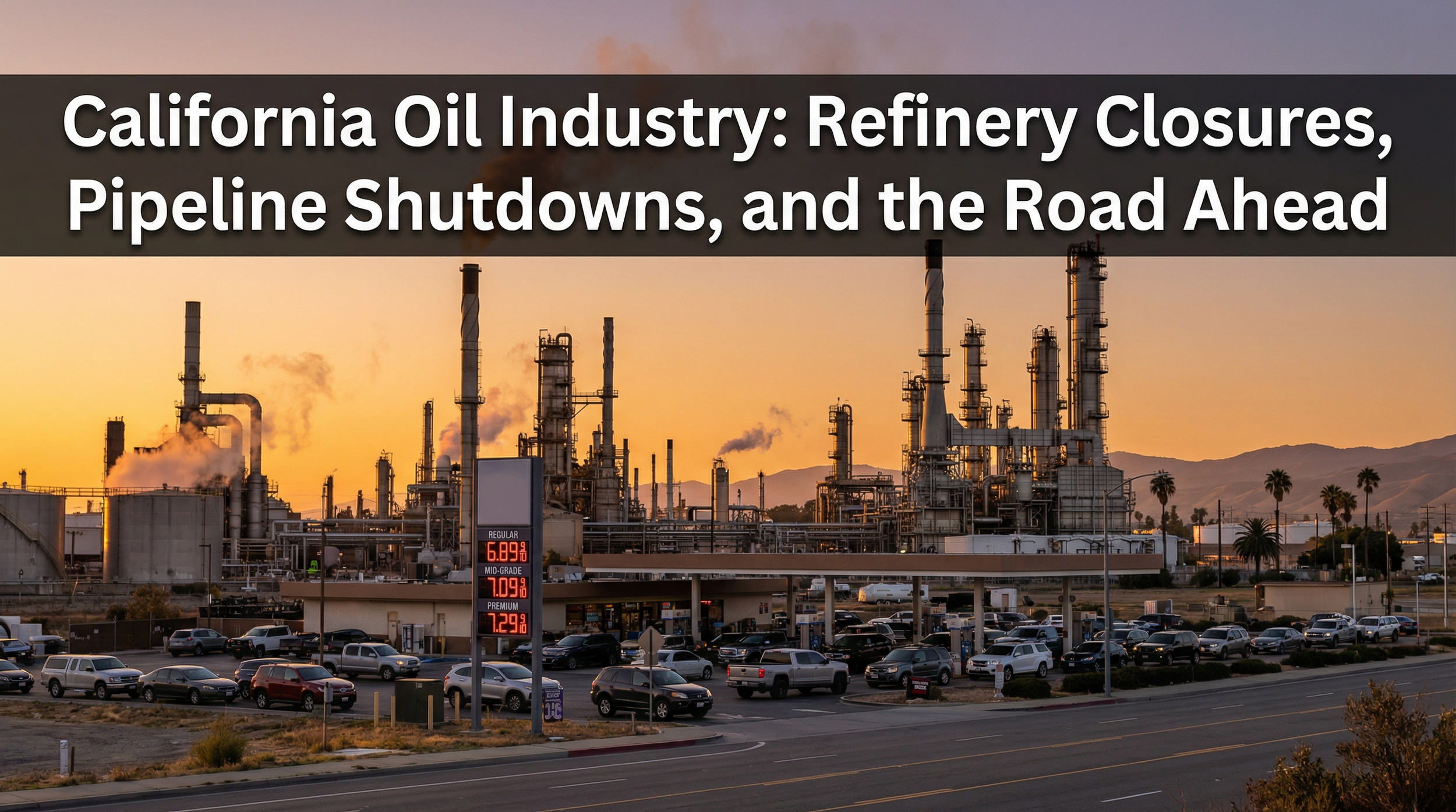
California Oil Industry: Refinery Closures, Pipeline Shutdowns, and the Road Ahead
California's petroleum sector is undergoing a structural transformation that is reshaping how oil is extracted, transported, and refined across the state. With major refinery closures eliminating approximately 17-20% of in-state capacity, critical pipelines shutting down, and an accelerating shift toward imported fuels, the state faces significant near-term price volatility and supply uncertainty.

Colorado River Governors Summit and the San Joaquin Delta
This report discusses an unprecedented high-level summit on January 30, 2026 convened by Interior Secretary Doug Burgum, bringing together governors from the seven Colorado River Basin states—California, Arizona, Nevada, Colorado, Wyoming, Utah, and New Mexico—to address the ongoing stalemate over post-2026 water allocation.

OPEB Funding in California Pensions
Other Post-Employment Benefits (OPEB) represent a significant long-term financial obligation for California public agencies. This report examines the regulatory framework governing OPEB in California, the approach taken by San Joaquin County, and the City of Lodi's unique sick leave conversion-based OPEB program.

Sierra Nevada Snowpack
What is the history and current status of the Sierra Nevada Snowpack that supplies surface to Sacramento, San Joaquin County and Lodi, Ca? This report provides a map and chart to track changes and trends over the past 100 years.
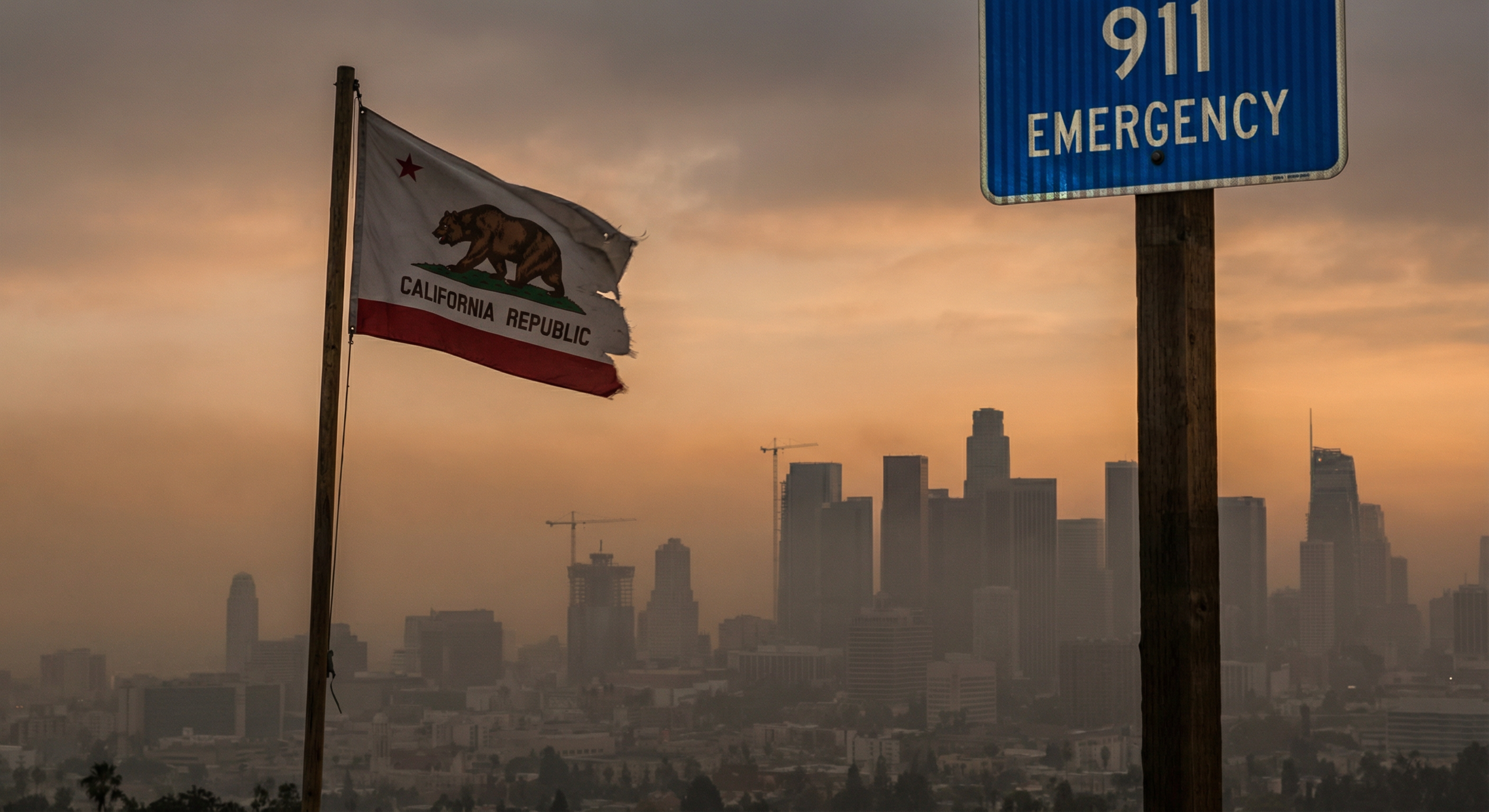
California's 911 Upgrade: History and Current Status
California's ambitious $450+ million NG911 modernization effort has stalled dramatically. After spending five years and billions in infrastructure investments, the state paused rollout in late 2024 due to critical operational failures and has now completely scrapped its regional design approach. The system is not operational yet…
California's Homeowners Insurance Crisis: A 2025 Update
The California homeowners insurance market faces unprecedented strain in 2025, with insurers reducing coverage, rising FAIR Plan reliance, and wild rate disparities. Lodi and San Joaquin County remain lower-cost havens, but the situation is volatile statewide.
California's Recent Climate and Energy Legislation
California's new climate and energy laws will extend the state's cap-and-trade program, boost electric bill credits, expand regional electricity markets, and bring new investments and protections to energy consumers across the state—including significant relief for Lodi and San Joaquin County residents facing rising energy costs.