
Lodi Eye
LodiEye provides additional information on trending stories / topics published by local media and shared on local social media accounts.
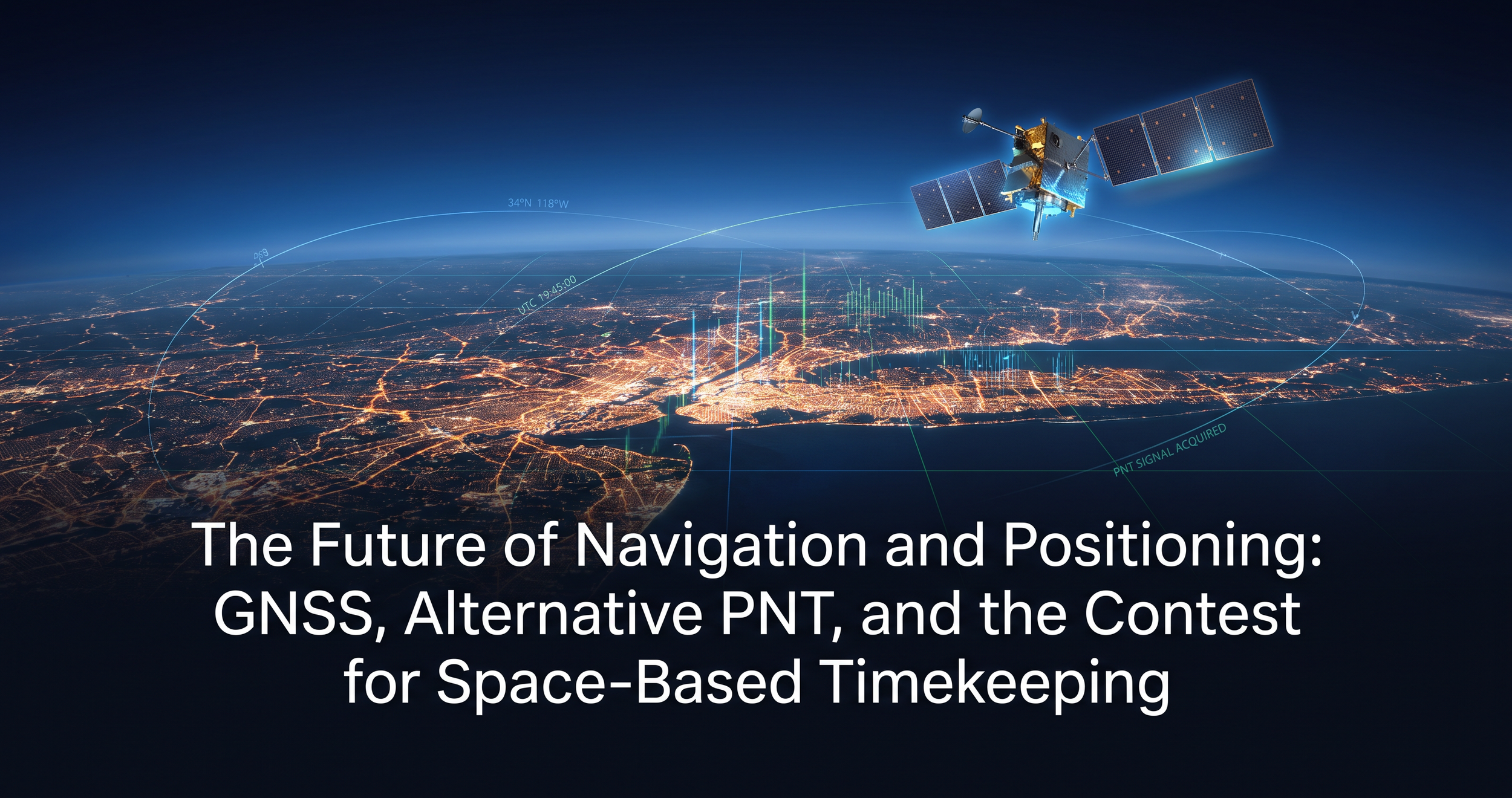
The Future of Navigation and Positioning: GNSS, Alternative PNT, and the Contest for Space-Based Timekeeping
Positioning, Navigation, and Timing (PNT) is the invisible substrate of the global economy. It synchronizes cellular networks, financial trades, power grids, container ports, aircraft approaches, and precision munitions. Four global constellations now compete for that substrate: the U.S. GPS, China's BeiDou, Russia's GLONASS, and the European Union's Galileo. Two decades of quiet Chinese investment, one American humiliation of a Chinese commercial ship in 1993, and two wars in the mid-2020s have reshaped the field in ways the founders of GPS could not have anticipated.
Three simultaneous trends now define the future of navigation:
The commercial world is drifting toward multi-constellation, multi-frequency, LEO-augmented PNT. No single system will be trusted alone for aviation, maritime, or autonomous ground applications by 2030.
The military world is decoupling from GNSS entirely. The next generation of missiles, drones, and bunker-busters is designed to fight through denial, spoofing, and constellation loss using inertial, visual, magnetic, and terrain-matching aids.
The geopolitical world is fragmenting into GNSS blocs. Iran's stated 2025 move toward BeiDou, alongside continued reliance on multi-constellation civilian receivers, illustrates how states under GNSS-denial pressure are hedging away from GPS. It will not be the last such case.
The Great Decay
In 2025, two of the most influential critics of technology power published landmark books on the same crisis. Cory Doctorow’s Enshittification describes how platforms deliberately degrade quality once users are locked in. Tim Wu’s The Age of Extraction analyzes how platforms have become history’s most effective instruments of wealth extraction. This article examines both frameworks—their diagnoses, convergences, divergences, predicted future trends, and actionable recommendations for policymakers, technologists, and communities.