
Lodi Eye
LodiEye provides additional information on trending stories / topics published by local media and shared on local social media accounts.

The AI Race: Who Leads, Who Follows, and Whether Anyone Controls It
The 2024–2026 period produced more concentrated AI advancement than any prior three-year window in computing history. The United States still leads on frontier model performance, raw compute, and private investment. China closed the model performance gap to under 3% by early 2026 and now manufactures roughly 85% of the world’s humanoid robots. The European Union built the world’s first comprehensive AI law. Singapore and the UAE now lead the planet in workforce AI adoption. And no binding global governance framework exists to manage any of it. This report maps the timeline of breakthroughs, scores five nation-state competitors across eight dimensions, and ranks the top companies in large language models, AI chips, and robotics.

Ukraine's TrophyLab: The Intelligence Revolution Reshaping Global Defense
On June 19, 2026, Ukraine's Ministry of Defense launched TrophyLab — a vetted-access platform at trophylab.mod.gov.ua that formalizes four years of battlefield forensics into the most comprehensive open technical intelligence resource ever assembled on a major power's military systems. The platform catalogs 115+ captured Russian weapons across 79 categories, backed by 225+ technical studies. For Western defense contractors and startups, it compresses the development cycle for countermeasures. But it also exposes a profound organizational challenge: the speed at which Ukraine and Russia iterate far exceeds what most Western defense institutions are built to absorb. Meanwhile, Iran has been running an analogous — though entirely closed and proxy-directed — weapons exploitation program that feeds directly back into the Russia-Ukraine battlefield through a circular technology loop.

It’s Not Just Anduril and Palantir Anymore: The 2026 Defense-Tech Landscape
This is a follow-up to the original LodiEye analysis published February 25, 2026, Anduril and Palantir: AI-Enabled Transformation of US Defense. Between late February and early June 2026, several open questions from that piece resolved — mostly in the direction it anticipated, and faster. Anduril raised a record round and started building combat drones months ahead of schedule; Palantir posted its fastest growth since going public; the Army’s Next Generation Command and Control prototype cleared its division-scale rehearsal; and a new, much larger joint program — the Golden Dome missile shield — has pulled both companies toward the center of the most expensive weapons effort in U.S. history. Around them, defense-technology venture funding has set an all-time record, surfacing a second tier of well-capitalized startups worth tracking.
This update is organized as (1) updates to the two principal companies, (2) the status of NGC2 going into its summer test, (3) the new Golden Dome program, (4) the broader defense-tech surge and the new names within it, (5) the new hardware — drones, autonomous vessels, and weapons — these companies are now producing, and (6) a quick-reference table reconciling specific claims in the original article against current facts.
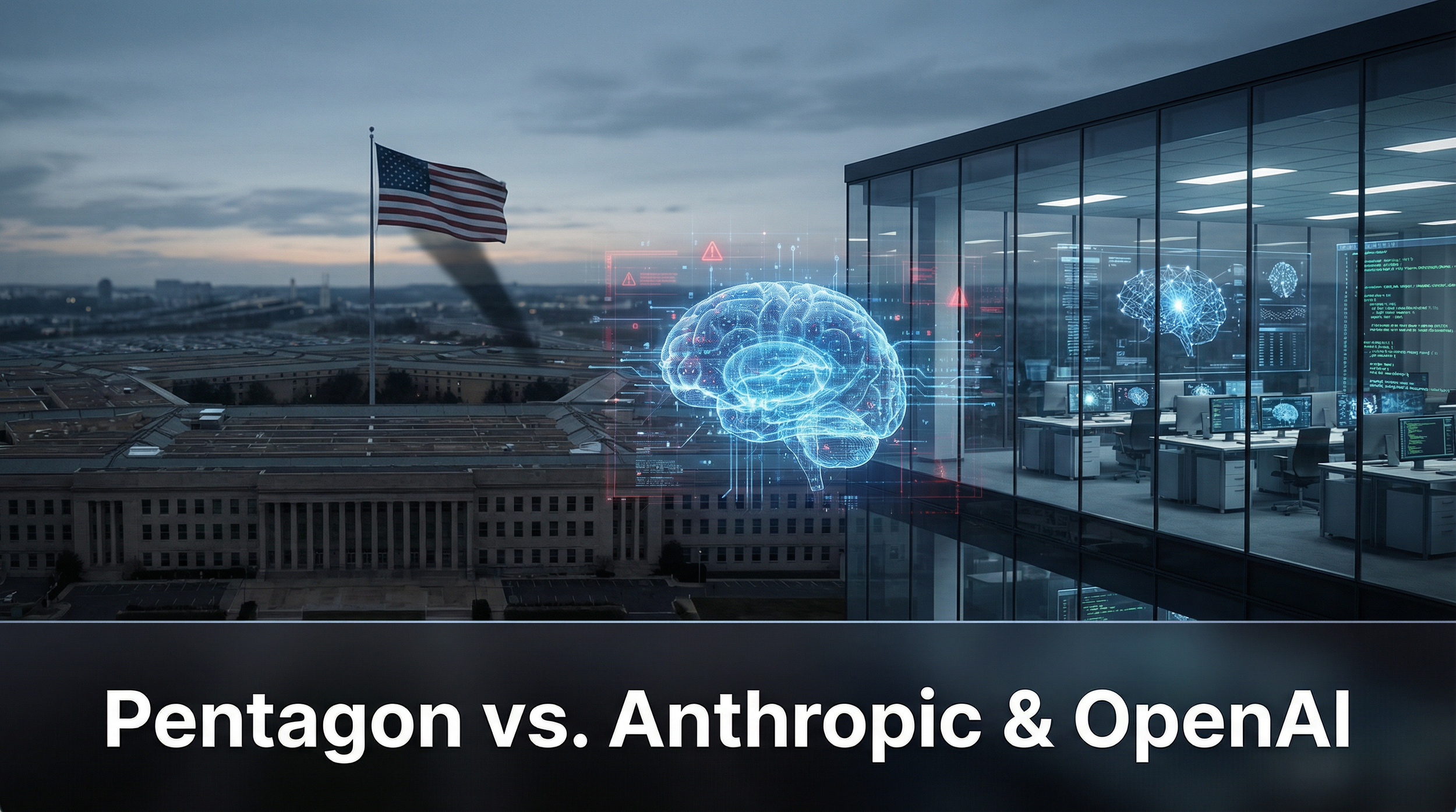
Pentagon vs. Anthropic & OpenAI
In late February 2026, Defense Secretary Pete Hegseth gave Anthropic CEO Dario Amodei until 5:01 PM on Friday, February 27, to sign a document granting the U.S. military unrestricted access to Anthropic’s AI model Claude — or face severe consequences. Anthropic refused, holding firm on two red lines: no mass surveillance of American citizens and no fully autonomous lethal targeting. The Pentagon followed through, designating Anthropic a “supply chain risk”.. Meanwhile, OpenAI rushed to fill the void with its own Pentagon deal — only to reverse course days later when CEO Sam Altman admitted the contract was “opportunistic and sloppy” and added the same safeguards Anthropic had demanded.

Pentagon vs. Anthropic
Defense Secretary Pete Hegseth has given Anthropic CEO Dario Amodei until Friday, February 27, 2026, to sign a document granting the U.S. military unrestricted access to Anthropic's AI model Claude — or face contract termination, a “supply chain risk” blacklisting, and forced compliance under the Defense Production Act. Anthropic is willing to work with the Pentagon but insists on two red lines: no mass surveillance of American citizens and no fully autonomous lethal targeting.

Anduril and Palantir: AI-Enabled Transformation of US Defense
Anduril Industries and Palantir Technologies are reshaping how the United States gathers intelligence and wages war by combining AI-native software platforms, autonomous systems, and hyperscale manufacturing into a tightly integrated defense technology ecosystem.