
Lodi Eye
LodiEye provides additional information on trending stories / topics published by local media and shared on local social media accounts.
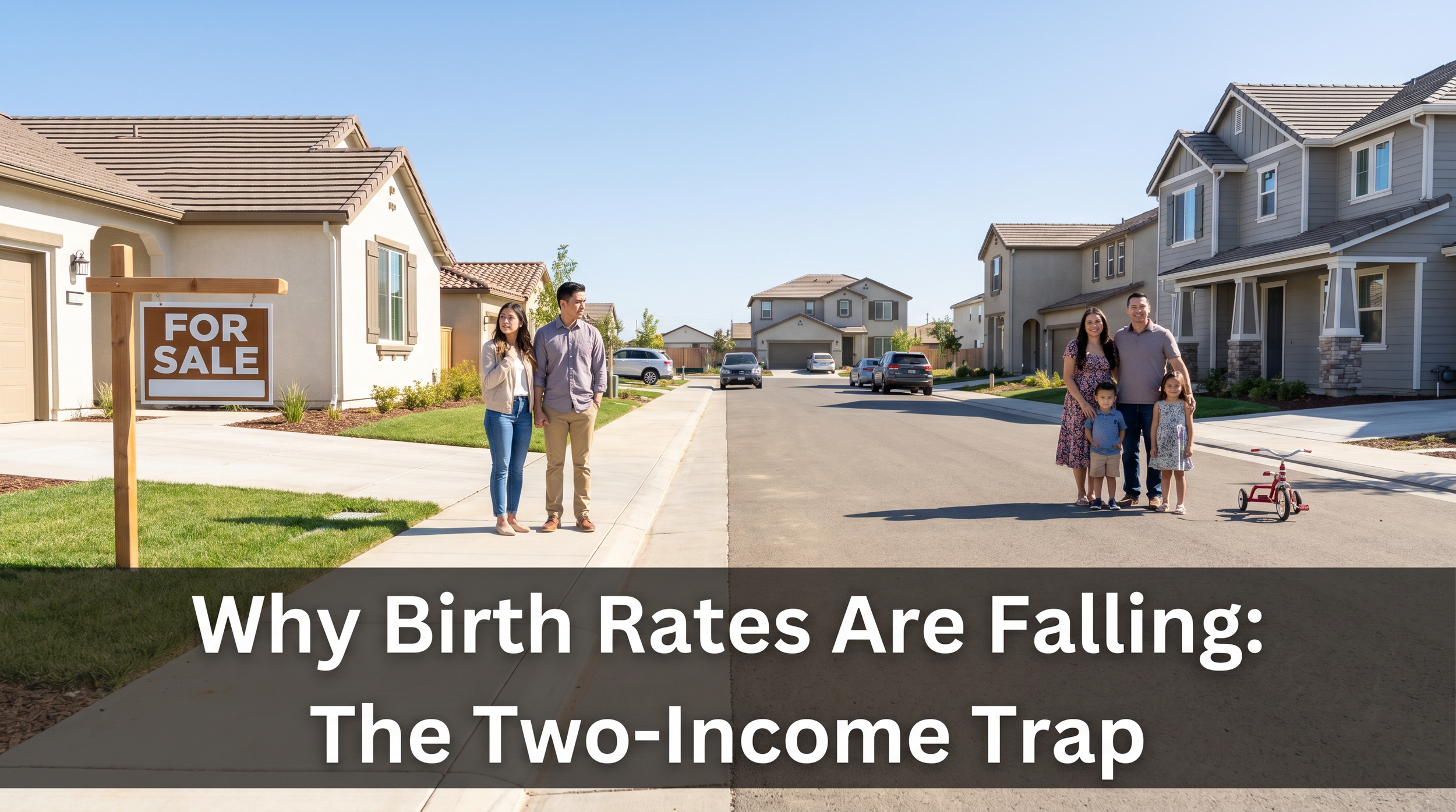
Why Birth Rates Are Falling: The Two-Income Trap
For 35 years, three measures — labor force participation, marriage, and birth rates — declined together, with the birth rate falling furthest to a record-low general fertility rate of 53.1 in 2025. This report argues that these trends share a common engine: the rising cost of housing relative to wages, compounded by childcare costs that now rival a mortgage. The result is a two-income trap. Housing increasingly requires two earners, yet childcare for two children — averaging about $29,100 a year and exceeding a mortgage in 45 states — consumes much of that second income. Couples respond the only way the math allows: they delay marriage and children until they can afford both a home and care, or until one salary can carry the household. Crucially, participation in the prime family-formation years (25–34) never fell — it held steady near 83–84% — which is exactly what we would expect if families need two incomes to afford a home. San Joaquin County, more affordable than coastal California, still posts above-average marriage and fertility, suggesting affordability and family formation rise and fall together.
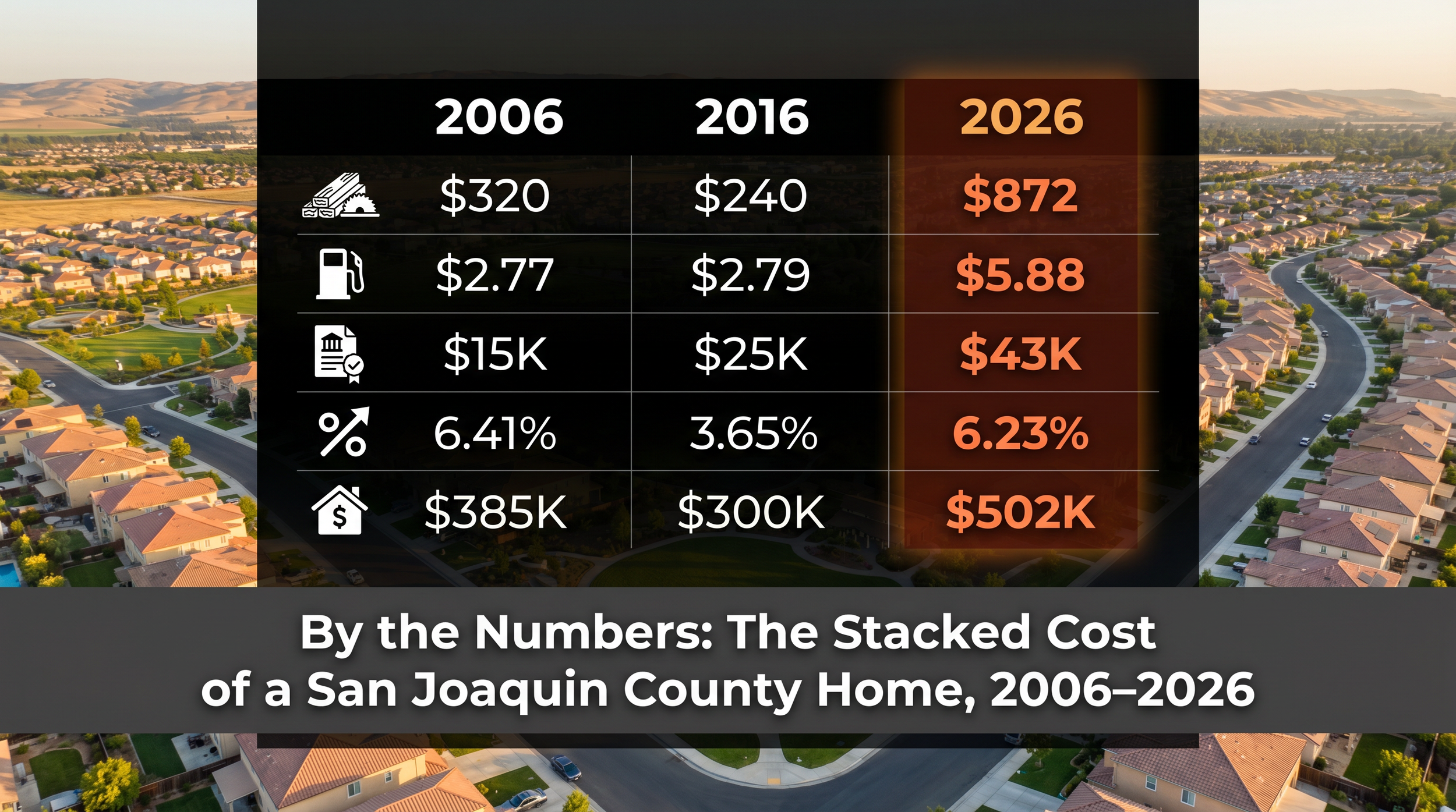
By the Numbers: The Stacked Cost of a San Joaquin County Home, 2006 to 2026
California's housing affordability crisis is usually told as a single story: not enough homes. The data across three reference years — 2006, 2016, and 2026 — shows it is actually six stories layered on top of each other. Mortgage rates have round-tripped to 2006 levels but now create a lock-in effect for the 77% of California homeowners holding sub-5% mortgages. Framing lumber has tripled. California gasoline has more than doubled. Tariffs on building materials, a non-issue in either earlier reference year, now add an estimated $17,500 to a typical new home. Construction labor has contracted under enforcement pressure. Lodi government fees on a typical home now exceed $43,000. And insurance premiums have roughly doubled since 2016, with FAIR Plan enrollment statewide up 445% since 2006.
The compounding is the story. Solving any single headwind helps. Solving none of them — letting the stack compound for another five years — risks a structural housing market that no longer functions for working Valley families.
The Vanishing Family Wage
In 1975, a single-income family in Lodi could comfortably purchase a home, raise two children, and build savings on one wage earner’s salary from a local agricultural, manufacturing, or public-sector job. The median home cost roughly 2.5 times the median household income. Today, that same home costs more than 6 times the median household income, childcare alone can consume 20–30% of a family’s take-home pay, and the commute required to earn higher wages adds thousands of dollars in annual transportation costs.