Lodi Eye
LodiEye provides additional information on trending stories / topics published by local media and shared on local social media accounts.
Lodi City Council Agenda — September 16, 2026
The September 16 meeting is a working session dominated by contract extensions and capital-project authorizations. The AMENDED packet (523 pages) adds one large minutes-approval bundle covering 22 back meetings from March 2024 through August 2026 and moves the Cal Cities voting-delegate appointment from the consent calendar to the Regular Calendar as G.3. No other staff reports were changed from the original release.
The largest fiscal actions on the consent calendar are the on-call well and pump repair authorization ($1.0 million), the after-school Bridge Program contract with Lodi Unified (up to $657,000), the DeBenedetti Park Improvements 2027 bid authorization (~$5.1 million project cost), and the Well No. 8 abandonment change orders ($320,000). The Access Center construction management extension to March 31, 2027 (Bickford Ventures) is the most politically watched consent item.
The Regular Calendar has three items. G.1 is the quarterly Access Center operations, construction, and funding update — the meeting's most substantive policy item — with a Council-feedback request on long-term financial sustainability. G.2 updates the unpermitted food-vendor task force. G.3 is the appointment of a Cal Cities voting delegate for the September 23–25 conference in Anaheim.
Council: Mayor Ramon Yepez, Mayor Pro Tempore Mikey Hothi, Council Members Cameron Bregman, Lisa Craig-Hensley, and Alan Nakanishi. Interim City Clerk Walfred Solorzano.
Lodi City Council Agenda - September 2, 2026
This is a housekeeping meeting rather than a policy meeting, and almost all of it is about who gets to decide things at City Hall. Of the ten action items, six either hand new decision-making power to the City Manager or sign off on decisions the City Manager has already made.
Three things make the meeting notable. First, a record minutes backlog: Consent item C.1 asks Council to approve 26 sets of minutes at once, reaching back to March 6, 2024 — and it is the second such batch in seven weeks, following another 26-set catch-up approved July 15, 2026 that reached back to November 2023. The staff report offers no explanation for the delay.
Second, the City Manager's authority continues to expand. Item C.4 would delegate to the City Manager all personnel and administrative matters for the Interim City Clerk — including appointment and termination — two weeks before the ordinance transferring City Clerk appointment authority from Council to the City Manager takes effect on September 18, 2026. Item G.1 asks Council merely to ratify a Public Works Director the City Manager already selected. Item G.2 would let the City Manager award a contract up to $360,000 without returning to Council.
Third, a federal grant report with weak delivery numbers. The public hearing (F.1) is Lodi's yearly report card to the federal government on how it spent its Community Development Block Grant money — the annual federal grant the City uses for neighborhood improvements, housing, and social services. Lodi was guaranteed $655,037 for the year and spent $282,568.19 of it, and it built none of the 54 affordable-housing units it had set as its annual goal.
Council will also meet privately beforehand on five matters, four of them lawsuits — including two separate 2026 suits by former City Manager Scott Carney and one by Christopher Bennitt.
Lodi City Council Agenda - August 19, 2026
This is a governance-heavy agenda dressed up as a routine August meeting. There are no public hearings. Five threads run through the 291-page packet: a twice-deferred, formally protested $616,700 citywide tree maintenance award (G.3) that will determine who operates Lodi's street-tree inventory for the next two to four years; a no-bid $115,000 consulting contract (G.2) to CityWise Strategies, LLC — the firm of Aaron Busch, Lodi's Interim City Manager through June 22, 2026; a first-reading ordinance moving City Clerk appointment and removal authority from the Council to the City Manager (G.6), introduced two days after the incumbent Clerk's last day; a single consent vote clearing a two-year backlog of 18 sets of minutes (C.1), ten of which record canceled meetings; and continued fiscal strain visible in a boiler award 57% over the Engineer's Estimate funded by draining two other capital accounts (C.6) alongside the elimination of executive CalPERS employee cost-sharing (G.5).
Also on the agenda: ratification of David Hanham as Community Development Director at $201,619.47, filling a vacancy open since February 24, 2026 (G.4); an informational report restoring Friday library service and ending Sunday hours for a net gain of four weekly public service hours at no added cost (G.1); a countywide free bus transfer pilot including Lodi GrapeLine (C.7); and recognition of Lodi as America's Favorite Small Town 2026.
Lodi City Council Agenda - August 5, 2026
This is a governance-heavy agenda dressed up as a routine August meeting. There are no public hearings. Five threads run through the 291-page packet: a twice-deferred, formally protested $616,700 citywide tree maintenance award (G.3) that will determine who operates Lodi's street-tree inventory for the next two to four years; a no-bid $115,000 consulting contract (G.2) to CityWise Strategies, LLC — the firm of Aaron Busch, Lodi's Interim City Manager through June 22, 2026; a first-reading ordinance moving City Clerk appointment and removal authority from the Council to the City Manager (G.6), introduced two days after the incumbent Clerk's last day; a single consent vote clearing a two-year backlog of 18 sets of minutes (C.1), ten of which record canceled meetings; and continued fiscal strain visible in a boiler award 57% over the Engineer's Estimate funded by draining two other capital accounts (C.6) alongside the elimination of executive CalPERS employee cost-sharing (G.5).
Also on the agenda: ratification of David Hanham as Community Development Director at $201,619.47, filling a vacancy open since February 24, 2026 (G.4); an informational report restoring Friday library service and ending Sunday hours for a net gain of four weekly public service hours at no added cost (G.1); a countywide free bus transfer pilot including Lodi GrapeLine (C.7); and recognition of Lodi as America's Favorite Small Town 2026.
Lodi City Council Agenda - July 15, 2026
The July 15, 2026 Lodi City Council meeting opens with a lengthy closed session covering the City Attorney and City Clerk recruitments plus two active lawsuits filed by former City Manager Scott R. Carney — a whistleblower/wrongful termination action and a companion Public Records Act suit. The open session moves through a Junior Giants proclamation, a certificate of appreciation for outgoing City Clerk Olivia Nashed, and a consent calendar dominated by two substantial items: TANC Project Agreement No. 3 Amendment No. 1, which zeroes out Lodi's scheduling rights on the California-Oregon Transmission Project, and a three-year $694,600 professional services agreement with West Yost & Associates for wastewater regulatory compliance at White Slough. No public hearings are scheduled.
The regular calendar features an informational presentation on Opportunity Zones 2.0 and a staff recommendation to nominate Census Tract 45.02 in place of the underperforming Tract 44.03, an ad hoc committee to advise on a Government Relations RFP, and appointment of Walfred Solorzano as Interim City Clerk at $70.41/hour. The meeting closes with the second reading and adoption of Ordinance No. 2048, which replaces Lodi's 2022 mobile food-vending framework with an operator-permit model but keeps the controversial food-truck caps.
Lodi City Council Agenda - July 1, 2026
The July 1, 2026 regular meeting is a light public-facing agenda built on a heavy financial foundation. There are no scheduled presentations and the closed session covers a single item: recruitment of a permanent City Clerk. The consent calendar carries the most consequential dollars — two write-off authorizations totaling roughly $3.32 million in uncollectible utility and general-billing accounts (items C.5 and C.6), alongside a no-bid power-cable purchase, a renewed Stockton fire-dispatch contract, and an environmental-remediation reimbursement tied to the downtown Central Plume.
The lone public hearing (F.1) introduces a new mobile food vending ordinance with population-based permit caps and buffer zones. The regular calendar is dominated by labor and finance housekeeping: a rewritten purchasing policy (G.1), a sweep of CalPERS cost-share reductions across bargaining units (G.2–G.6), AFSCME salary-schedule corrections (G.7–G.8), and adoption of an SB 707 meeting-disruption policy due by July 1, 2026 (G.9).
This summary covers every item across the closed session, consent calendar, public hearing, and regular calendar. It includes a dedicated section on the City Clerk transition (and the background of long-serving Clerk Olivia Nashed), an expanded item-by-item consent calendar table, and concludes with a detailed addendum analyzing exactly which departments, revenue streams, and years are driving the $3.32M write-off.
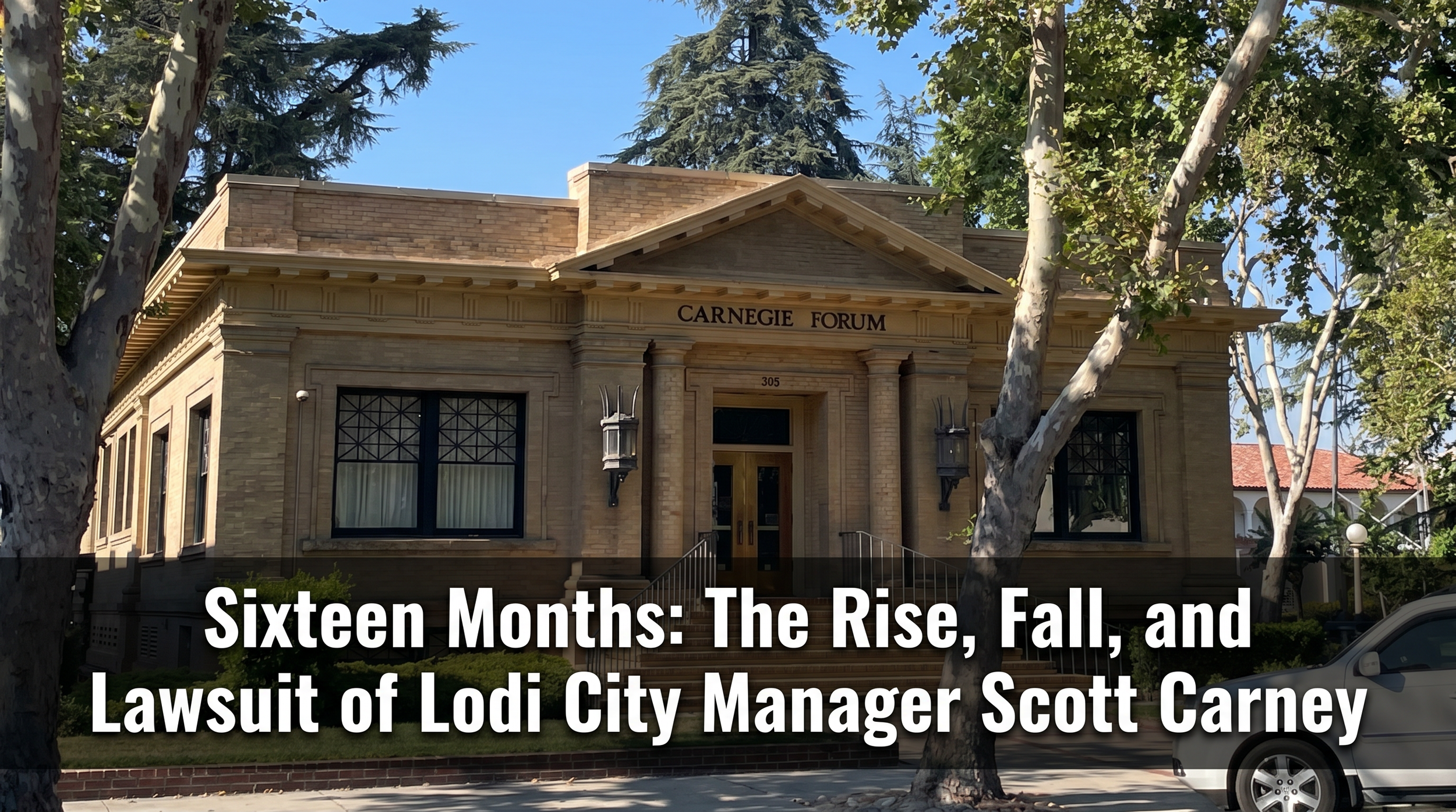
Sixteen Months: The Rise, Fall, and Lawsuit of Lodi City Manager Scott Carney
Scott Carney's tenure as Lodi's eighth city manager lasted just sixteen months — from June 2024 to his formal termination in October 2025 — and produced one of the most turbulent chapters in the city's modern administrative history. A public confrontation with then-Mayor Cameron Bregman at the April 1, 2025 council meeting, sweeping allegations of financial misconduct, a six-month paid administrative leave, five independent investigations, and a whistleblower lawsuit filed June 4, 2026, in San Joaquin County Superior Court make up the arc of a story that ultimately revealed genuine internal-control weaknesses but no intentional fraud.
This deep dive lays out the full context: who Carney is, his record in Stockton and Sacramento, the leadership vacuum he inherited, the specific allegations he raised, what four independent audits found, the lawsuit now before the court, and how Lodi's experience compares to a striking pattern of similar California city-manager whistleblower cases.
Lodi City Council Agenda - June 17, 2026
The June 17 meeting is dominated by one marquee action — adoption of the FY 2026/27 Financial Plan and Budget — set against a backdrop of tightening General Fund reserves. The all-funds budget totals $302,351,060, with a General Fund of $96,208,300 that plans a second consecutive deficit year, drawing unreserved reserves down from 39% to 27% of revenue over three years.
The closed session continues the high-profile City Manager matters that have been before the Council since 2025. The consent calendar runs 18 items, the only genuinely contested one being the tree-maintenance award (a bid protest). Public hearings cover a routine landscape-district levy, a capped 2.6% wastewater rate increase, and the annual vacancy report (7.6% citywide). The regular calendar adds a five-year homeless-shelter operator agreement with OMI and a Council-requested discussion on preventing data centers in Lodi.
Lodi City Council Agenda - June 3, 2026
The June 3 meeting opens with a 6:30 p.m. closed session on existing litigation (Scott R. Carney v. City of Lodi), then a 7:00 p.m. open session with a heavy policy load. The headline item is the public hearing to adopt the Downtown Specific Plan (DTSP) — a long-range visioning and implementation framework for downtown and the Main Street corridor east of the railroad. Two other public hearings cover the 2026-27 CDBG Annual Action Plan ($665,263 in federal funds) and the annual Military Equipment Use Policy review required under AB 481.
The 13-item Consent Calendar is dominated by professional-services contracts, led by a $2.39 million five-year energy-efficiency administration contract and a $176,268 website-hosting agreement that is actually a renegotiated savings of about $66,000. The Regular Calendar includes a $70,192 funding request from the Downtown Lodi Business Alliance and the FY 2026/27 General Fund and Measure L budget presentation (draft budget ~$96.5 million). The lone ordinance is the second reading of Ordinance No. 2047, a development agreement allowing Rogers Media to install three programmable electronic signs on city property.
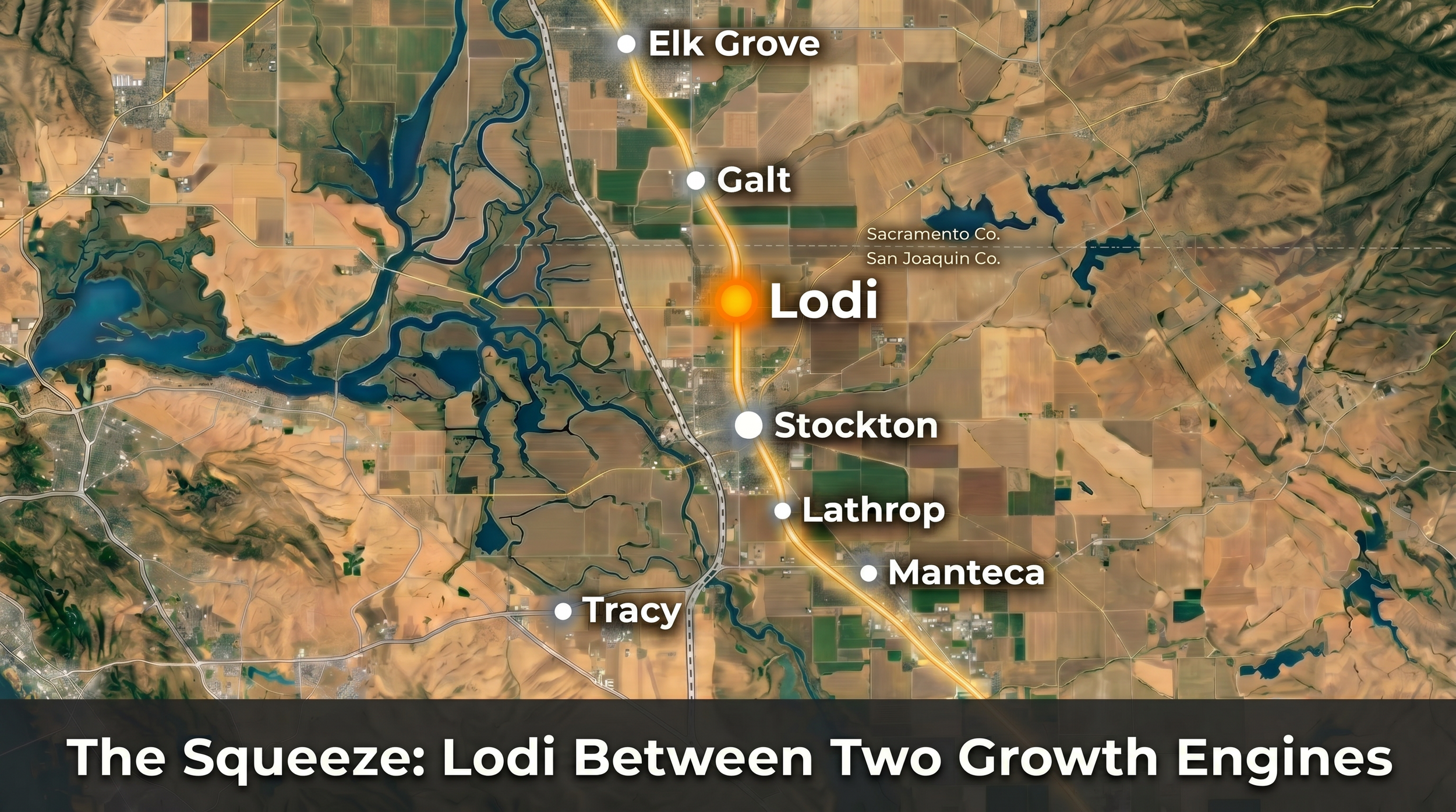
The Squeeze: Lodi Between Two Growth Engines
Lodi has two big plans on the table. One is meant to grow the local economy. The other is meant to revitalize downtown. Both rest on assumptions about regional growth that the numbers no longer support. Over the last six years, California's official population data show Lathrop growing 42.7% while Lodi grew 3.6%. Lodi's housing stock is growing almost twice as fast as its population — a signal worth paying attention to on its own. Meanwhile, every city around Lodi — Manteca, Lathrop, Tracy, Elk Grove, Galt, and Stockton — has its own plan, and those plans are actively competing for the same residents, employers, and state funding Lodi's plans assume the city can attract.
This report identifies which specific parts of the Economic Development Strategic Plan (EDSP) and the Downtown Specific Plan (DSP) are most exposed to what neighboring cities are doing, points out where the plans' description of the broader economy and Lodi's own business profile does not match the available data, and offers residents and city officials a shared factual basis for the conversation about what Lodi's plans need to address head-on.
What Lodi Can Do About Its Budget Gap
When Lodi's budget shortfall comes up at Council meetings or in conversation around town, the choices usually get framed as just two: cut services and staff, or raise taxes. Both are real options, but they aren't the whole list. California cities have a substantially broader toolkit, and most of those tools sit between "cut" and "tax" rather than alongside them.
This report walks through what's actually available. We cover five categories of tools — plus an important clarification about Lodi's pension reserves, which often get described inaccurately in public discussion. For each tool, we cover what it solves, who has to approve it, and what it costs in the long run. None of these tools fixes Lodi's budget gap by itself, and several that look attractive at first turn out to carry hidden costs. But taken together, the categories describe what the City can actually do — and that's a better starting point for a public conversation than a forced choice between cuts to services or city staff and increasing taxes.
Lodi City Council Agenda - May 20, 2026
Three public hearings are being set on this consent agenda for June 3, 2026: the CDBG Annual Action Plan, the Downtown Specific Plan, and the Police Department's annual Military Equipment Use Policy review. The Regular Calendar features the FY 2024/25 Annual Comprehensive Financial Report (with a modified audit opinion tied to CalPERS reporting) and Part 2 of the FY 2026/27 budget series covering Enterprise, Special Revenue, and Capital Outlay budgets.

Lodi Brings In Veteran Economic Developer to Jump-Start Strategic Plan
The City of Lodi is hiring retired economic development executive Donald Burrus to help implement its new Economic Development Strategic Plan, a five-to-ten-year framework aimed at expanding jobs, increasing city revenues, broadening local goods and services, and investing in infrastructure and community amenities. The move signals that City Hall is trying to translate a long list of strategic goals into near-term execution at a time when officials say economic development has been underemphasized and higher-paying job growth has become a central civic priority.
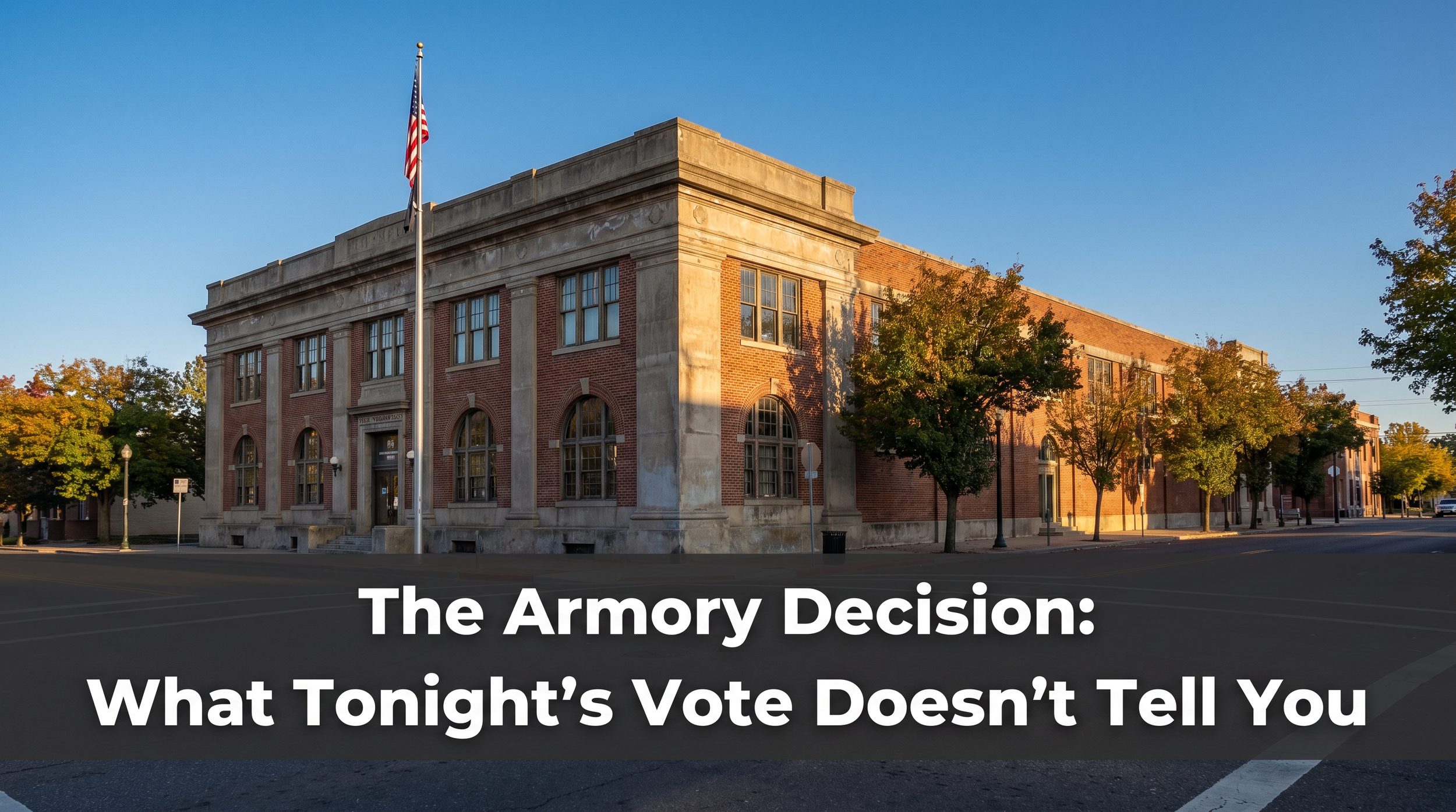
The Armory Decision: What Tonight's Vote Doesn't Tell You
The Lodi City Council votes tonight on whether to file a letter of interest in purchasing the Armory at 333 N. Washington Street under California Senate Bill 855, which authorizes the state to dispose of seven specified armory properties. The procedural deadline is Monday, May 11.
The decision tonight is narrower than the staff report frames it. Filing a letter of interest is not a commitment to buy — it is the procedural foothold that keeps the option alive. The substantive decision is months away, and four pieces of information not in the staff report should drive it: where the other six SB 855 armories are headed and what local agencies have paid for similar properties; what realistic rehabilitation actually costs given that the Lodi Armory is reinforced concrete and already operates as a city-leased gymnasium; whether the federal and state historic tax credits — potentially worth 40 percent of qualified rehabilitation expenditures — can be captured under a public-private structure; and how the active Diede Construction renovation of the American Legion Memorial Building directly across the street reshapes the corridor argument.
What Mayor Yepez's Utility Fee Changes Mean for Lodi Households
Mayor Ramon Yepez has proposed two reforms to Lodi's utility billing: a credit card "convenience fee" to recoup the roughly $1.2 million the city pays annually in processing fees, and the elimination of late fees for customers facing financial hardship. LodiEye verified the City's actual 46-day electric shut-off timeline against the August 2022 Council agenda report, confirmed the pandemic-era $19.2 million past-due balance, and benchmarked Lodi's electric disconnection policy against California's SB 998 water standard. The Yepez package is roughly revenue-neutral but rebalances who pays. Aligning electric shut-offs with SB 998's 60-day floor and tying hardship relief to Lodi's existing SHARE/FIDP/Medical/CARE assistance programs would give the city a cleaner, more defensible disconnection policy.
Lodi City Council Agenda — May 6, 2026
The May 6 meeting is a heavyweight transition night for Lodi. After more than a year of acting and interim leadership, the Council is being asked to install three permanent executives in one sitting: Kara Reddig as City Manager ($285,000 base, 3-year term, effective June 22), Jamie Bandy as Director of Administrative Services ($315,000 fully-burdened, effective May 12), and Bandy as City Treasurer. A fourth personnel item brings retired Vacaville economic development director Donald Burrus back to public service as a part-time annuitant under PEPRA's 180-day exception.
Beyond people, the agenda also delivers a first-of-its-kind revenue-share billboard partnership with Rogers Media (greater of $25,000 a year or 25% of net ad revenue), a same-week deadline question about acquiring the State-owned Lodi Armory, a placeholder asking whether the City should formally prevent data centers in Lodi, and the first of three FY 26/27 budget study sessions revealing a structural gap that has forced 37 deferred General Fund positions, a $1.5M cut to fire vehicle replacement, and $2.8M in department-wide reductions. The 22-item Consent Calendar is unusually heavy with end-of-fiscal-year contract resets totaling roughly $15 million.
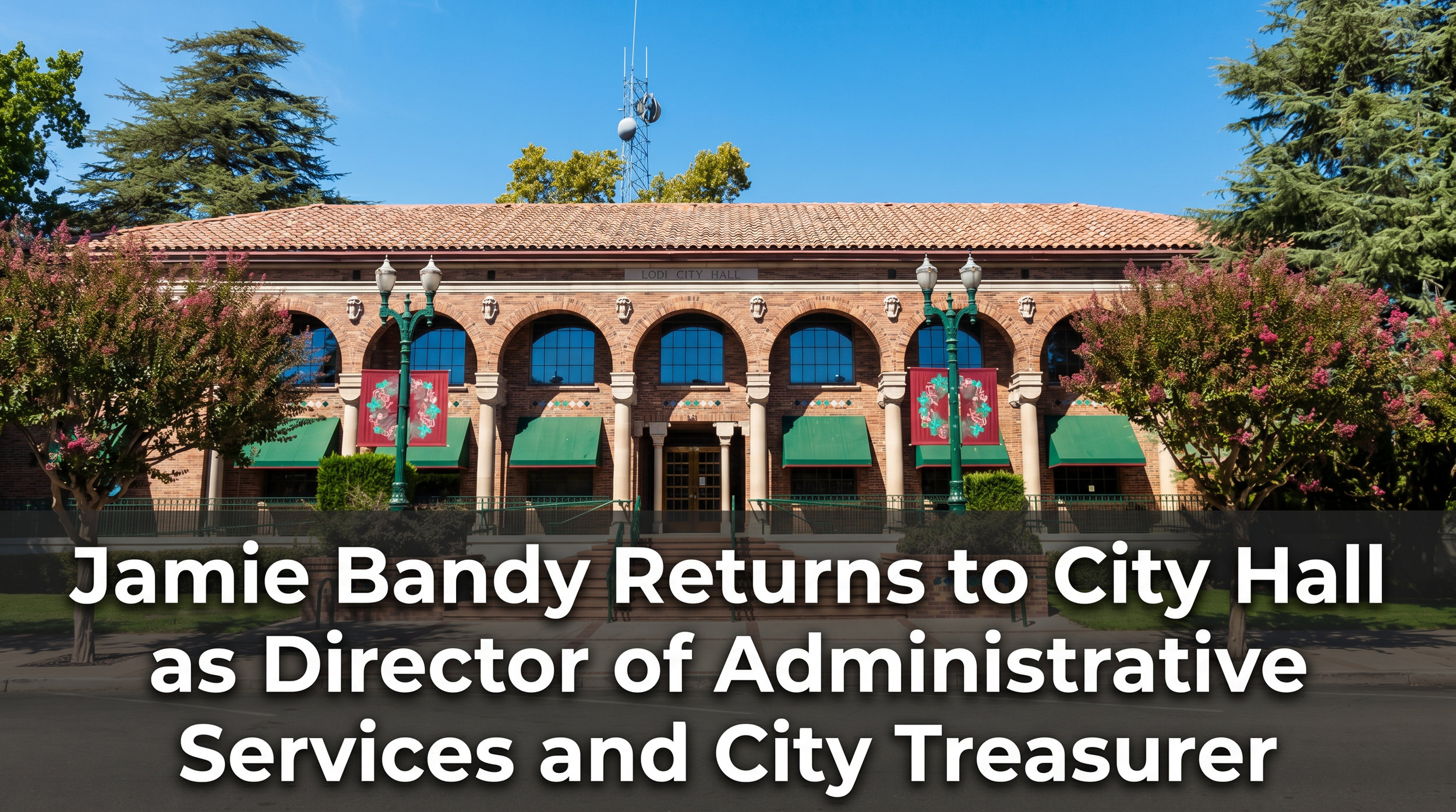
Jamie Bandy Returns to City Hall as Director of Administrative Services and City Treasurer
The Lodi City Council’s May 6, 2026 agenda includes the appointment of Jamie Bandy as the city’s next Director of Administrative Services, with an effective start date of May 12, 2026 and a fully-burdened compensation package valued at approximately $315,000 per year. The same agenda action designates Bandy as the city’s City Treasurer, the statutory officer responsible for the custody and investment of public funds. The appointment closes a high-profile vacancy that has shadowed the city since the 2025 forensic-audit fallout, returns a Lodi-rooted public-finance professional to City Hall after roughly seventeen years away, and pulls together Finance, Human Resources, and Information Technology under a single executive who has run each of those functions in different forms during her career.
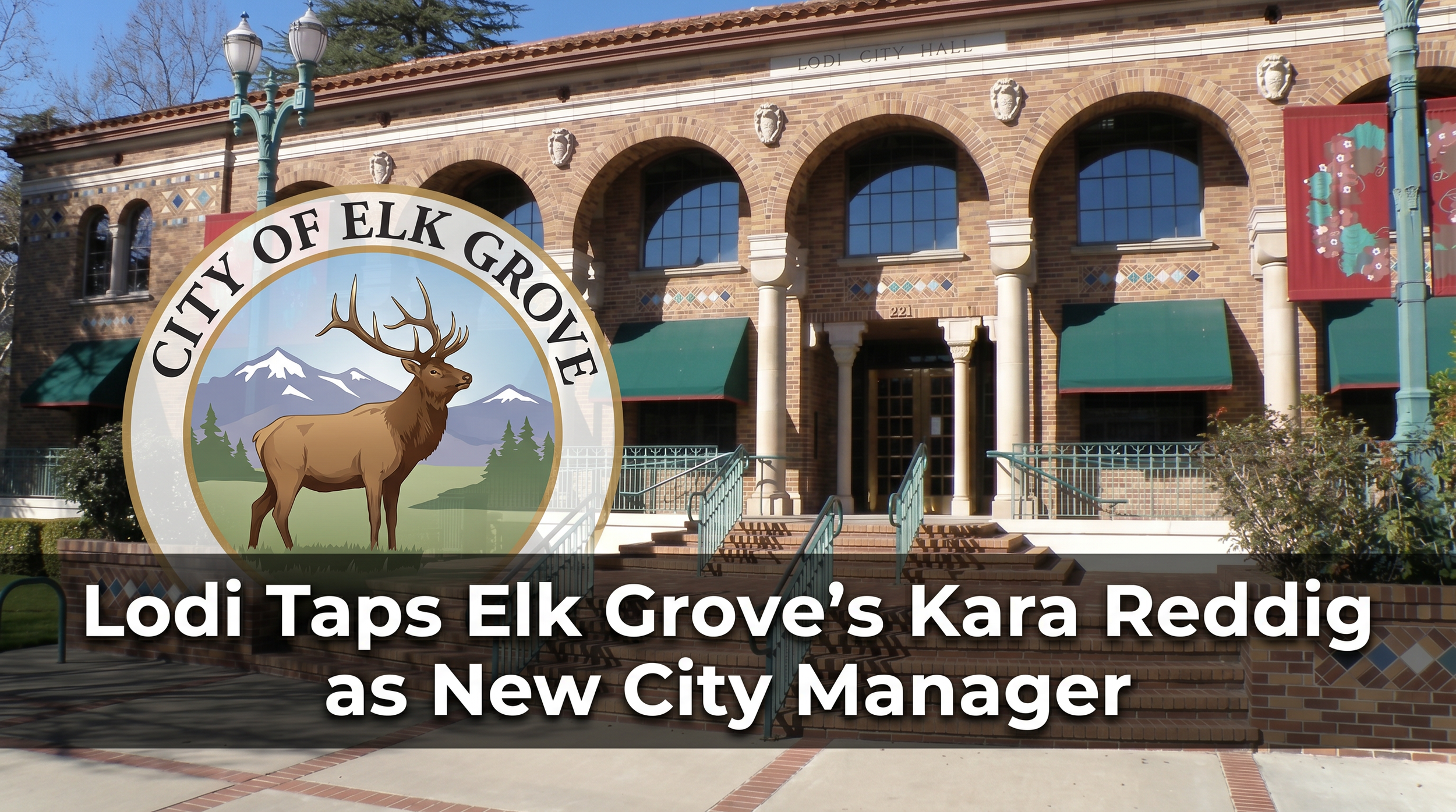
Lodi Taps Elk Grove's Kara Reddig as New City Manager
After more than a year of acting appointments, interim placeholders, and legal bills approaching seven figures, the City of Lodi has hired Kara Reddig, Deputy City Manager of Elk Grove, as its next City Manager. A seasoned municipal executive with more than two decades of local-government leadership, Reddig arrives to stabilize an office that has cycled through four different managers since April 2025 — and to reset a City Hall still working through the fallout of the Scott Carney removal, an estimated $600,000 in legal costs, and two independent reviews of the city's internal controls.

County Funds Flow to Lodi: $38,200 Across Nine Nonprofits
Nine Lodi-area nonprofits will share roughly $38,200 in one-time county funding after the San Joaquin County Board of Supervisors unanimously approved a $67,700 round of District 4 discretionary allocations on Tuesday. The awards — directed by Supervisor Steve Ding, whose district covers Lodi and surrounding communities — land at a moment when local nonprofits are navigating rising operating costs, tight municipal budgets, and shifting grant cycles. This report pairs the county data with a verified accounting of Lodi City Council nonprofit allocations for FY 2025–26 through April 16, 2026.
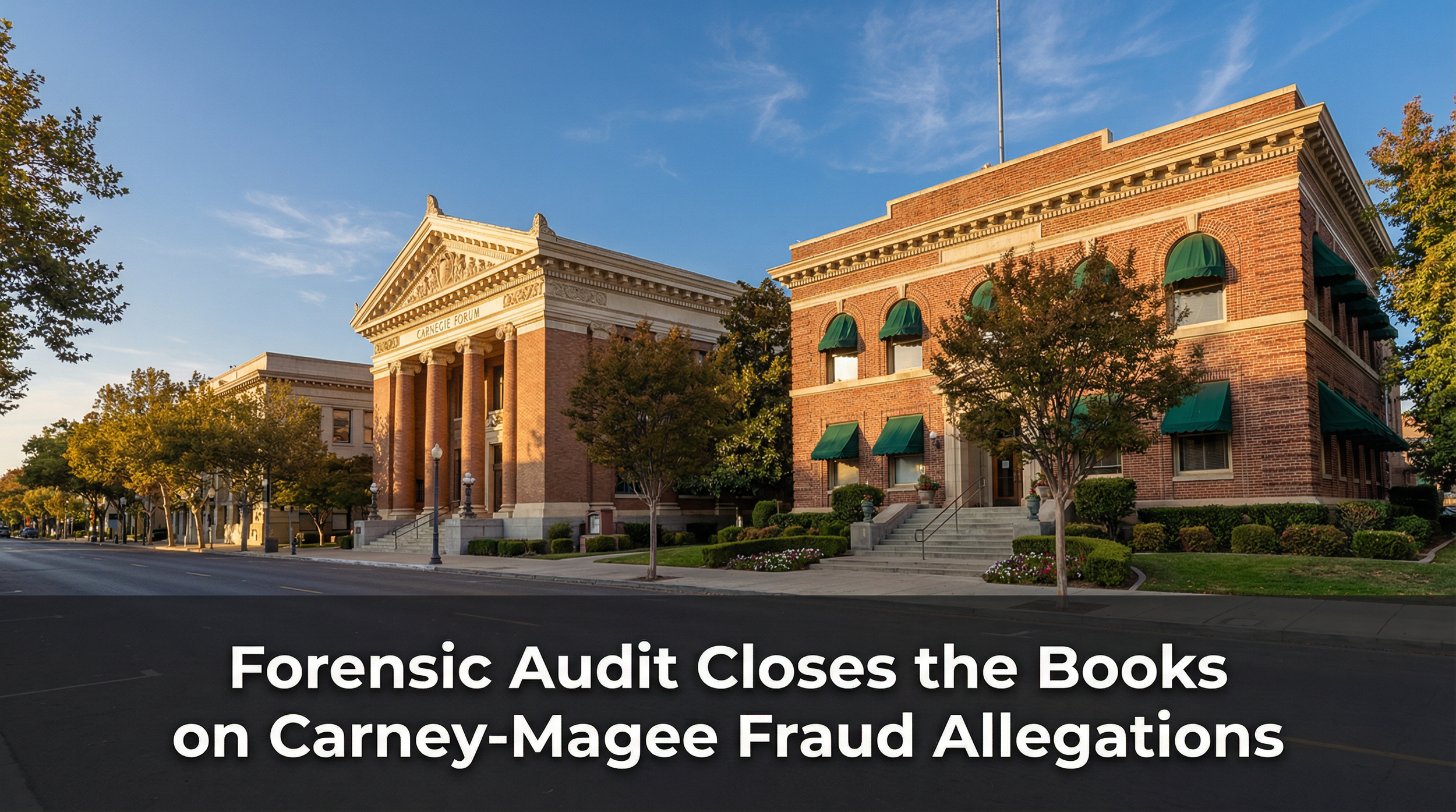
Forensic Audit Closes the Books on Carney-Magee Fraud Allegations
After a year-long investigation involving five independent firms and costing taxpayers well over $1 million, the Hoslett Forensics final report — to be presented to the Lodi City Council on April 15, 2026 — finds no intentional fraud at City Hall. Credit card policy violations totaled $8,625 over five years, and a utility deposit discrepancy originally claimed at $1.2 million was determined to be approximately $67,000 in clerical errors. By state, national, and private-sector benchmarks, Lodi’s violation rate of 0.077% ranks at the extreme low end of the scale. The report confirms that real internal control weaknesses exist and recommends structural reforms — several of which are already underway.