
Lodi Eye
LodiEye provides additional information on trending stories / topics published by local media and shared on local social media accounts.

Data Centers, Demystified: A Field Guide for Lodi
When you check Instagram with your morning coffee, ask Siri for tomorrow’s forecast, stream a movie on Netflix tonight, or tap your card at the gas station on Cherokee Lane, something invisible happens. Your phone or the payment terminal sends a message to a building you have never seen, often hundreds or thousands of miles away. A few milliseconds later, that building sends an answer back. The building is a data center, and there are now several thousand of them scattered across the United States.
For most of the internet’s history, those buildings were not something the average user thought about. They worked. They stayed in the background. Recently they have started showing up in local news more often, partly because they consume enormous amounts of electricity and water, and partly because a new category of facility, specifically engineered to train artificial intelligence models, did not really exist five years ago and now does. That category is growing faster than any other type of industrial construction in the country.
This is a field guide to what those buildings actually do, who builds them, and how the major operators differ from one another. It is written for people who use the products coming out of them every day but have not had a reason to think about the buildings themselves.
The 60 kV Tax on Lodi
Six miles from downtown Lodi, the Northern California Power Agency operates the Lodi Energy Center — a 311 MW combined-cycle gas plant in which the City of Lodi holds a 30 MW (~10%) stake. For fourteen years that plant has been geographically adjacent to Lodi Electric Utility's customers but electrically distant from them, separated by a constrained PG&E 60 kV system that fails NERC contingency standards.
The Northern San Joaquin 230 kV Transmission Project, scheduled for energization in December 2029, will close that gap. The visible consequence is more than $8 million per year in eliminated transmission wheeling charges. The structural consequences — resource deliverability, congestion exposure, fast-ramp value capture, and incremental capacity for growth — are larger in aggregate and far less visible. After 2029, NCPA's biggest investment in Lodi and NCPA's biggest load served in Lodi will finally share one electrical system.
What Would a 10-Megawatt Data Center Cost Lodi?
LodiEye’s earlier article on the data center question asked what kind of facility Lodi could realistically host. The answer was: roughly 10 megawatts — about the size of the Nautilus operation in Stockton, or NTT’s facility in Sacramento. Big enough to matter to the City budget. Small enough to be plausible.
This follow-up moves from “what’s possible” to “what would it cost, and how long would it take.” If Lodi decided to host a 10-megawatt data center at the White Slough complex on Thornton Road, the City would have to commit between $108 million and $221 million in infrastructure investment over the next five to seven years — before any data center operator turns dirt.
That number is on the order of Lodi’s entire annual general fund budget. It is also separate from — and additional to — the $60 to $150 million it would cost a developer to build the data center itself.
Is a Data Center in Lodi's Future?
At the May 6, 2025 Lodi City Council Meeting, Councilman Cameron Bregman raised the question of whether Lodi should explore data center opportunities — an idea, in his framing, worth examining seriously. This report accepts that invitation and asks: given Lodi's specific situation, what would actually be involved? Where would such a facility plausibly go, what would it cost, what would it return, and what could go wrong?
Ava Community Energy Expansion
Ava Community Energy, an Oakland-based not-for-profit Community Choice Aggregator (CCA), announced on February 25, 2026 that it will begin providing electricity generation service to approximately 60,000 eligible accounts in unincorporated San Joaquin County starting in May 2026. PG&E will continue to deliver electricity, maintain power lines, and handle billing. Lodi Electric Utility customers within city limits are not affected.
Electric Utility Prices - January 2026
California's electricity rates have diverged dramatically from national averages over the past two decades, creating significant economic implications for residents and businesses. This report examines the historical trends, current state, and future outlook for electricity pricing, with specific attention to San Joaquin County and the City of Lodi.
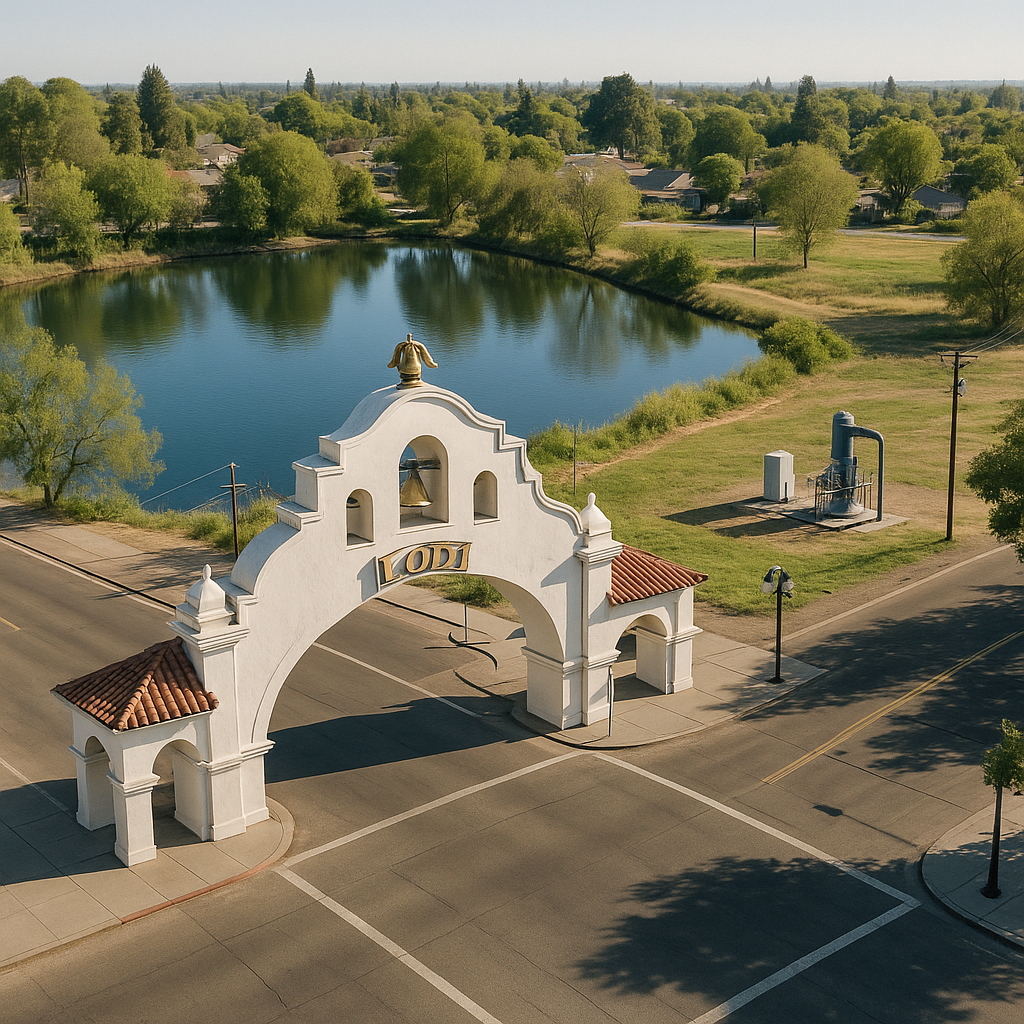
Lodi's Water Supply Status and Growth Plan
Lodi faces a complex water supply scenario as it pursues ambitious growth plans over the next five years while managing significant groundwater challenges in the critically overdrafted Eastern San Joaquin Subbasin. The city's diversified water portfolio provides near-term stability, but long-term sustainability requires careful management of both supply and demand.

Lodi's Electrical Capacity for Summer Heat and Growth Plans
Lodi Electric Utility serves approximately 27,400 electric accounts across a 14-square-mile service territory with an annual budget exceeding $100 million. With summer heat waves and Lodi’s plan for residential and commercial growth, what roles do the Lodi Peaker Plant and the planned 230 kV power plant play?

Power Outage Analysis for Lodi, California (2020-2025)
Lodi Electric Utility (LEU) maintains exceptionally high reliability standards, with outage durations 13 times shorter and frequency 7 times lower than national averages. Lodi Electric customers experience, on average, 0.13 outages per year, lasting an average of 20.3 minutes. This is significantly lower than the nationwide average of 1.44 outages and 123.49 minutes per outage.