The Lodi Armory: A Chronological History, Architecture, and Primary-Source Record, 1910–2026
The Lodi Armory: A Chronological History, Architecture, and Primary-Source Record, 1910–2026
LodiEye Civic Research Briefing — May 2026
Summary
Under California Senate Bill 855, signed into law October 7, 2025, the Lodi Armory was designated surplus state property. On May 6, 2026, the City Council voted to direct staff to pursue acquisition discussions with the state. The letter-of-interest deadline under Military & Veterans Code §435 was May 11, 2026.
This briefing assembles the primary-source record on the building's history, architecture, civilian and military uses, and current disposition — drawing on the 2002 U.S. Army Corps of Engineers NRHP evaluation, the Lodi Laserfiche archive, and the SB 855 legislative file.
The National Guard Armory at 333 N. Washington Street is Lodi's most architecturally and historically layered civic building. Built in 1936 under the Works Progress Administration, it is a board-formed reinforced-concrete structure in the Spanish Revival style — one of roughly ten state-owned California National Guard armories built in that era. It served as the home station of the artillery unit that became Alpha Battery, 1st Battalion, 143rd Field Artillery Regiment, for nearly ninety years, while simultaneously operating as the city's primary indoor public gathering space for recreation, concerts, dances, and community events.
Architectural character summary
| Feature | Detail |
|---|---|
| Style | Spanish Revival |
| Structural system | Board-formed reinforced concrete on continuous concrete footing |
| Assembly hall | Two-story, nine structural bays; column-free interior |
| Entry | Slightly arched portal |
| Roof | Side-gabled; originally red clay tile; later composite shingle |
| Exterior details | Overhanging eaves, exposed rafter tails, exterior buttresses, stucco finish |
| Flooring | Hardwood; one full basketball court, two half-courts, volleyball courts |
| Conditioned area | ~10,200 sq ft city-used common area; est. 15,000–20,000 sq ft total |
| Site area | 1.75 acres |
| Construction year | 1936 |
| Construction cost | $86,000 (~$2 million in 2026 dollars) |
| Structural condition | "Good condition" per 2002 Army Corps evaluation; active gymnasium 2026 |
| NRHP status | Determined eligible (Criteria A and C) by U.S. Army Corps of Engineers, 2002 |
| Training capacity | 150 personnel — largest of six remaining SB 855 armories |
Part I — Pre-Armory Era: 1898–1935
The predecessor unit (1898–1920)
Before the armory building existed, there was already a National Guard presence in Lodi's civic life. The unit that eventually became Alpha Battery at the Lodi Armory traces its regimental lineage to Battery A, 1st Battalion of California Heavy Artillery, which mustered into federal service in San Francisco between May 6 and 11, 1898. Battery A and D Batteries sailed to the Philippines, participating in the Spanish–American War and the Philippine–American War. Following service in those two conflicts, Battery A was mustered out of federal service in San Francisco on September 21, 1899.
The regiment was reorganized as the 1st Battalion of California Field Artillery on December 20, 1912, with headquarters at Oakland. The city of Lodi incorporated in 1906, and by the 1910s was a growing agricultural center of approximately 3,000 people. National Guard companies in small California cities of this era typically met in rented commercial halls, city hall meeting rooms, or improvised drill floors — there was no dedicated armory structure in Lodi during this period.


Mexican Border Campaign (1916)
On June 18, 1916, the 1st Battalion of California Field Artillery was called into federal service at its home station and mustered into federal service on June 28, 1916, at the Sacramento Fairgrounds as part of the 1st California Brigade. The battalion served along the Arizona–Mexico border at Nogales and Yuma, protecting the border and railroad infrastructure. This mobilization was part of the broader U.S. response to Pancho Villa's raids across the border and the deployment of General Pershing's Punitive Expedition into Mexico. The unit returned to California after the crisis subsided.
World War I and the interwar period (1917–1935)
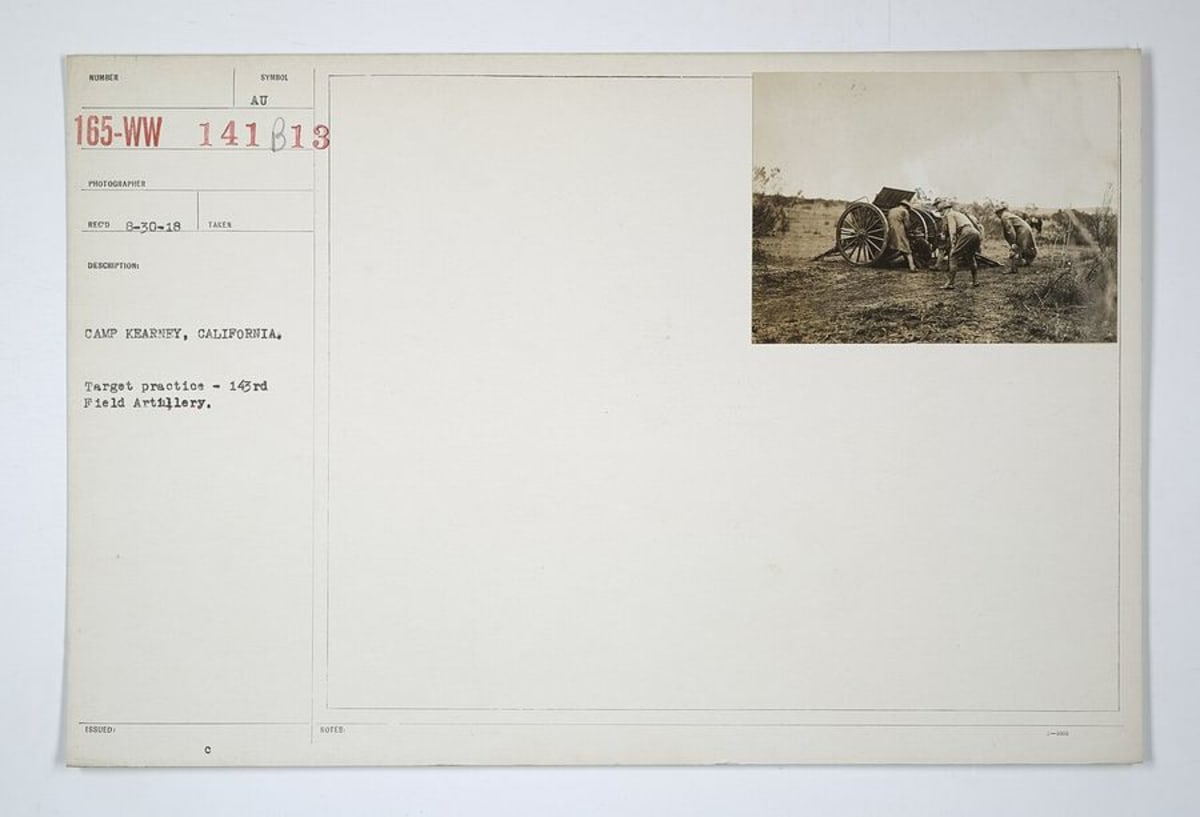
During World War I, the regiment gained cultural notoriety when film star Mary Pickford adopted it — and the 143rd appears as extras in her 1918 war film Johanna Enlists. The unit participated in World War I and earned Campaign Participation Credit for that conflict.

In the interwar period, the California National Guard operated without a statewide armory building program. Lodi's city records from this era are accessible through the city's Laserfiche archive, and the fiscal year 1933–1934 and 1934–1935 city budgets document the municipal context in which the WPA application would later be made. The July 22, 1935 City Council minutes contain a critical early reference: the minutes record that the armory project "would have to be re-submitted as a WPA project" following a procedural issue — establishing that the city had already made one unsuccessful application before the successful 1935–1936 submission.


Part II — Construction: 1935–1936
The WPA application and funding
The Works Progress Administration was established by President Roosevelt in 1935 as the principal New Deal public employment program, providing jobs through construction of public buildings, roads, and infrastructure. The WPA worked through state and local sponsors: a local government or state agency would propose a project, provide the land and a percentage of materials costs, and the WPA would fund labor. For armory construction specifically, the California Military Department served as the state sponsor, while the City of Lodi held the property.

The July 22, 1935 council minutes establish that Lodi city officials were actively negotiating the project terms with WPA administrators by mid-1935. By late 1935, the project was approved. City budget records for fiscal year 1935–1936 document the municipal financial context of the construction year. The building was under construction during 1936 and was recorded as complete in the city's annual timeline for that year.
The construction cost was $86,000 in 1935–1936 dollars — approximately $2 million in 2026 purchasing power — making it a significant public investment for a city of Lodi's scale. A WPA cornerstone plaque was installed on the building at the time of construction, as was standard practice for WPA-built civic structures of this era.
Discrepancy: 1930 vs. 1936
The city's 2010 General Plan Historic Resources Table lists the Lodi Armory with a year built of 1930. The official city timeline, fiscal records, the 2002 U.S. Army Corps of Engineers NRHP evaluation, and the SB 855 legislative record all give the construction year as 1936. The 1930 notation likely reflects a data-entry error or confusion with the broader California National Guard armory building program, several of whose buildings — including Long Beach — were completed in 1930. The 1936 date is supported by multiple primary sources and should be treated as authoritative.
Architecture: Spanish Revival on reinforced concrete
The Lodi Armory is one of the California Army National Guard's WPA-era armories built in the Spanish Revival style — a design language the California Military Department employed for its Depression-era armory construction program across the state. The San Jose Second Street Armory is one comparable example: it is also constructed with board-formed concrete and carries Spanish Revival stylistic details.
Structural system
The building is constructed of board-formed reinforced concrete on a continuous concrete footing. The central form is a two-story assembly hall spanning nine structural bays — an open, column-free interior capable of housing military formations, indoor athletics, or large public gatherings. The board-form technique leaves the impression of wooden plank grain on the exposed concrete surface, a characteristic finish of WPA-era institutional construction that is visible in the building's interior.
Exterior character
- Overhanging eaves with exposed rafter tails
- A side-gabled roof (originally red clay tile; replaced with composite shingle at some point after construction)
- Exterior buttresses flanking the assembly hall bays
- A slightly arched entry portal
- Stucco-finished exterior walls
Why the structural system matters
Unlike unreinforced masonry — brick or adobe — construction common in pre-1940 California public buildings, reinforced concrete performs in earthquakes the way modern buildings do. This is the single most consequential fact about the building's long-term viability: a WPA-era reinforced-concrete structure in good condition does not present the same seismic risk as a comparable-age brick building, and does not require the same order of magnitude of structural investment before it can safely host crowds.
Footprint
The building's conditioned space is approximately 10,200 square feet of main assembly hall and ancillary rooms under the 2002 city–state joint-use agreement, with total building area estimated in the 15,000–20,000 square foot range for the full structure including wings.
The California National Guard armory building program
The Lodi Armory was built as part of a state and federally coordinated effort to provide the California National Guard with purpose-built training facilities during the Depression decade. The Long Beach Armory (854 E. 7th Street, completed 1930) was "one of ten California Army National Guard stations" built in this era. Alfred Eichler, an architect in the Architecture Division of the California Department of Public Works from 1925 to 1962, designed several California National Guard armories during this period, including documented designs for armories in Stockton, Pomona, and Long Beach. Whether Eichler or another state architect designed the Lodi building specifically has not been confirmed in accessible public records.
Part III — State Acquisition and World War II (1936–1945)
City-to-state transfer (c. 1950)
The October 4, 1950 Lodi City Council minutes contain a critical record: at that meeting, the "execution of a deed [and] a sales agreement was authorized" in connection with the Lodi Armory. This is the primary-source documentation of the transfer of the armory from City of Lodi ownership to State of California ownership. The SB 855 legislative record and the 2002 NRHP evaluation both note this transition, listing the armory with a "1936 (city)" construction date and a "1950 (state)" acquisition date. From 1950 onward, the building was owned by the California Military Department.
World War II: federal mobilization (March 3, 1941)
The armory's defining military moment came on March 3, 1941 — nearly ten months before Pearl Harbor — when Alpha Battery of the regiment that would become the 143rd Field Artillery was called into federal service from the Lodi Armory as part of national mobilization preparations. This mobilization is formally documented in the 2002 U.S. Army Corps of Engineers NRHP eligibility evaluation and constitutes one of the two Criterion A associations for which the building was determined eligible for the National Register.
The unit served in World War II and earned Campaign Participation Credit. The regiment's broader history during the war included service in multiple theaters, although the specific deployment record of the Lodi-based battery has not been fully reconstructed in accessible public sources.
December 1945: first documented civilian–military dual use
The December 7, 1945 Lodi City Council minutes contain the first directly documented instance of civilian use of the armory: the minutes record a discussion of use of the "Lodi Armory during [the] winter months at a rental of $60.00 per month." This is the earliest primary-source evidence of the armory's function as a civilian community facility, establishing that the dual-use pattern began almost immediately after World War II ended.
The Japanese American assembly point (May 18, 1942)

On May 18, 1942, the armory was used as the assembly point where approximately 800 Lodi residents of Japanese descent were collected before being transported by bus to the Stockton Fairgrounds Assembly Center and subsequently to the Rohwer War Relocation Camp in Arkansas. The corresponding Dorothea Lange War Relocation Authority photographs of Lodi-district arrivals at the Stockton Assembly Center are dated May 19, 1942, confirming the assembly-point date. (Some earlier sources, including drafts of this briefing, cited "May 18, 1943" — that date is incorrect; the Stockton Assembly Center itself operated only May 10 – October 17, 1942.)
This event was part of the forced removal and incarceration of Japanese Americans under President Roosevelt's Executive Order 9066, signed February 19, 1942. The San Joaquin Valley had a substantial Japanese American agricultural community, many of whom farmed around Lodi. The armory — the city's largest indoor public facility — was the logical staging point for a forced assembly of this scale.


The civil-rights record is on the federal evaluation — not the city timeline
The 1942 assembly-point use is formally documented in the 2002 U.S. Army Corps of Engineers NRHP eligibility evaluation and constitutes the second Criterion A association underlying the building's eligibility for the National Register. It is not referenced in the official Lodi city timeline, in most local press coverage of the 2026 acquisition debate, or in most public discussions of the building's history.
Part IV — Postwar Community Life (1945–2001)
The armory as Lodi's indoor gathering space
Through the postwar decades, the armory served the community in ways that generated significant oral history but limited documentary record. City council minutes from 1945 establish the rental precedent. Community recollections gathered through social media and local history groups describe the armory as hosting:
- Roller skating (among the most frequently recalled uses)
- High school and community dances
- Temporary school classrooms — following a local school fire, the armory was used as a replacement school facility
- Youth programs and athletic events
The armory's large hardwood-floored assembly hall made it the de facto indoor public gathering space for a city that had no dedicated recreation center, community center, or indoor gymnasium of comparable scale. This community-use function ran continuously alongside the building's military training function through the Cold War decades.
Musical history: Jim Doval and the 1960s music scene
The armory's role in the regional music scene is documented in a firsthand account from blues musician Lowell Fulson, who described being taken to the Lodi Armory by a Stockton drummer, where he was introduced to Fresno's "Jim Doval & the Gauchos," a prominent regional band of the 1960s. This places the armory squarely in the circuit of Central Valley dance concert venues that hosted touring and regional bands in the early-to-mid 1960s — a use pattern typical of National Guard armories nationwide during this era.
Cold War and postwar military operations
The Lodi-based battery unit earned Campaign Participation Credit across multiple postwar conflicts and state mobilizations:
| Operation / event | Year |
|---|---|
| Korean War | 1950–1953 |
| Los Angeles Riots | 1992 |
| Golden Gate Bridge security | 2002–2004 |
| Airport security | 2006 |
| Operation Enduring Freedom / JTF-GTMO | 2000s |
| Operation Iraqi Freedom | 2007–2008 |
| California wildfires | 2007, 2008, 2015, 2016 |
| JTF Rattlesnake | 2019 |
The 1st Battalion, 143rd Field Artillery was activated for federal service in support of Operation Iraqi Freedom from 2007 to 2008, with subordinate batteries executing force protection missions throughout central and northern Iraq. Alpha Battery at the Lodi Armory is equipped with the M119A3 Howitzer. The California Military Department's statewide Sustainable Armory Renovation Program (SARP), established under Governor Brown's administration, identified the Lodi, Santa Rosa, and Torrance armories as "high on the department's list for an overhaul" — suggesting that the Lodi Armory was flagged as needing renovation well before its ultimate designation as surplus property.
Part V — Formalized City Recreation Use (2001–2023)
The 2001 lease agreement
City council records from May 15–16, 2001 document the formalization of the City of Lodi's lease with the California Military Department for use of the National Guard Armory building at 333 N. Washington Street. This represented the transition from the informal or rolling rental arrangement that had existed since at least 1945 to a structured, documented lease relationship.
The 2002 joint-use retrofit and NRHP evaluation
In March 2002, two significant actions occurred simultaneously:
- The City Council awarded a contract for a retrofit of the armory building. The contractor received pricing from subcontractors based on square footage. The retrofit remodeled the main building into a working gymnasium and restroom facility, establishing the hardwood-floored court layout that has been in continuous use since.
- The U.S. Army Corps of Engineers Sacramento District conducted a formal National Register of
Historic Places eligibility evaluation of the Lodi Armory. The evaluation found the building
eligible under two criteria:
- Criterion A (association with broad patterns of national history): March 3, 1941 federal mobilization of Alpha Battery; May 18, 1942 Japanese American forced removal assembly point
- Criterion C (architectural significance): WPA-era armory construction and Spanish Revival architecture
- The evaluation found the building "in good condition," noting only failing acoustic ceiling tiles in the assembly hall and peeling paint along the base of some exterior walls, and affirmed that it "retains its integrity of location, setting, design, feeling, and association."
The 2005 lease amendment, 2010 rent, and 2014 month-to-month
City council Resolution No. 2005-99 documents an Amendment No. 1 to the Lodi Armory lease, dated for reference purposes April 22, 2005. By 2010, the city's rent under the lease had been set at $1,785 per month. The lease under those terms expired at the end of 2014, after which the Parks, Recreation and Cultural Services Department continued using the armory on a month-to-month basis under the prior terms while a new agreement was negotiated.
The 2018 five-year lease renewal
On February 21, 2018, the Lodi City Council adopted a resolution authorizing the City Manager to execute a new five-year lease with the State of California (California Department of General Services / Military Department) for use of the Lodi Armory for recreation programs. Key terms:
| Term | Detail |
|---|---|
| Location | Lodi Armory, 333 N. Washington Street, Lodi, CA 95240 |
| State agency | California Military Department, 9800 Goethe Road, Sacramento |
| Real Property # / Lease No. | 604 / L-2015 |
| Lessee | City of Lodi |
| Rent | $2,500 / month (up from $1,785 set in 2010) |
| Maintenance credit | $900 / month (up from $600) |
| Net annual cost increase | $4,980 / year |
| Special condition | PRCS required to refinish the hardwood floor |
| Approval | Parks & Recreation Commission, unanimous, Feb. 6, 2018 |
The council communication explains that the armory features hardwood flooring striped for one full-size basketball court, two small half-courts, and side-by-side volleyball courts, plus restrooms, a storage room, and a common area — and that the City "does not own any indoor sports facilities" of comparable scale.
Part VI — Closure and Surplus (2023–2025)
Museum artifact collection (October 9, 2023)
The California State Military Museum announced on October 9, 2023, that its director had traveled to the "soon-to-be-closed Lodi Armory to collect artifacts, photographs, and historical documents pertaining to Battery A, 1st Battalion." This is the first public documentation of the California Military Department's decision to close and decommission the Lodi Armory, and it explicitly names Battery A, 1st Battalion as the unit whose history was being archived. The museum's collection effort preserved material from approximately 90 years of the unit's Lodi-based history.
SB 855: legislative surplus designation (2025)
California Senate Bill 855 was authored by the Senate Committee on Military and Veterans Affairs and introduced March 6, 2025. The bill authorized the Director of General Services, with the approval of the Adjutant General, to transfer, exchange, or sell seven specified armory properties that the California Military Department had identified as no longer suitable for National Guard training:
- SB 855 passed the Senate: May 29, 2025
- SB 855 passed the Assembly: September 12, 2025
- Signed into law by Governor: October 7, 2025 (Chapter 461, Statutes of 2025)
The Lodi Armory at 333 N. Washington Street is one of the six armories remaining in active disposition (the Montebello Armory was subsequently withdrawn for affordable housing development under the Governor's housing initiative). Under Military and Veterans Code Section 435, local agencies receive first-priority status and a 90-day window from the DGS notice posting to express interest before the property moves to public bidding.
Part VII — City Acquisition Proceedings (2026)
City Council vote, May 6, 2026
Lodi City Council Agenda Item G.5, presented at the May 6, 2026 regular meeting, asked the council to authorize a non-binding letter of interest to the California Department of General Services. Economic Development Director Luis Aguilar briefed the council that the letter-of-interest deadline under the §435 process was Monday, May 11, 2026.
Two council members framed the opposing positions in the staff meeting preview:
- Council Member Craig-Hensley argued for filing the letter, citing the corridor opportunity formed by the armory, Lawrence Park, Tom Chapman Field, Zupo Field, the Grape Bowl, and the Diede Construction renovation of the American Legion Memorial Building across the street at 320 N. Washington.
- Council Member Bregman raised fiscal caution, citing parks operations and staffing constraints and concerns about adding another property obligation the city cannot maintain.
The council voted to direct staff to initiate discussions with the state about the potential transfer or sale of the armory and to consider submitting a non-binding letter of interest, with instruction to return with options and potential financing paths.
The building's context in the Downtown Specific Plan
The 1.75-acre state-owned parcel at 333 N. Washington Street sits inside the Downtown Specific Plan area. The SB 855 legislative comparison table confirms the Lodi Armory has the largest unit training capacity of the six remaining SB 855 armories at 150 personnel — more than double Porterville and Gilroy, and roughly two and a half times San Bruno. This structural capacity directly correlates to the size of the assembly hall, which is the primary asset for any future community or sports facility use.
Part VIII — Potential Future Uses (2026 and beyond)
The three uses discussed below are framed as inclusive and complementary, not as competing alternatives. The building's defining physical asset — a 10,200-square-foot column-free hardwood-floored assembly hall, ancillary office and meeting rooms, restrooms installed under the 2002 retrofit, and entry-vestibule and lobby wall space — is large enough to accommodate all three at once. The architectural footprint and the building's documented dual-association NRHP eligibility (Criterion A: military mobilization plus civil-rights history; Criterion C: WPA-era Spanish Revival architecture) make a layered programming model the most natural fit. Each use is grounded in an existing Lodi-area organization with a documented service base, not a hypothetical operator.
Why all three fit together
BOBS and PRCS use the main assembly hall on a posted schedule for practices, league play, tournaments, and clinics. The Japanese American interpretive installation occupies permanent wall and vestibule space — it does not consume program hours. The veterans service space uses a single ancillary office room and a small meeting room, on a posted weekday schedule that runs in parallel with whatever is happening in the main hall. None of the three uses displaces or competes with the others; they share the building the way the armory has always been shared between civic and military uses since 1945.
Use 1 — BOBS youth sports anchor
The Boosters of Boys/Girls Sports Organization (BOBS), founded in 1960 by then-Parks & Recreation Director Ed DeBenedetti and Recreation Supervisor Tom Atkins, is Lodi's largest recreational youth sports umbrella. A 24-member volunteer board oversees roughly 1,000 volunteers, an annual operating budget of approximately $300,000, and programs that serve about 4,000 area youth across baseball, softball, soccer, football and cheer, basketball, and a running club. BOBS' Comet Basketball program currently plays at the Lodi Grape Pavilion; the armory's hardwood-floored assembly hall — striped under the 2002 retrofit for one full-size basketball court, two half-courts, and side-by-side volleyball courts — is dimensionally suited to be the program's permanent indoor home.
The 2018 council communication on the five-year lease made the underlying point explicitly: the City "does not own any indoor sports facilities" of comparable scale. A city-owned armory would eliminate the rent line that ran $2,500/month under the 2018 lease, secure the floor against future state disposition, and give BOBS, the Parks, Recreation and Cultural Services Department, and adult-league users a predictable indoor venue. The 150-personnel training capacity that made the armory militarily useful translates directly into spectator and program capacity for tournaments, clinics, and league play.
What this use needs
- Main assembly hall — existing basketball and volleyball court markings, hardwood floor refinished as a condition of the 2018 lease
- Ancillary rooms — team storage, officials' room, first-aid
- Existing restroom facility installed under the 2002 retrofit
- Continuity of operator: PRCS already manages joint-use scheduling under the current lease
Use 2 — Japanese American history interpretation
The May 18, 1942 assembly-point use is one of the two Criterion A associations underlying the building's 2002 NRHP eligibility determination. The federal evaluation documents that approximately 800 Lodi residents of Japanese descent were collected at the armory before transport to the Stockton Assembly Center and onward to the Rohwer War Relocation Camp in Arkansas — an event that is not referenced in the official Lodi city timeline, in most local press coverage of the 2026 acquisition debate, or in most public discussions of the building's history.
The Lodi–Stockton chapter of the Japanese American Citizens League (JACL) remains an active organization in the region and holds its annual installation luncheons and community events locally. A modest permanent interpretive installation — entry-vestibule signage, a wall-mounted exhibit panel set in a corner of the assembly hall lobby, and a small archival display case — would not interfere with sports or community programming and would bring the federal evaluation's civil-rights record into public view for the first time on the building itself. Comparable WPA-era assembly-point sites in California have used the same low-footprint pattern, often developed in partnership with local JACL chapters, regional history museums, and the National Park Service Japanese American Confinement Sites grant program.
The interpretive scope can scale to available funding and partner capacity, from a single bronze plaque to a periodic rotating exhibit. The key precondition — primary-source documentation of the 1942 event — is already in hand through the 2002 U.S. Army Corps of Engineers evaluation and the SB 855 legislative record.
What this use needs
- Entry vestibule or lobby wall space for permanent signage and a memorial plaque
- Limited assembly-hall wall area for a rotating exhibit panel and archival display case
- Partnership pathway: Lodi–Stockton JACL, California State Military Museum (custodian of the artifacts collected from the building in October 2023), and the NPS Japanese American Confinement Sites grant program
- Federal documentary basis already established in the 2002 NRHP evaluation
Use 3 — Veterans service space
The armory's other Criterion A association — the March 3, 1941 federal mobilization of Alpha Battery, nearly ten months before Pearl Harbor — ties the building directly to the Lodi-based artillery unit whose lineage runs from the 1898 Spanish–American War muster through Operation Iraqi Freedom in 2007–2008 and the wildfire and JTF Rattlesnake deployments of the 2010s. The California State Military Museum's October 9, 2023 collection of Battery A, 1st Battalion artifacts from the "soon-to-be-closed" armory preserved that record off-site; bringing a piece of it back into the building would close the loop the museum visit opened.
San Joaquin County operates a county Veterans' Services Office that helps veterans and their families file VA benefit claims, navigate disability and pension applications, and connect to housing, health, and education services. Currently veterans in northern San Joaquin County who want in-person service must travel to county facilities outside Lodi. A dedicated wing of the armory could host a regular schedule of County Veterans' Service Officer office hours, a veterans service-organization meeting room used by American Legion, VFW, and Disabled American Veterans posts, and a small permanent display honoring the 1st Battalion, 143rd Field Artillery and the 90 years of Lodi-based Alpha Battery service.
The American Legion Memorial Building under renovation by Diede Construction at 320 N. Washington Street — directly across the street from the armory — creates a natural veterans-services corridor of two adjacent civic properties with complementary purposes. Council Member Craig-Hensley's May 6, 2026 corridor argument identified that adjacency as one of the strategic reasons to pursue acquisition.
What this use needs
- One ancillary office room for County Veterans' Service Officer rotating hours
- A small meeting room for American Legion, VFW, and Disabled American Veterans post use
- Wall area for a permanent unit history display, ideally in partnership with the California State Military Museum which already holds the 2023 collected artifacts
- Adjacency to the 320 N. Washington Memorial Building under Diede Construction renovation
The combined program in practice
Running all three simultaneously honors both Criterion A associations on which the 2002 NRHP eligibility rests — the March 3, 1941 military mobilization and the May 18, 1942 civil-rights history — and operationalizes the corridor-strategy framing that the council majority articulated on May 6, 2026. The Japanese American interpretation does not require a competing building or competing funding stream; the veterans service space does not require dedicated hours separate from BOBS programming; the BOBS youth sports anchor secures the floor against future state disposition for the very recreation use that has been continuous since 1945.
A minimal-cost acquisition pathway: state legislation
The default disposition pathway under Senate Bill 855 and Military and Veterans Code Section 435 is a 90-day local-agency priority window followed by transfer at fair-market value or movement to public bidding. That default is not the only available path. The Legislature can authorize a property transfer on more favorable terms by special bill — including transfer at a nominal price, transfer in exchange for restricted public use, or transfer with state-assumed responsibility for a portion of the seismic and life-safety capital costs. The seven-armory disposition list in SB 855 itself is an example of the Legislature setting site-specific transfer terms outside the default Department of General Services process.
Lodi is represented by two state legislators whose districts cover the armory site:
- State Senator Jerry McNerney (D), Senate District 5, which includes all of San Joaquin County and the Tri-Valley area of Alameda County. McNerney's 2026 legislative package includes veterans-protection legislation (SB 1201), reflecting an existing track record on veterans issues that aligns with one of the three proposed uses.
- Assembly Member Heath Flora (R), Assembly District 9, which includes Lodi, Manteca, Galt, Lockeford, Linden, Ripon, Galt, and the surrounding San Joaquin and Stanislaus communities. Flora has served as Assembly Republican Minority Leader since June 2025, giving him direct floor-leadership leverage on bills with bipartisan support.
A bipartisan McNerney–Flora bill structured to transfer the Lodi Armory to the City of Lodi at a nominal price — or at no cost — in exchange for a recorded restriction requiring continued public use would substantially change the financing problem the council faces. A bill of this design has several features that recommend it: it costs the state nothing it isn't already losing under SB 855 (the property is already designated surplus); it converts a state-owned property the state has decided not to operate into a city-owned property the city will operate; it preserves the building's NRHP-eligible character through a use-restriction covenant; and it gives both legislators a tangible local-delivery accomplishment in their home district with bipartisan authorship.
Comparable structures exist in California legislative precedent. State property transfers conditioned on public-use covenants and offered at nominal consideration to local agencies have been enacted by bills authorizing specific dispositions outside the standard DGS sale process. The model is well-established; the question is whether Lodi's two state legislators are willing to author and carry such a bill.
What a McNerney–Flora transfer bill could authorize
- Transfer of the 333 N. Washington Street parcel from the State of California to the City of Lodi at nominal consideration (a typical figure in comparable bills is $1)
- A recorded covenant requiring continued public use — recreation, civic, historical interpretation, and veterans services — for a specified term
- Optional: state assumption of a defined share of seismic, life-safety, or ADA capital improvement costs, paid from the Property Acquisition Law Money Account or a similar source
- Reversion clause if the public-use covenant is breached, returning the property to state ownership
- NRHP-eligibility preservation language consistent with the 2002 U.S. Army Corps of Engineers determination
If a transfer bill of this kind is feasible, it materially changes the cost-benefit analysis the council weighed on May 6, 2026. The fiscal caution Council Member Bregman raised — concern about adding another property obligation the city cannot maintain — rests primarily on the capital-cost side of the ledger (seismic, ADA, life-safety) and the operating-cost differential between the current $2,500/month lease and full ownership. A legislative transfer that includes nominal acquisition price and state participation in capital improvements would reduce both of those obligations. It is a path worth pursuing in parallel with the §435 letter-of-interest process, not as a substitute for it.
Open questions
Regardless of acquisition pathway, the council and staff will need answers to:
- The seismic and life-safety improvements required to bring the 2002-condition assessment current under the 2025 California Building Code
- The capital cost of ADA-accessibility upgrades to public-assembly standards
- The operating-cost differential between the current $2,500/month lease and full city ownership including utilities and maintenance
- The financing path among general fund, voter-approved bond, community foundation partnership, state or federal historic-preservation and confinement-sites grant programs, and — if pursued — a McNerney–Flora transfer bill
Chronological timeline: 1898–2026
LodiEye is the investigative research arm of Lodi411.com, a citizen-run civic data and transparency platform serving Lodi, California and San Joaquin County. LodiEye is not a traditional news outlet. It does not employ professional journalists or reporters, and the people behind it do not hold journalism degrees or have professional newsroom experience. LodiEye is best understood as civic research and analysis — not peer journalism — and is not a substitute for the local and regional news organizations that do this work professionally. For traditional reporting on Lodi, San Joaquin County, and the broader region, readers are encouraged to consult the Lodi News-Sentinel, Stocktonia, The Sacramento Bee, CalMatters, and other established news outlets staffed by credentialed journalists.
This LodiEye civic research briefing was produced using artificial intelligence tools under the direction and review of the founder. Lodi411 uses multiple AI platforms in its research and publication workflow, including Anthropic's Claude (primarily Opus and Sonnet models) and Perplexity AI across a variety of large language models offered by each. These tools were used in the following capacities:
Source Discovery: AI-assisted search and retrieval identified roughly two dozen primary and archival sources, including Lodi Laserfiche council minutes and resolutions (1935, 1945, 1950, 2001, 2002, 2005, 2018), the 2002 U.S. Army Corps of Engineers NRHP eligibility evaluation, the SB 855 legislative file (Senate Committee on Military and Veterans Affairs), California State Military Museum and California State Archives holdings (Alfred Eichler Collection), Library of Congress Sanborn maps and Federal Art Project posters, and National Archives photographic records (War Relocation Authority, Farm Security Administration, U.S. Signal Corps). Perplexity AI was used for initial source discovery and real-time data retrieval; Claude was used for deeper analysis of identified sources.
Credibility Validation: AI cross-referenced claims across multiple independent sources, prioritizing federal government records (NRHP evaluation, NARA, Library of Congress), state legislative records (California Legislative Information, Digital Democracy), municipal primary sources (Lodi Laserfiche), peer-reviewed and institutional history (California Military Department, California State Archives), and news reporting (Citizen Portal, local press). Multiple AI models were used to independently verify key data points, including the construction-year discrepancy (1930 vs. 1936), the unit lineage of Alpha Battery / 1st Battalion, 143rd FAR, and the chain of lease amendments from 2001 through 2018.
Analysis and Synthesis: Claude Opus and Sonnet assisted in reconstructing the building's chronological record from fragmented primary sources, identifying the dual-association NRHP eligibility pattern (military mobilization plus civil-rights history), and developing the discrepancy analysis comparing the city's 2010 General Plan Historic Resources Table against the federal evaluation. The civilian–military dual-use framework that organizes Parts III through V was developed collaboratively.
Presentation: Claude assisted in drafting, structuring, and formatting the briefing for clarity and readability, including the Part I–VII chronological structure, the architectural character summary table, the 1898–2026 visual timeline, and the integration of public-domain photographic and cartographic material from federal archives and the Library of Congress.
Final Review: Multiple AI models reviewed the completed draft for factual consistency, source attribution accuracy, logical coherence, and balanced presentation. All editorial judgments, analytical conclusions, and publication decisions were made by the human editor.
Lodi411/LodiEye believes transparency about AI use serves both readers and the broader information ecosystem. Readers who spot errors are encouraged to write editor@lodi411.com so corrections can be made.
References
- Council directs staff to pursue discussions with state about Lodi Armory after briefing on opportunity — Citizen Portal coverage of the May 6, 2026 council meeting.
- The Armory Decision: What Tonight's Vote Doesn't Tell You — LodiEye, May 6, 2026.
- 143rd Field Artillery Regiment — Wikipedia — Unit lineage, campaigns, deployments.
- City of Lodi Budget, FY 1935–1936 — Lodi Laserfiche.
- Lodi City Council Minutes, July 22, 1935 — WPA resubmission reference.
- Lodi City Timeline — 1936 armory completion — City of Lodi.
- National Park Service / NRHP cornerstone reference (PDF)
- Lodi City Council Agenda — May 6, 2026 — LodiEye agenda briefing.
- Lodi General Plan Historic Resources Table (2010) — Lists armory at 333 N. Washington as NRHP-eligible.
- CA State Military Museums — San Jose Second Street Armory (comparable Spanish Revival board-formed concrete)
- Lodi City Council Minutes, October 4, 1950 — City-to-state deed and sales agreement.
- Lodi City Council Minutes, December 7, 1945 — First documented civilian rental at $60/month.
- 2018 Lodi Armory Lease — Council Agenda Report — Five-year lease terms.
- Agenda Report, March 20, 2002 I-06 — Joint-use retrofit contract.
- Lodi City Council Minutes, March 6, 2002 — Retrofit contract award.
- Resolution No. 2005-99 — Amendment No. 1 to Lodi Armory lease.
- CA State Military Museum — Lodi Armory closure artifact collection (Oct. 9, 2023)
- SB 855 (2025–2026) — Sale of armories
- SB 855 — Digital Democracy bill tracking
- Alfred Eichler Collection — California State Archives — Comparable WPA-era armory drawings.
- Sanborn Fire Insurance Maps, Lodi — 1926–1950 edition (LOC)
- Sanborn Lodi maps — Wikimedia Commons (LOC mirrors)
- Community oral history — armory memories (Facebook)
- Lowell Fulson recollection — Jim Doval & the Gauchos at the Lodi Armory
- Lodi Boosters of Boys/Girls Sports (BOBS) — Founded 1960; ~1,000 volunteers, ~4,000 youth, ~$300K operating budget; basketball at Lodi Grape Pavilion.
- What are the B.O.B.S. — Organization history and structure.
- Japanese American Citizens League — Districts & Chapters
- Lodi & Stockton JACL Installation Luncheon — Active chapter programming.
- San Joaquin County Veterans' Services — County Veterans' Service Office mandate and programs.
- National Park Service — Japanese American Confinement Sites Grant Program
- Senator Jerry McNerney — Senate District 5 — All of San Joaquin County plus the Tri-Valley area of Alameda County; in office since December 2, 2024.
- Senator McNerney — 2026 Legislative Package — Includes SB 1201 (“No Hungry Heroes Act”) protecting veterans' CalFresh access; track record on veterans issues relevant to a potential armory-transfer bill.
- Assembly Member Heath Flora — Assembly District 9 — Lodi, Manteca, Galt, Lockeford, Linden, Ripon and surrounding San Joaquin/Stanislaus communities; Assembly Republican Minority Leader since June 9, 2025.
Photographs in this briefing are public-domain federal government works (U.S. Army Signal Corps, Farm Security Administration, War Relocation Authority, National Archives) or public-domain Library of Congress holdings (Sanborn maps, WPA Federal Art Project posters), accessed via Wikimedia Commons.