Lodi Eye
LodiEye provides additional information on trending stories / topics published by local media and shared on local social media accounts.

Pneumonic Plague: The Siberia Case and California's Own Record
A laboratory technician in Siberia died on October 2 of a pneumonia that Russian authorities have not identified, and because she worked at an anti-plague research institute, the World Health Organization and the U.S. Centers for Disease Control and Prevention both opened files on the case. The word plague carries six centuries of weight, and it is worth separating that weight from what the disease actually is now. Plague never left California. It lives in ground squirrels and chipmunks across the Sierra and the coastal ranges, it produces a handful of human cases in the state each decade, and it is curable with antibiotics that have been available since the 1940s. It is also the reason Los Angeles saw the last urban plague epidemic in the United States, in 1924, and the last person-to-person transmission of the disease this country has recorded. San Joaquin County sits outside the zone where plague circulates, and no human case has ever been recorded here.
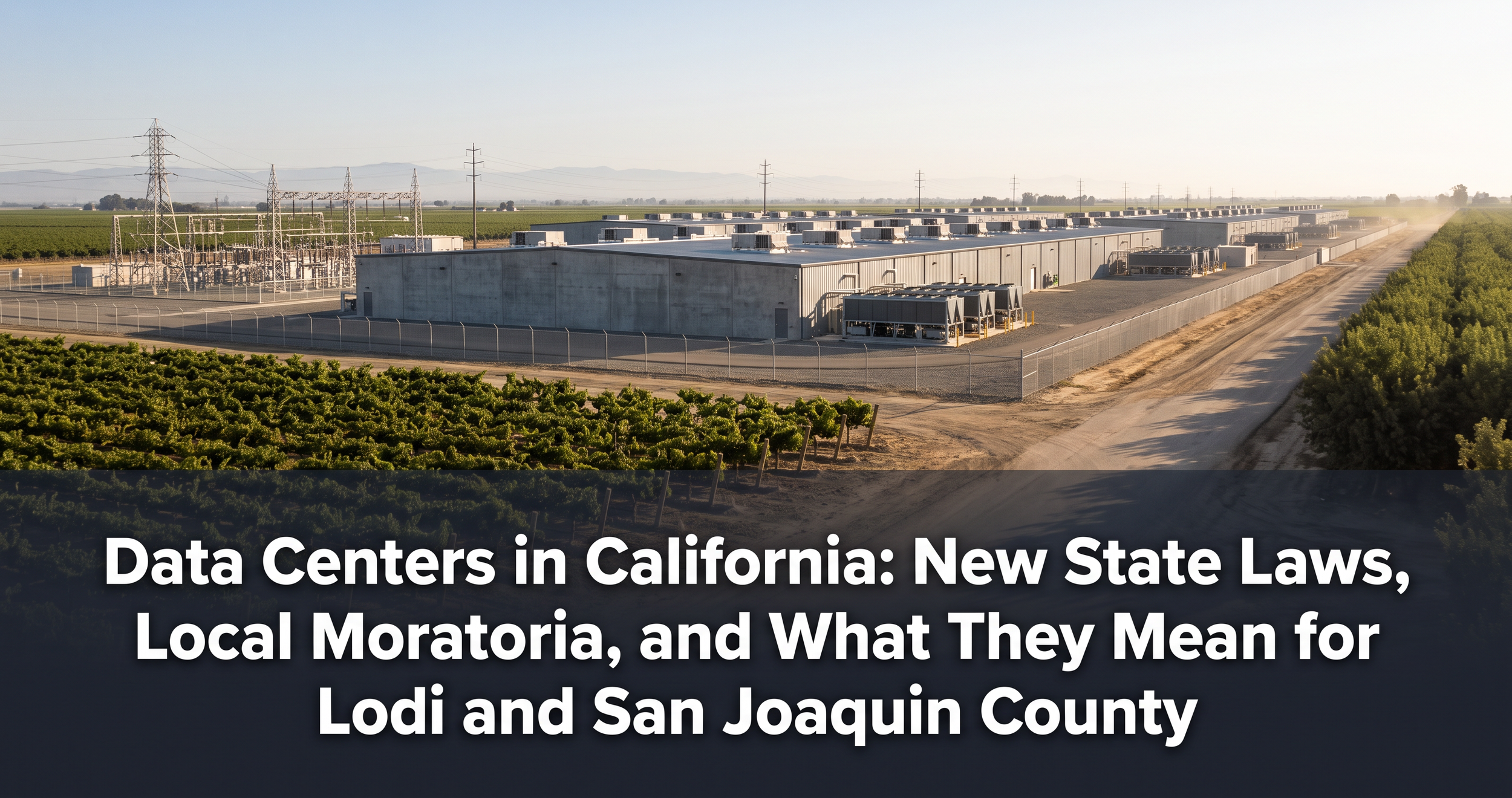
Data Centers in California: New State Laws, Local Moratoria, and What They Mean for Lodi and San Joaquin County
Data centers are large buildings filled with computer servers that run cloud services and artificial intelligence. California is building them and restricting them at the same time. The California Energy Commission estimates that data centers now draw about 1,000 megawatts, roughly 2 percent of peak demand on the state’s main power grid, and projects about 4,500 megawatts by 2040. Pacific Gas and Electric says developers have asked it to serve 12.7 gigawatts of new data center load, more than twelve times what operates statewide today, though only a small share of those requests have signed agreements.
Cities and counties have responded quickly. Monterey Park, Coachella and Calexico have adopted permanent bans, and Alhambra voters decide on one November 3. Three counties and about twenty cities have adopted urgency moratoria, which are temporary freezes on new approvals that state law allows for 45 days and up to two years with extensions. About a dozen more jurisdictions are drafting restrictions. San Jose, Santa Clara, Pittsburg and Vernon continue to permit and build.
On September 21, Governor Newsom signed seven laws on data centers. Together they require data centers to pay for the grid upgrades and power supply they need, end the shortcuts that let some projects skip state environmental review, require public reporting of energy and water use, and require water supply studies before approval. Most take effect January 1, 2027.
San Joaquin County has no data center applications and no data centers in its unincorporated areas. On September 1 the Board of Supervisors ordered a six-month study and asked its lawyers whether a temporary moratorium would hold up legally. Lodi has no data center rules. A proposal to place one near the White Slough wastewater plant was raised at the City Council in May and withdrawn by June. Lodi’s electric system is the main physical limit on any future proposal.[
Lodi City Council Agenda - October 7, 2026
The Council’s only public hearing Wednesday would start the formal annexation of about 96.1 acres on Lodi’s west side, between West Vine Street and Kettleman Lane, west of Lower Sacramento Road. Applicant Dobbins Properties is asking the Council to pre-zone the land for homes, commercial uses, a mixed-use corridor along Kettleman, and a 10-acre public facility site that includes a 2-acre fire station reservation, then send the request to the San Joaquin Local Agency Formation Commission (LAFCO), the county board that approves city boundary changes. The packet says staff corrected the acreage figures to 96.1 acres and 19.91 mixed-use acres, but the pre-zoning map printed in the packet still shows the old 95.3-acre breakdown, and the Planning Commission resolution listed as Attachment 6 is missing from the packet.
The Regular Calendar and Ordinances sections are empty. Everything else sits on the Consent Calendar, which the Council approves with one vote unless someone pulls an item. That calendar holds eight sets of minutes reaching back to January 2025, a 180% increase to a planning consultant contract three months into its term, a $240,543 sole-source library software contract, Federal Transit Administration (FTA) purchasing rules, an after-the-fact extension of an expired transit advertising contract, and the Electric Utility’s year-end financial report.
The Electric Utility finished FY 2025/26 with $47.6 million in cash, 160% of its reserve target, but spent about $684,000 more than it took in. Its forecast reserve falls to 119% of target by FY 2029/30 as spending on the 230-kilovolt (kV) transmission connection ramps up, and it assumes 2% rate increases in FY 2029, 2030, and 2031.
The Council meets in closed session at 6:15 p.m. for the City Manager’s initial performance review and two lawsuits filed by former City Manager Scott R. Carney.
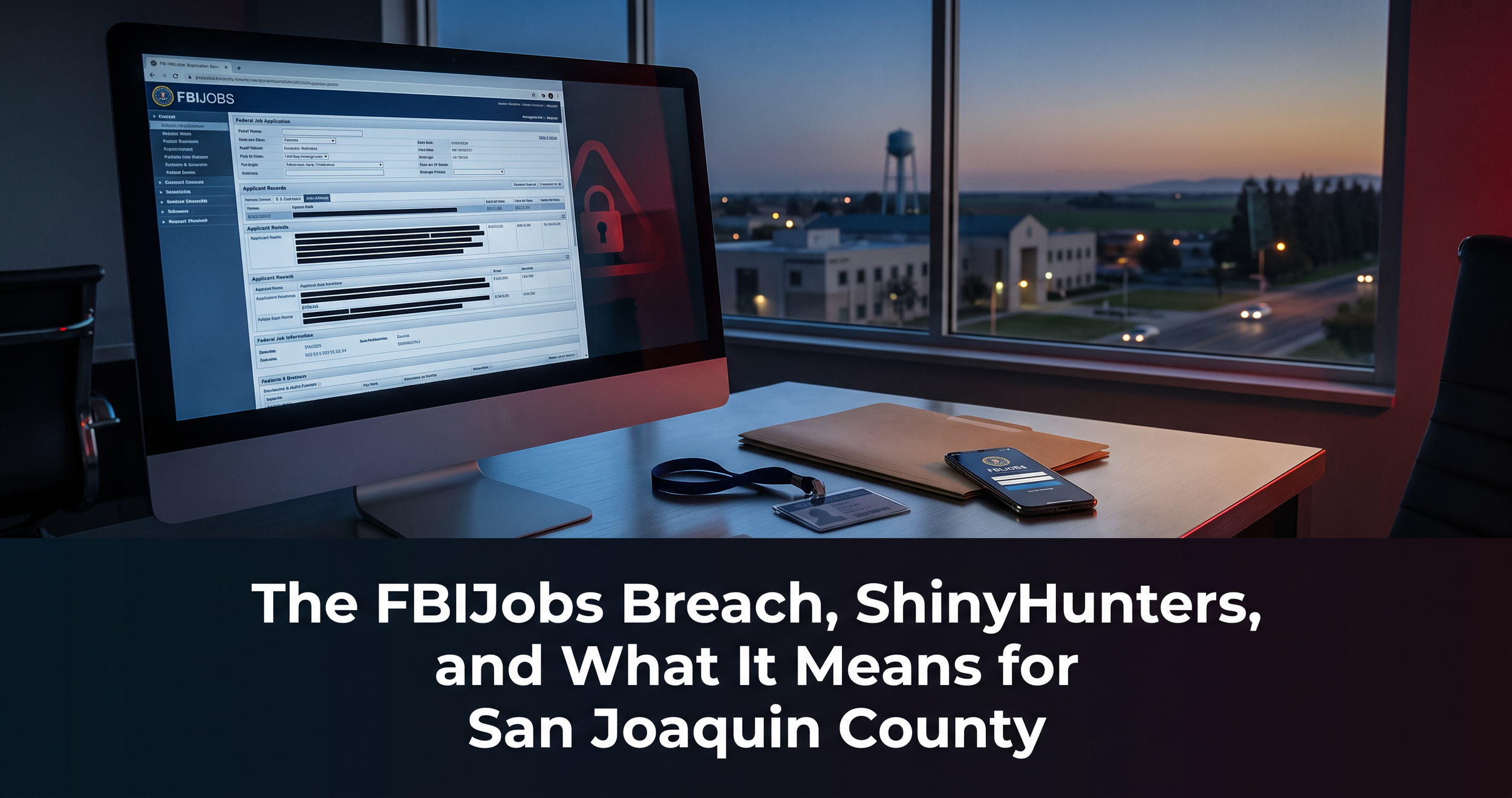
The FBI Jobs Breach, ShinyHunters, and What It Means for San Joaquin County
In late September 2026, a hacking and extortion group called ShinyHunters said it had broken into FBIJobs.gov, the FBI’s recruiting website, altered the site, and stolen sensitive records on FBI employees and job applicants. The FBI first said it was investigating claims of unauthorized activity. It later called the matter a cyber incident and said it was contacting affected people. Internal notices reported by news organizations told employees that names, home addresses, job titles and Social Security numbers were exposed.
Journalists who examined samples of the stolen data reported records tied to real FBI or Justice Department personnel, including family contact information and medical or psychiatric material. That supports the conclusion that a serious theft occurred. It does not prove every claim the hackers have made. Their statements that they took records on nearly all FBI personnel, a large number of applicants, and 2 to 3 terabytes of data in total have not been confirmed in full.
The hackers say they got in through Oracle PeopleSoft, a widely used software package for payroll, human resources and finance, and then moved into other FBI-managed systems. The FBI has not confirmed that account. The claim came during a documented ShinyHunters campaign against a serious PeopleSoft security flaw, one that lets an attacker into a system over the internet without a password. Oracle released a fix on June 10. Google’s Mandiant security unit later documented attackers getting past temporary network blocks at organizations that had not installed the fix.
Two developments followed in the last days of September. Dutch police and the FBI announced that a 24-year-old Amsterdam man, described by the FBI as one of the group’s alleged leaders, had been arrested on September 15, about a week before the FBI breach became public. Separately, ShinyHunters told several news outlets it does not plan to publish or sell the FBI data and called the episode a “marketing campaign.” That statement cannot be verified, and the data remains in the group’s hands. On October 1 the group’s leak site was back online, listing two new corporate targets.
For San Joaquin County, the incident is a reason to check local systems. It is not evidence of a local breach. County documents show the county uses PeopleSoft for human resources and has been working on an upgrade, and older materials describe PeopleSoft-based employee self-service, finance and payroll functions. The county’s current software version, whether the system can be reached from the internet, and whether the June fix is installed are not public

The Kelvin Wave Is Here: What the Tide Gauges Show, From San Diego to Stockton
For a month, the 2026 El Niño's Kelvin wave has been reported as something on its way. The tide gauges show it has already arrived. On October 1, water at San Diego ran 1.21 feet above the predicted tide and Los Angeles ran 1.08 feet above it. San Francisco ran 0.79 feet above, and Port Chicago, on Suisun Bay at the mouth of the Delta, ran 0.75 feet above. All four readings were still rising.
Measured against the average of the last three Septembers, the gauges are about 11 inches high in Southern California and 6 to 7 inches high in the Bay and Suisun Bay. The signal has reached the San Joaquin River at Stockton, where the September average stage ran about 3 inches above the previous three Septembers. The September and October 2026 tide readings are NOAA preliminary data. NOAA has not yet completed its quality review, and the figures may shift slightly once it does.
The wave will not flood Lodi. What it does is raise the starting water level for every tide and storm this winter, across the Bay and into the Delta channels that drain the Mokelumne. The winter's highest tides arrive November 24–26 and December 23–25. Researchers expect two to four more Kelvin waves before spring.
Measure L Citizens’ Oversight Committee - September 30, 2026
Lodi’s Measure L oversight committee meets Wednesday to receive a rebuilt draft of the Fiscal Year 2024/25 Measure L Annual Accountability Report. Measure L is the half-cent local sales tax Lodi voters approved in November 2018. The ballot estimated $5.4 million a year. In FY 2024/25 it brought in $9.1 million.
The committee reviewed a draft for this same fiscal year on December 8, 2025. The dollar figures have not changed. Staff has moved the report into the City’s ClearGov budget software and added historical department, General Fund, and staffing sections. The committee takes no action on the report Wednesday; staff will ask for a recommendation to the City Council at the next meeting, more than 15 months after FY 2024/25 closed.
The report shows the Measure L fund spent $208,107 more than it took in during FY 2024/25, its first deficit year. The balance fell to $1,580,709, leaving $124,625 above the required 16% reserve. The new ClearGov version also introduces errors: a summary table drops Parks entirely, the Fire section counts the Library’s Measure L librarian in every year, and several charts labeled “FY25 Expenditures” show budget figures instead of actual spending. FY 2025/26 ended June 30, 2026, but the report includes only that year’s adopted budget, with no actual results or year-end fund balance.
Power Outages in Lodi, 2021–2026: An Update on Records and Causes
Lodi Electric Utility (LEU) serves about 28,000 accounts within roughly 14 square miles. Most outages on its system over the past five years were short and local, affecting a few dozen to a few hundred customers for an hour or two.
The two largest events came on back-to-back days in September 2022, and neither started on LEU's neighborhood lines. One was a load cut ordered in error by the regional power agency. The other was a failure of protective relays on one of the three transmission feeds that bring power into the city.
Weather-related outages in Lodi have come mostly from winter wind storms that push branches and debris into overhead lines. Summer heat has mattered mainly through the limits of the transmission lines that feed the city, not through failures of local equipment.
Where Lodi Floods First: Scenarios for the 2026–27 El Niño Winter
California entered fall under a statewide emergency proclamation and a forecast for one of the strongest El Niño events on record (NOAA outlook). That is not a prediction that Lodi will flood. The local preparedness questions center on storm drains in town, the Mokelumne River corridor through Woodbridge and Thornton, north-Delta levees, and access to the White Slough wastewater plant west of Interstate 5.
Governor Gavin Newsom proclaimed the emergency on September 21. The proclamation itself warns that “very strong El Niño events do not produce uniform statewide outcomes.” This report sets out what each flood scenario would look like around Lodi, which parts can be mapped from official data, which cannot, and what local agencies can finish before the storms arrive.

Fewer Cattle, Costlier Beef: Twenty Years of the U.S. Beef Industry and What It Means in San Joaquin County
The United States started 2026 with 86.2 million cattle and calves, the smallest herd since 1951. Ground beef averaged $6.92 a pound nationally in August. Beef imports are at a record, and two of the four companies that slaughter most of the country's cattle are controlled from Brazil. This report walks through how the industry got here over the last twenty years, from the ranch to the grocery store, and then looks at what those national trends mean for cattle producers, dairies and shoppers in San Joaquin County.
Operation Sparkplug: An Update to the Gang Picture in San Joaquin County
Four Lodi residents were federally indicted on September 23 as members of Varrio Mojado Sureño, a gang that has been in Lodi for years but did not appear in our April report. This report looks at the case, what it changes in that earlier picture, and the other gang-related cases in San Joaquin County since April.

Now It's 75 Percent: The September El Niño Forecast and the Mokelumne Clock
Updated with NOAA CPC, IRI, ECMWF, and Weather West data through August 19. This brief updates our April 22 report, "Strongest El Niño in 140 Years?", and our early-August follow-up, "It's Here: El Niño Arrives Ahead of Schedule — and the Forecast Keeps Climbing".
In April, El Niño was a forecast NOAA handicapped at 61%. By early July it was a fact, with an 81% chance of a very strong peak. The August 13 diagnostic discussion moved the goalposts again — twice. NOAA now puts the chance of a very strong El Niño this fall and winter above 90%, and for the first time assigns a probability to something it calls a historic event: a 69% chance that the October–December peak exceeds every El Niño in the record back to 1950. The mid-August IRI/Columbia model ensemble goes further still, with 15 of its models forecasting peak anomalies at or beyond +3.0°C — past the top of the IRI's own intensity scale.
The California translation arrived the same week. Citing the August ECMWF ensemble, UCLA climate scientist Daniel Swain reports 70–100% odds of above-average winter precipitation statewide — and the same odds that December–February lands among the top 20% of California's wettest winters on record. For Lodi, the preparation questions the April report framed as contingencies — Mokelumne flood-control releases, harvest-season rain, flood insurance — are now the base-case planning scenario. The core caveat survives: probability is not destiny, and 2015–16 proved a monster label can deliver an ordinary winter. But every forecast revision since April has moved one direction.
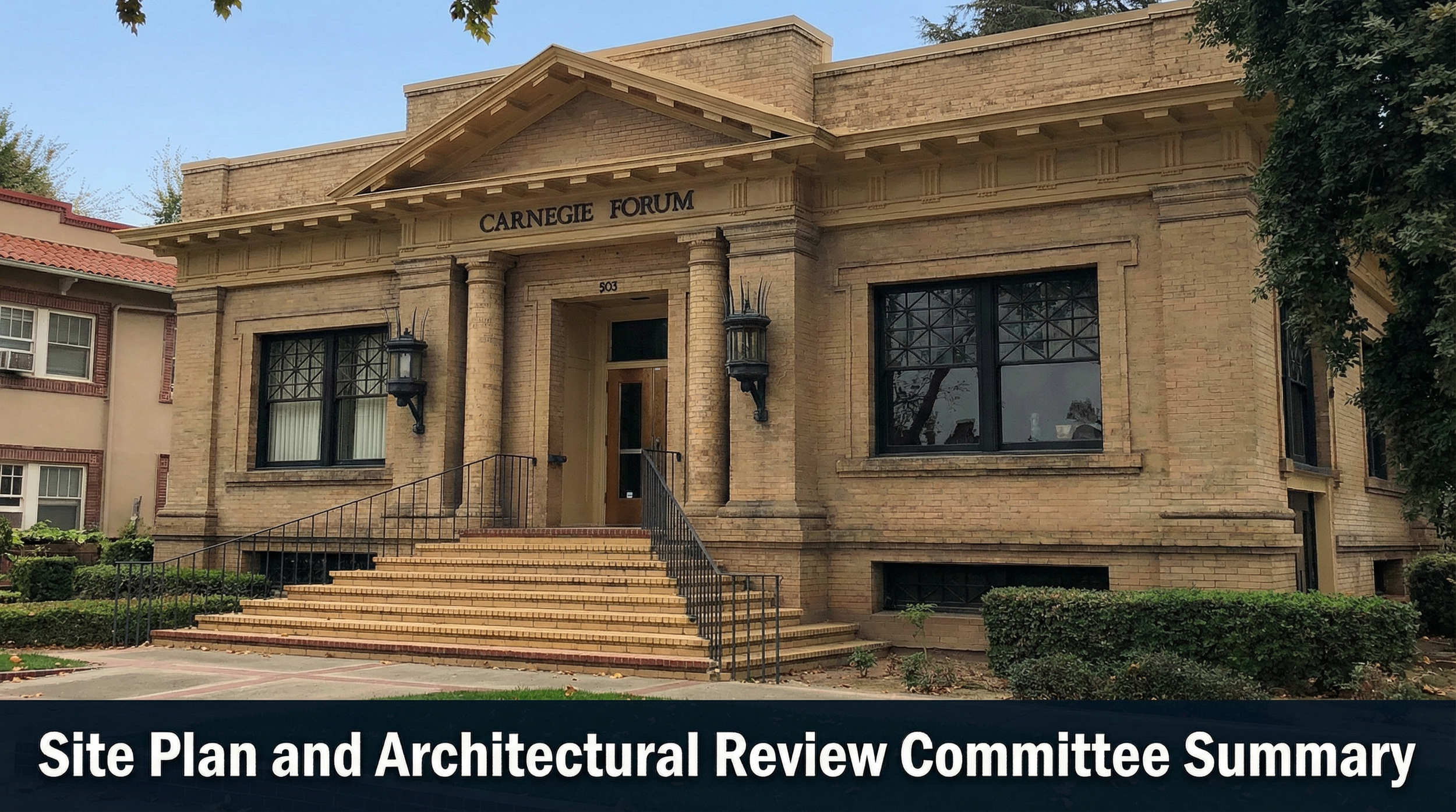
Lodi Site Plan and Architectural Review Committee - September 23, 2026
The September 23, 2026 Site Plan and Architectural Review Committee (SPARC) meeting is a single-hearing sitting on a project that has been moving through Lodi's development pipeline since 2023. Item 4a is design and site-plan review for a proposed Maverik convenience store, seven auto and five truck fuel dispensers, and an 8.81-acre commercial lot at 4872 East Kettleman Lane — the southeast corner of Kettleman and South Beckman Road, roughly 350 feet east of the State Route 99 interchange. The Committee's action is quasi-judicial and triggers ex parte disclosure under Resolution No. 2006-31 and campaign-contribution disclosure under Government Code §84308.
The site was annexed into the City by San Joaquin Local Agency Formation Commission (LAFCO) on August 26, 2026. The Committee sits at 5:15 p.m.; at 7:00 p.m. the Planning Commission takes up the linked Use Permit for a Type 21 off-sale alcohol license at the same store (PL2023-042 U), plus an unrelated Tentative Parcel Map at 401 North Ham Lane (PL2026-013). Staff finds no further environmental review is required under the California Environmental Quality Act (CEQA) Guidelines §15162, relying on the 2025 Maverik Initial Study/Mitigated Negative Declaration (State Clearinghouse No. 2024030646). Staff recommends approval subject to the Conditions of Approval in Attachment D.
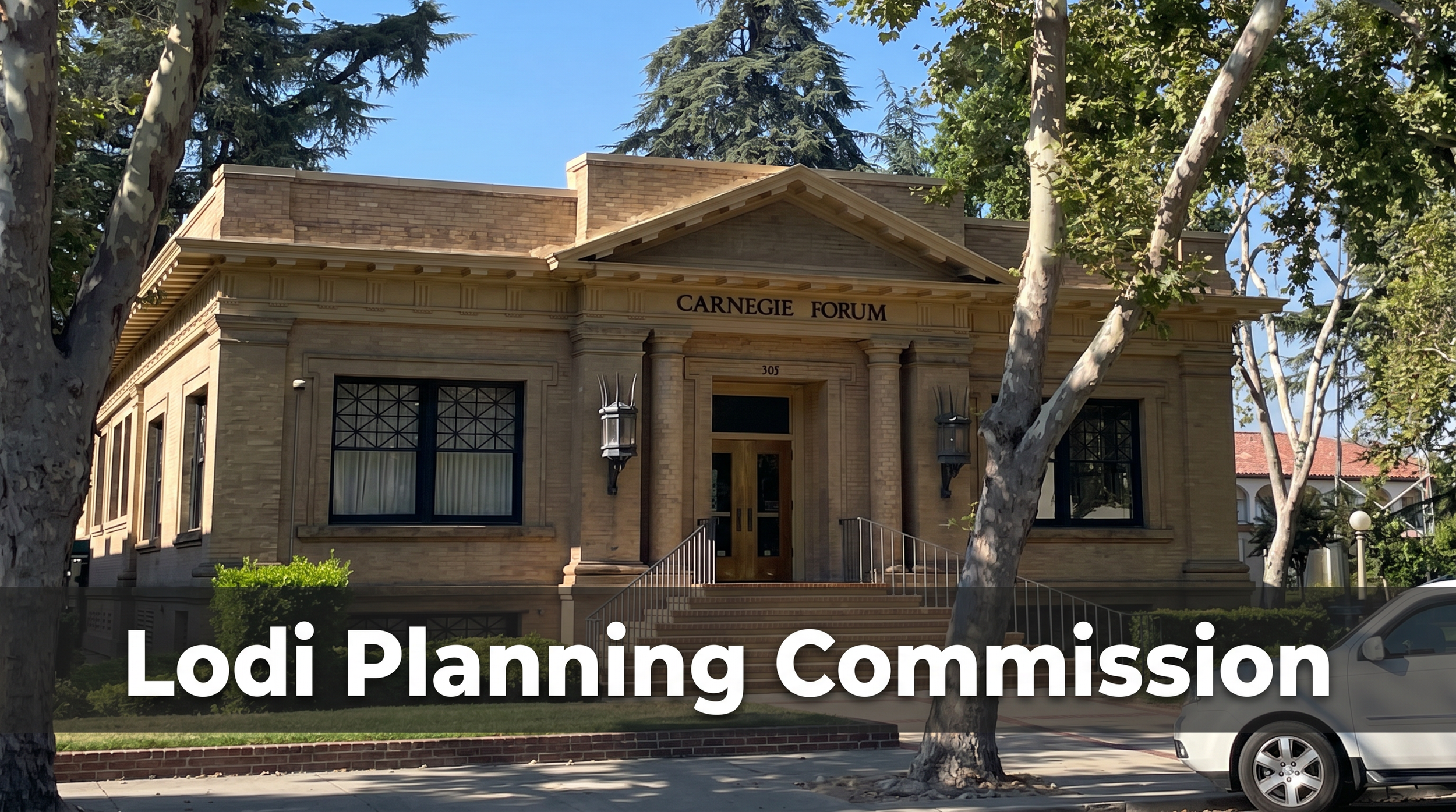
Lodi Planning Commission - September 23, 2026
The September 23, 2026 Lodi Planning Commission Regular Meeting is a short, two-hearing sitting. Both items are quasi-judicial and require ex parte disclosures under Resolution No. 2006-31. Neither reopens the underlying environmental analysis: staff relies on categorical exemptions and a Section 15162 finding on the 2025 Maverik Initial Study/Mitigated Negative Declaration.
Item 4a is a Tentative Parcel Map to split one lot into two at 401 North Ham Lane in an RMD (Residential Medium Density) infill setting on 10,700 square feet. Staff argues the site is already two legal lots dating to a 1957 conveyance and this action only re-divides the western legal lot. Item 4b is a Use Permit authorizing a Type 21 off-sale ABC license (beer, wine, and distilled spirits) at a proposed Maverik convenience store and gas station at 4872 East Kettleman Lane — 24 hours a day, 7 days a week, at a freeway-adjacent parcel that was annexed into the City by LAFCO on August 26, 2026. Because ABC has classified the entire City as overconcentrated with alcohol licenses, the Commission must also make a Public Convenience or Necessity (PCN) finding.

Water Supply and Groundwater in San Joaquin County and Lodi
Lodi and eastern San Joaquin County draw on two water systems that behave very differently. One is the Mokelumne River, delivered to Lodi through a 40-year contract with Woodbridge Irrigation District and backed by some of the oldest water rights on the river. The other is the groundwater under our feet, the Eastern San Joaquin Subbasin, a 707,000-acre aquifer the state has classified as critically overdrafted, meaning more is being pumped out than is going back in. Roughly half of Lodi's drinking water comes from each.
The near-term picture is stable. Groundwater levels in the subbasin are holding, there is no measurable land subsidence, water quality at the basin scale is within targets, and Lodi has banked more than 53,000 acre-feet of unused river water since 2003. (An acre-foot is about 326,000 gallons, roughly what two or three households use in a year.) The long-term picture is not resolved. The subbasin loses about 89,000 acre-feet of storage a year on average, and the Groundwater Authority's own model says pumping must fall by about 95,000 acre-feet a year to stop the decline. Projects now funded cover about a third of that. The rest depends on a large program to store extra Mokelumne River water underground in wet years, which is still waiting on a state water-rights decision, or on a program to limit pumping that the Authority acknowledges could limit growth.
Four statewide decisions now in motion will shape which of those paths the region takes: the Delta tunnel, the Sites reservoir, the Bay-Delta Plan's flow requirements, and the Colorado River settlement. Dan Walters laid these out in a September 11 CalMatters column, “California's future water supplies depend on the outcomes of four intertwined battles,” which argues that the next few months of decisions on those four fronts will determine how water is managed and allocated for decades, with a governor trying to settle two of them before leaving office. This report takes his statewide framing and follows it down to San Joaquin County and Lodi. Three of the four fronts touch the county directly, and the nearest is the State Water Board's October 28–29 hearing on adopting the Bay-Delta Plan update, which sets the flow rules for the Mokelumne.
The risk is not evenly shared. Groundwater-dependent farms outside the surface-water districts and rural residents on private wells carry the most exposure. City of Lodi water customers carry the least in the near term, with their exposure showing up later as rates and growth limits rather than shortages.

Lodi Finance Committee - September 16, 2026
The September 16, 2026 Lodi Finance Committee Special Meeting is a compliance-and-treasury sitting with three Regular Calendar items: approve the June 10, 2026 minutes, receive the Quarterly Investment Report for the quarter ending June 30, 2026, and review a Purchasing Policy redline that adds Federal Transit Administration (FTA) procurement language requested by a recent FTA audit of the Public Works Transit Division.
Total cash and investments at June 30, 2026 stand at $242.0 million — essentially flat year over year, but reflecting a significant rebalancing over the last four quarters into Medium Term Corporate Notes (24.57% of the portfolio, near the 30% policy cap) and out of Municipal Securities and U.S. Treasuries. The Purchasing Policy revisions would be the third Council adoption of the policy in six years and are driven directly by FTA audit findings on the Transit Division.
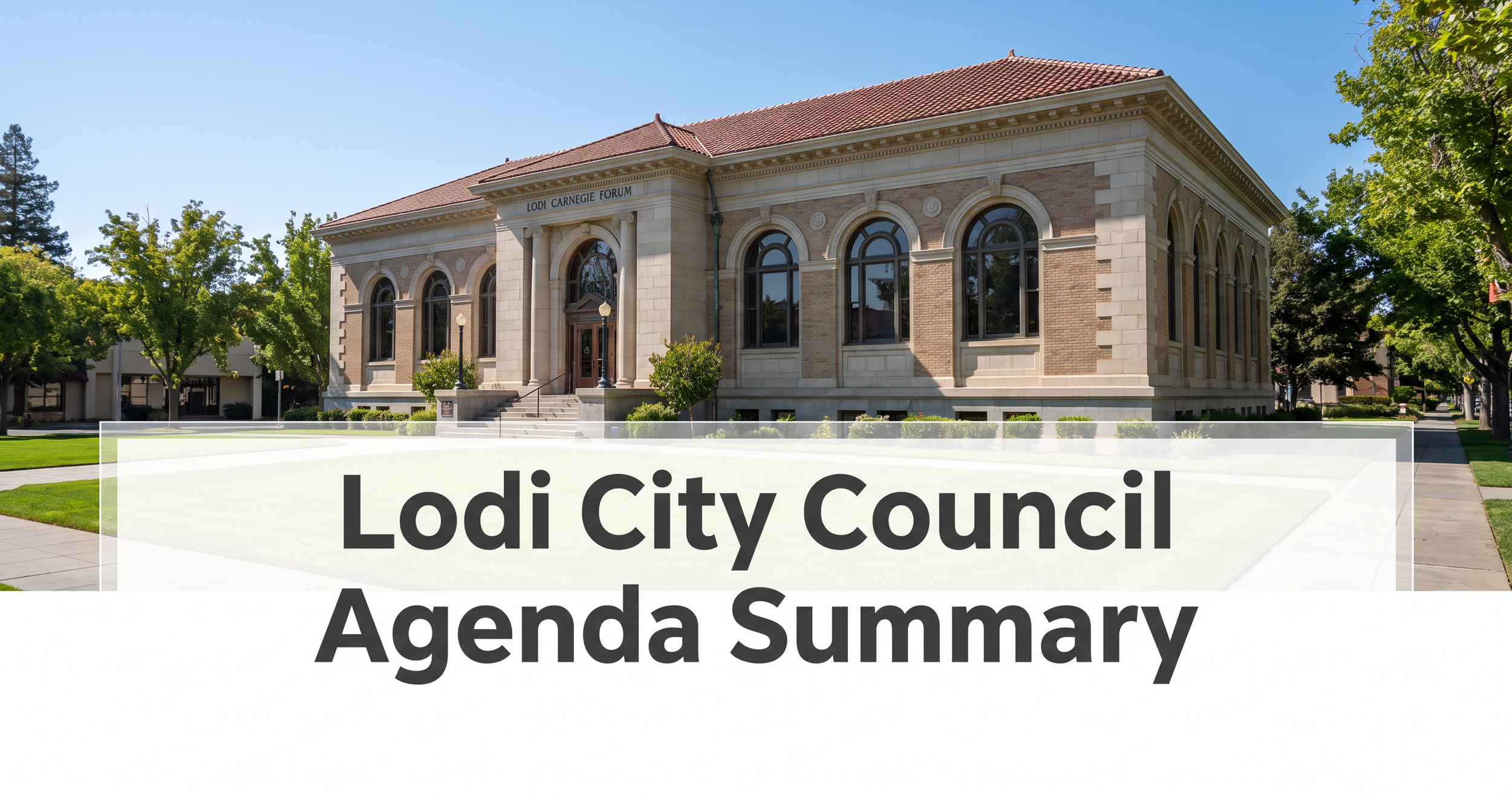
Lodi City Council Agenda — September 16, 2026
The September 16 meeting is a working session dominated by contract extensions and capital-project authorizations. The AMENDED packet (523 pages) adds one large minutes-approval bundle covering 22 back meetings from March 2024 through August 2026 and moves the Cal Cities voting-delegate appointment from the consent calendar to the Regular Calendar as G.3. No other staff reports were changed from the original release.
The largest fiscal actions on the consent calendar are the on-call well and pump repair authorization ($1.0 million), the after-school Bridge Program contract with Lodi Unified (up to $657,000), the DeBenedetti Park Improvements 2027 bid authorization (~$5.1 million project cost), and the Well No. 8 abandonment change orders ($320,000). The Access Center construction management extension to March 31, 2027 (Bickford Ventures) is the most politically watched consent item.
The Regular Calendar has three items. G.1 is the quarterly Access Center operations, construction, and funding update — the meeting's most substantive policy item — with a Council-feedback request on long-term financial sustainability. G.2 updates the unpermitted food-vendor task force. G.3 is the appointment of a Cal Cities voting delegate for the September 23–25 conference in Anaheim.
Council: Mayor Ramon Yepez, Mayor Pro Tempore Mikey Hothi, Council Members Cameron Bregman, Lisa Craig-Hensley, and Alan Nakanishi. Interim City Clerk Walfred Solorzano.
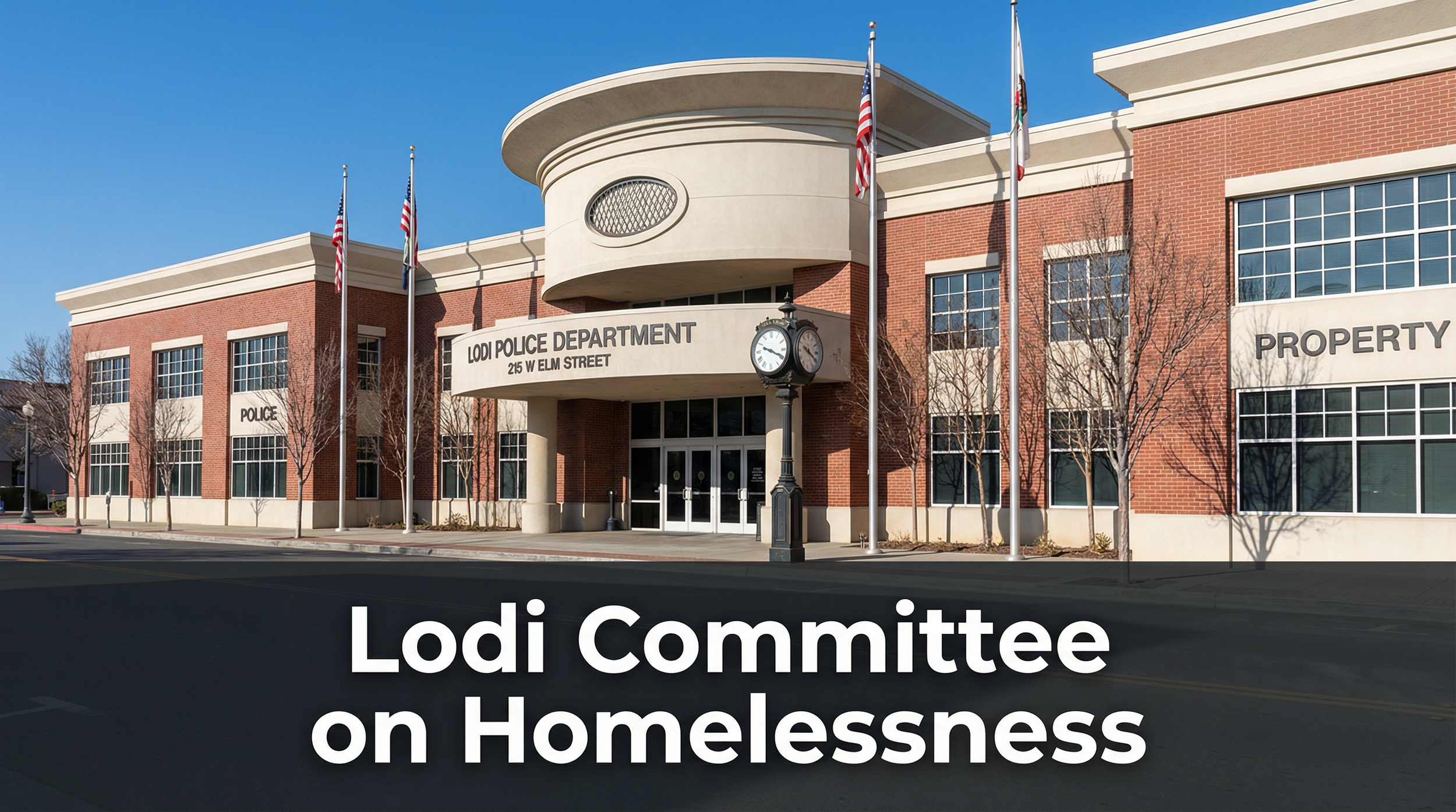
Lodi Committee on Homelessness — September 10, 2026
The September 10, 2026 Lodi Committee on Homelessness (LCOH) meeting runs the standard monthly service-provider and subcommittee round — with three items that make it worth attending in person. The Community Engagement & Public Relations subcommittee is bringing an LCOH website proposal up for discussion and approval. A roundtable with Rep. Josh Harder is added under Item V, paired with a proposal to move the meeting to October 15, 2026. And a Temporary Pet Fostering Project update now appears as its own agenda item.
The packet's system-wide summary of 16 secured jobs, 21 program transitions, and 43 housing transitions in August (90 / 134 / 255 year-to-date) is labeled DRAFT-Only because HMIS client-ID de-duplication across providers is not yet complete. For August, only Lodi Access Center and Family Promise submitted client IDs — and no duplicates were found between them, the first tangible progress on the reconciliation problem the Data subcommittee has been working since July.
Underneath the routine numbers, Lodi Access Center posted its highest 20-month client volume, Hope Harbor's family shelter reported zero new family intakes because units are full, and AHLM's housing supports is not currently accepting new referrals. The City's application for CalTrans Encampment Recovery Funds — filed to help fund LAC for one year — is the funding thread most likely to resurface in the staff update.
Lodi Improvement Committee — September 8, 2026
This is the most consequential Lodi Improvement Committee meeting of 2026. Three items in a row put the committee's own existence on the table: a redlined bylaws rewrite that would dissolve the Lodi Improvement Committee and replace it with the "Lodi Community Advisory Committee on the City's Strategic Vision," a possible recommendation of that rewrite to the City Council, and a reorganization vote for a temporary Chair and Vice Chair placed at the very end of the agenda, after member comments.
The rewrite is not a housekeeping edit. It would strip the committee's crime, blight, code-enforcement and infrastructure-advocacy mandates; convert membership from seven Council-appointed residents to seven seats filled by other City bodies with the Mayor as automatic Chair; drop regular meetings from monthly to quarterly; tighten removal for absence; and eliminate the committee's own fund account and audit provision.
The meeting also carries a Lodi Committee on Homelessness presentation, catch-up approval of two sets of minutes (July 14 and the one-minute August 11 meeting that died for lack of quorum), the 2026 activities matrix, and November scheduling of the 2027-29 CDBG application overview and NOFA.
Lodi City Hall: Senior Staff Turnover, 2015–2026
This report covers senior staff turnover at Lodi City Hall from January 2015 through August 31, 2026 — an eleven-year window across the City Manager, City Attorney, Police Chief, Fire Chief, Public Works Director, Community Development Director, Electric Utility Director, Parks & Recreation Director, City Clerk, Library Services Director, Human Resources Manager, IT Manager, Deputy/Assistant City Manager, and Finance division. Where a role's history is short without pre-window context (Library, HR, City Clerk, Community Development), the report reaches back to the late 1990s to give the count meaning. Confirmed appointments taking effect after Aug 31, 2026 — David Hanham (Community Development, Sept 7), Taryn Jones (City Attorney, Sept 21), and Christina Castro (Public Works, Oct 5) — are flagged as scheduled.
Turner Road Safety Report
Turner Road has two separate safety stories. One is the resident-driven fight over crashes, speeding, and turning conflicts near California Street, Edgewood Drive, and Vintage Church. The other is the eastern interchange area at State Route 99 and Cherokee Lane, where the city and Caltrans already completed a major reconstruction project. The report also explains how Turner Road compares with other Lodi corridors, what fixes are on the table, and what Lodi would need to create a formal Neighborhood Traffic Calming Program.