Lodi Eye
LodiEye provides additional information on trending stories / topics published by local media and shared on local social media accounts.
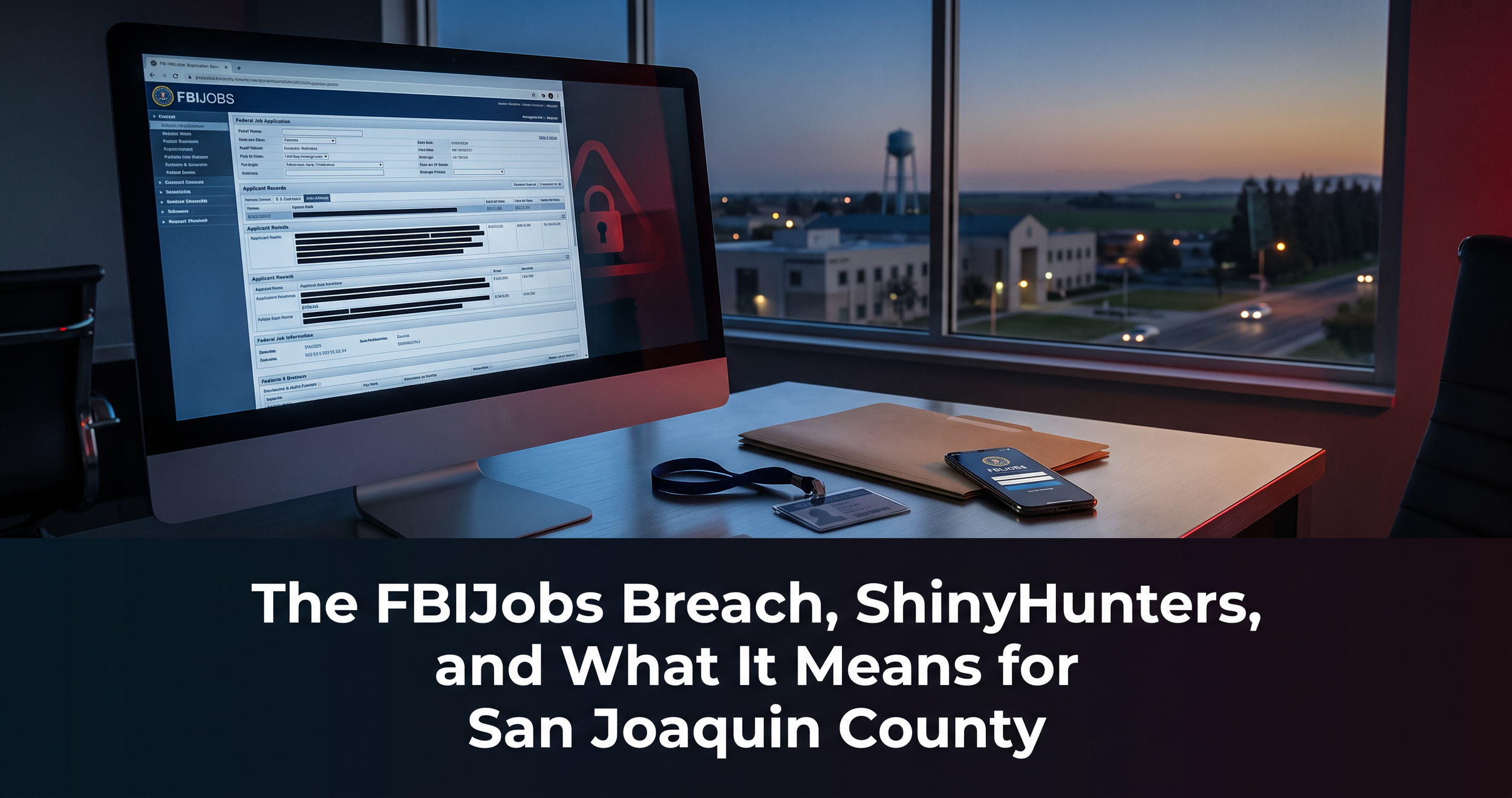
The FBI Jobs Breach, ShinyHunters, and What It Means for San Joaquin County
In late September 2026, a hacking and extortion group called ShinyHunters said it had broken into FBIJobs.gov, the FBI’s recruiting website, altered the site, and stolen sensitive records on FBI employees and job applicants. The FBI first said it was investigating claims of unauthorized activity. It later called the matter a cyber incident and said it was contacting affected people. Internal notices reported by news organizations told employees that names, home addresses, job titles and Social Security numbers were exposed.
Journalists who examined samples of the stolen data reported records tied to real FBI or Justice Department personnel, including family contact information and medical or psychiatric material. That supports the conclusion that a serious theft occurred. It does not prove every claim the hackers have made. Their statements that they took records on nearly all FBI personnel, a large number of applicants, and 2 to 3 terabytes of data in total have not been confirmed in full.
The hackers say they got in through Oracle PeopleSoft, a widely used software package for payroll, human resources and finance, and then moved into other FBI-managed systems. The FBI has not confirmed that account. The claim came during a documented ShinyHunters campaign against a serious PeopleSoft security flaw, one that lets an attacker into a system over the internet without a password. Oracle released a fix on June 10. Google’s Mandiant security unit later documented attackers getting past temporary network blocks at organizations that had not installed the fix.
Two developments followed in the last days of September. Dutch police and the FBI announced that a 24-year-old Amsterdam man, described by the FBI as one of the group’s alleged leaders, had been arrested on September 15, about a week before the FBI breach became public. Separately, ShinyHunters told several news outlets it does not plan to publish or sell the FBI data and called the episode a “marketing campaign.” That statement cannot be verified, and the data remains in the group’s hands. On October 1 the group’s leak site was back online, listing two new corporate targets.
For San Joaquin County, the incident is a reason to check local systems. It is not evidence of a local breach. County documents show the county uses PeopleSoft for human resources and has been working on an upgrade, and older materials describe PeopleSoft-based employee self-service, finance and payroll functions. The county’s current software version, whether the system can be reached from the internet, and whether the June fix is installed are not public
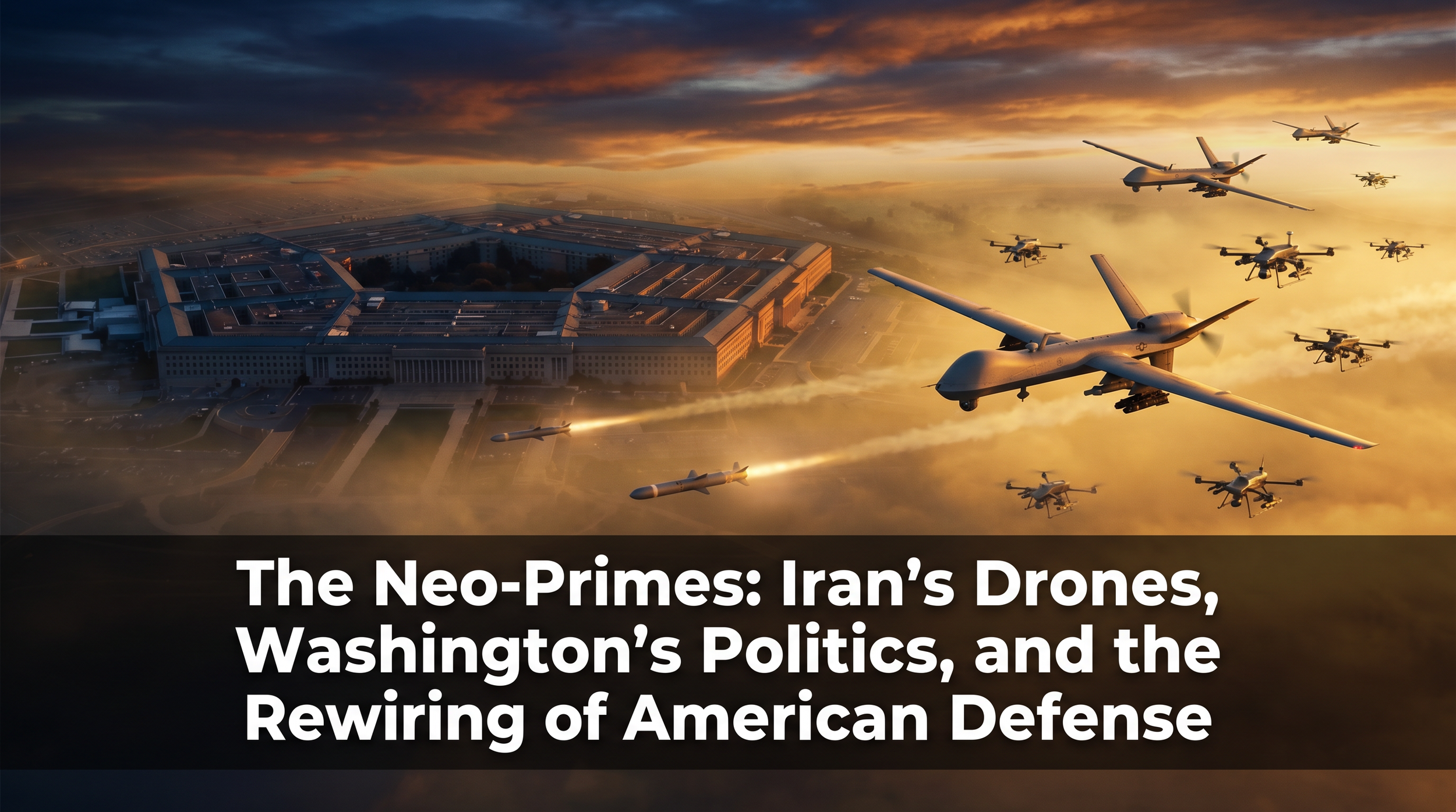
The Neo-Primes: Iran's Drones, Washington's Politics, and the Rewiring of American Defense
A cohort of Silicon Valley defense firms the trade press now calls "neo-primes" — Palantir, SpaceX, and Anduril — is displacing the Lockheed-RTX-Northrop Grumman triad from a growing share of Pentagon procurement. Two forces are driving the shift: the brutal cost asymmetry exposed by the Iran war, and an unusually tight political alignment between the Trump administration and the companies themselves.
Two risks sit alongside the opportunity — a potential bipartisan backlash if the alignment starts to look partisan, and the possibility that the Pentagon ends up just as locked into three new vendors as it was into the old ones.
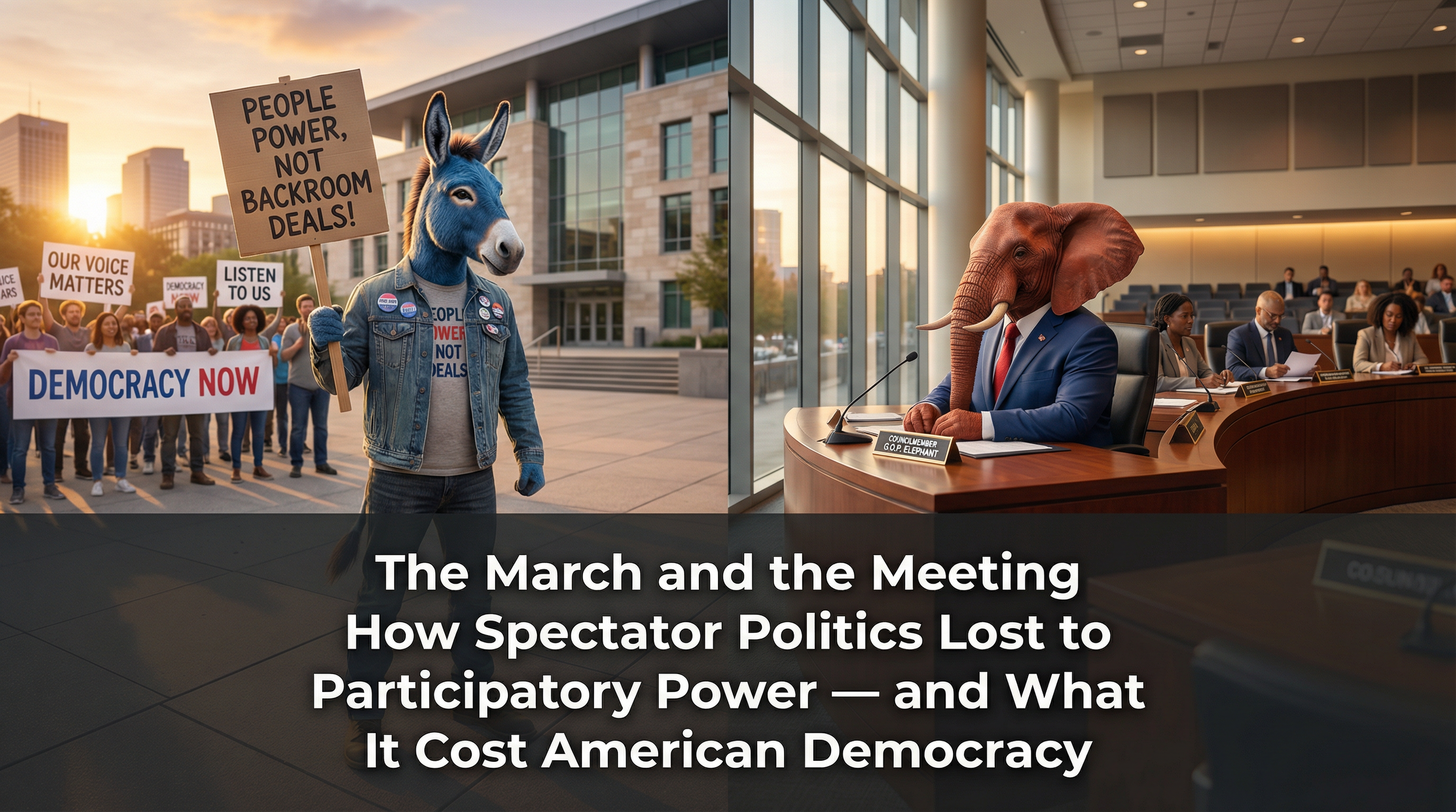
The March and the Meeting
Democracy is not a spectator sport. It requires informed, engaged citizens at every level — from the local planning commission to the statehouse to Congress. Over the past decade, two fundamentally different models of political engagement have competed for dominance in American life. One side marched, protested, donated online, and went home. The other side filed to run, joined committees, built institutions, and stayed. This analysis traces a decade of political spending, civic participation, and institutional investment to document how performative engagement — protests, social media campaigns, and billion-dollar ad buys — lost to the patient, relational, participatory work of capturing democratic institutions from the inside out.

Make America Great Again & America First: Rhetoric, History & Reality
The twin slogans "Make America Great Again" and "America First" are the defining political rhetoric of the current era. This analysis maps those slogans against historical fact, economic data, and the lived experience of average American citizens. The core findings: the grievances that animate these movements are substantially real — rooted in genuine deindustrialization and political neglect of working-class communities over four decades. However, the proposed remedies — broad tariff regimes, immigration contraction, and withdrawal from multilateral institutions — have measurably increased costs for most American households in 2025 while failing to restore conditions that produced mid-20th-century working-class prosperity. Historical evidence across 200 years of US trade policy, spanning both Republican and Democratic administrations, consistently finds that broad protectionism raises consumer costs, invites retaliation against America's most competitive export sectors, and fails to revive targeted industries. A research-justified path forward distinguishes sharply between strategic sectoral protection — which has historical support — and broad universal tariffs, which do not.
Infectious Disease Crisis in America: The Vaccination Policy Fallout
The United States is experiencing its worst measles outbreak in 35 years and a sustained pertussis surge, driven by declining vaccination rates and unprecedented federal actions to weaken childhood vaccine recommendations. Since January 20, 2025, more than 3,600 confirmed measles cases have been reported across 46 states, with 4 deaths and an 11% hospitalization rate. The Trump administration, under HHS Secretary Robert F. Kennedy Jr., gutted the childhood vaccine schedule from 18 to 11 recommended diseases, fired all expert ACIP members, terminated $500 million in vaccine research, and altered CDC messaging to suggest a link between vaccines and autism. A federal judge blocked these changes on March 16, 2026, ruling they likely violated federal law. Meanwhile, California has emerged as the strongest state-level counterweight, but San Joaquin County faces a “very high risk” rating for measles due to only 60% of children under 5 being vaccinated.
The SAVE America Act: Facts, Impacts & What It Means for California and San Joaquin County
The Safeguard American Voter Eligibility (SAVE) America Act, passed by the U.S. House in February 2026, would require documentary proof of U.S. citizenship to register to vote and mandate photo ID for all voters, including mail ballot voters. Proponents claim it addresses noncitizen voting. However, federal and state data consistently show noncitizen voting occurs at rates between 0.00028% and 0.02% of all ballots cast. Meanwhile, 21.3 million eligible American citizens lack ready access to the required documents. For California—an all-mail voting state—and for San Joaquin County, with its diverse population and approximately 376,000 registered voters, the bill would fundamentally disrupt voter registration, mail ballot processes, and election administration.
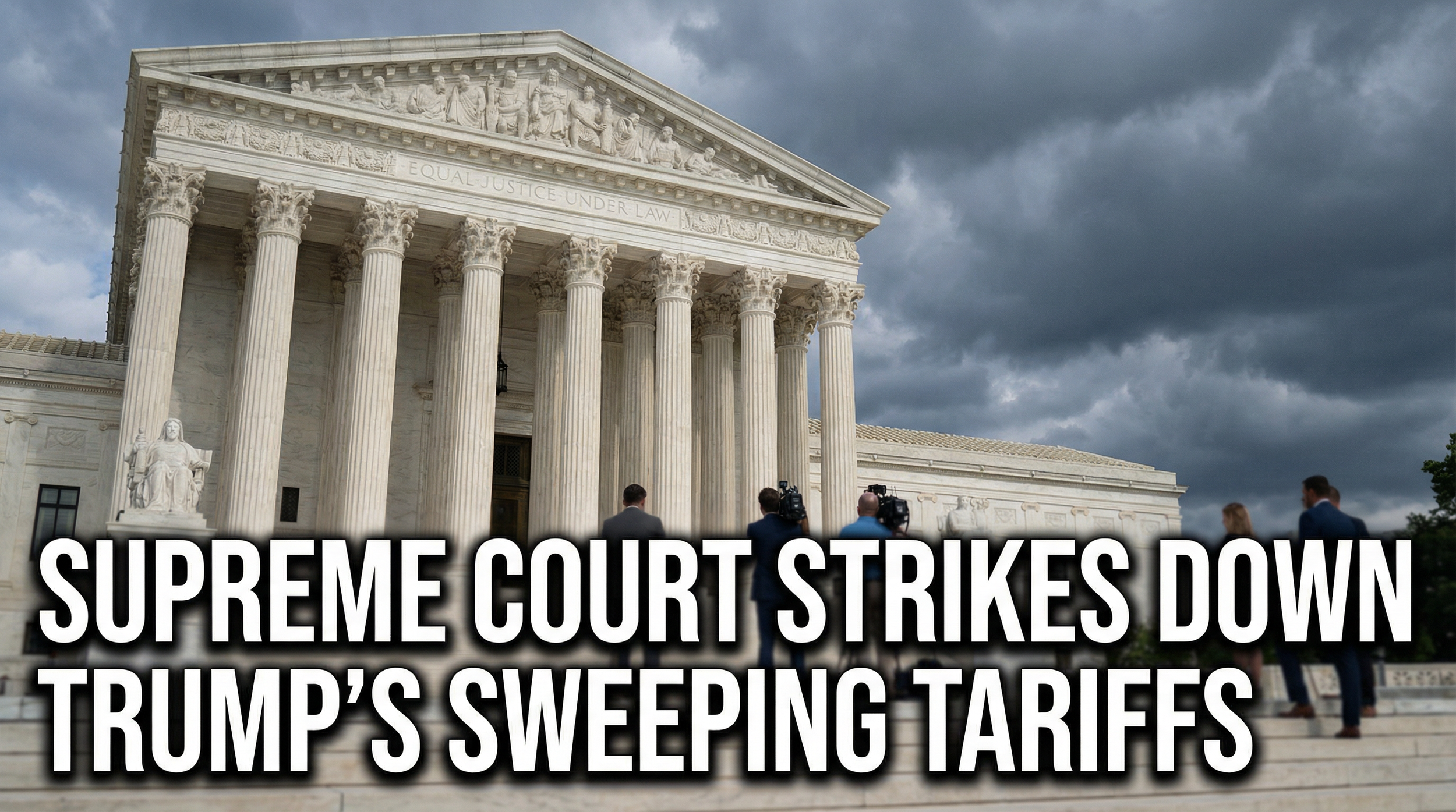
Supreme Court Strikes Down Trump's Sweeping Tariffs
In a 6-3 decision, the U.S. Supreme Court ruled that President Trump exceeded his authority when he used the International Emergency Economic Powers Act (IEEPA) to impose sweeping global tariffs. The ruling invalidates the "reciprocal" tariffs from Liberation Day and the duties on Canada, Mexico, and China tied to fentanyl trafficking — but leaves sector-specific tariffs under other statutes in place.
The El Paso Drone Crisis
On February 11, 2026, the FAA issued an unprecedented order closing all airspace within a 10-nautical-mile radius of El Paso International Airport for 10 days, citing “special security reasons.” The closure — the first of its kind since the September 11, 2001 attacks — grounded all commercial, cargo, and general aviation traffic, disrupting operations for nearly 700,000 residents and diverting emergency medical evacuation flights to Las Cruces, New Mexico, approximately 45 miles away.

Tragedy in Louisville: UPS Flight 2976 Crash
A devastating cargo plane crash near Louisville Muhammad Ali International Airport has left the community reeling after UPS Flight 2976 went down shortly after takeoff on November 4, 2025, killing at least 14 people and leaving several others still missing. This represents the deadliest incident in UPS Airlines' history and has raised serious questions about the aging McDonnell Douglas MD-11 freighter fleet.