Lodi Eye
LodiEye provides additional information on trending stories / topics published by local media and shared on local social media accounts.

The Coupled War: Two Straits, One Enclosed Sea, and the Vulnerability Nobody Is Pricing
The Strait of Hormuz and Bab el-Mandeb are contested at the same time for the first time. Two chokepoints, two different actors, two different stated reasons. Most coverage treats this as the whole story, with Gulf water supply filed separately as a humanitarian worry held in reserve.
That separation is wrong. Gulf desalination plants share buildings with power plants, share a shallow enclosed sea with the tankers now being struck, and depend on the same sea lanes for the parts and chemicals that would repair them. The tanker war and the water war run on the same infrastructure.
This report covers what has happened at both straits, what each Gulf state faces, how the water and shipping vulnerabilities connect, what production has been lost, and which parties would have to sign what for any of it to stop. It closes with the transmission line to San Joaquin County: diesel and fertilizer.

Legionnaires' Disease in Lodi: What You Need to Know
Legionella bacteria were confirmed in the tap water of a California state office building in Lodi in June 2026 — and this city is not alone. San Joaquin County has its own documented history with the bacteria, from Stockton's airport to a state prison medical facility. This report covers what happened at the Lodi building, where else Legionella has turned up in the county, what the disease does to the body, who faces the greatest danger, how doctors treat it, and what filters and systems actually stop the bacteria.

The Bill That Could Price Lodi Out of Its Own Public Records
UPDATE — JULY 11, 2026
The provisions this report warned about are out of the bill — for the second time.
At the June 30 Senate Judiciary Committee hearing, Assemblymember Blanca Pacheco again stripped AB 1821 of its fees, its purpose test, and its "malicious intent" lawsuit provision. The committee passed the reduced bill and sent it to the Senate floor. What remains is the narrow, original-intent version the Assembly approved in May: the initial response window would shift from 10 calendar days to 10 business days, and the "unusual circumstances" extension from 14 calendar to 14 business days. The three structural changes this analysis examines below — charging by the hour for "commercial" requests, letting agencies ask why you want records, and suing requesters for "malicious intent" — are no longer in the text.
Assembly Bill 1821, moving quickly through the Legislature, would rewrite California's 58-year-old Public Records Act — letting government agencies ask why you want records, charge by the hour for requests they label "commercial," and sue requesters they judge to be acting with "malicious intent." This analysis explains what the bill does, which Lodi and San Joaquin County records it would put at risk, and how its "representative of the news media" exemption would land on the small, shrinking set of outlets that still cover this region.
AB 1821 cleared the Assembly 55–12 on May 27 in a narrow form, then was rewritten in the Senate. The far-reaching provisions face their first vote today, June 30, in the Senate Judiciary Committee (9:30 a.m., 1021 O Street, Room 2100). No Senate floor vote is scheduled; a floor vote — and a return to the Assembly to concur in the Senate's changes — would follow only if the bill clears committee. The provisions described below are the current amended text and may still change.
The Fentanyl Crisis in San Joaquin County
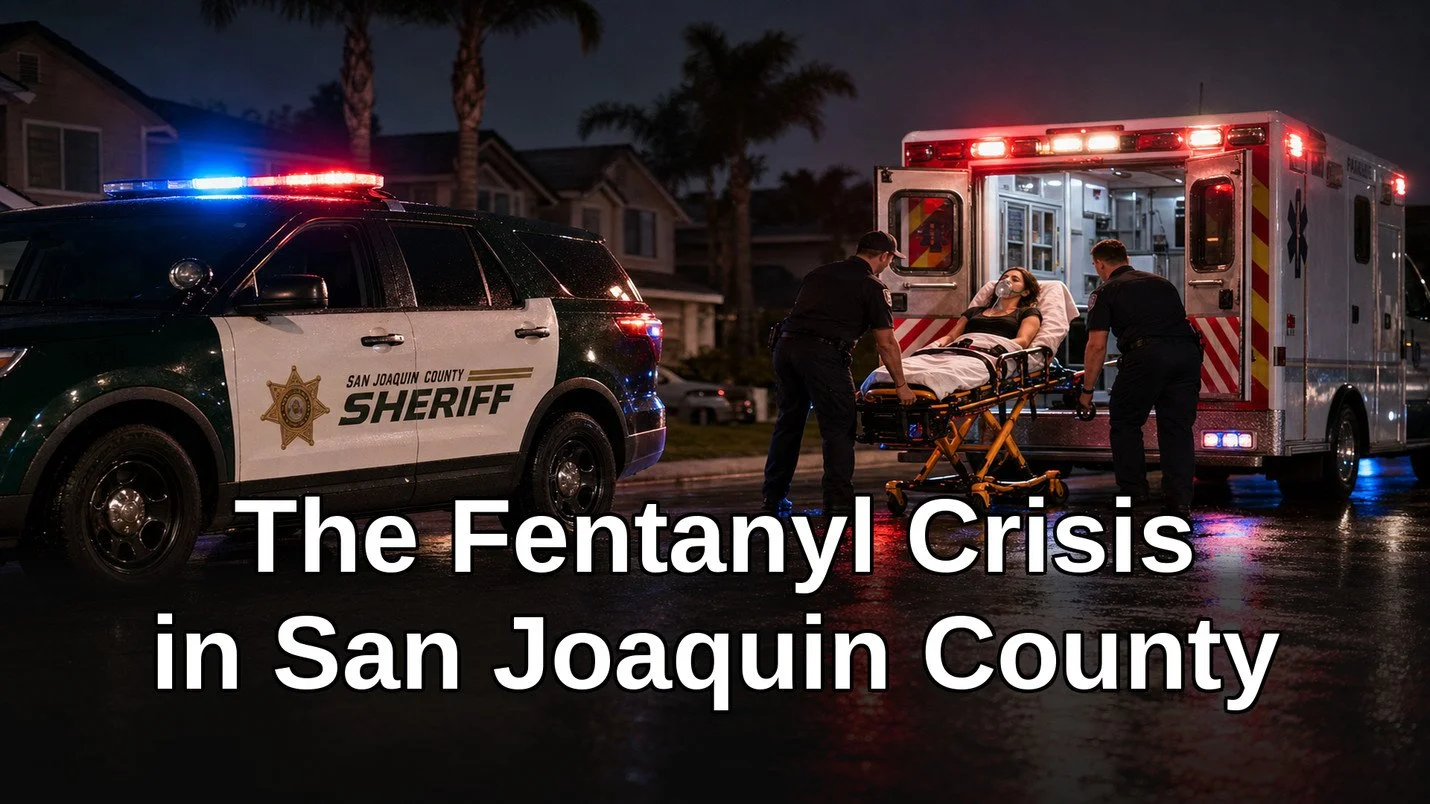
Over five years, San Joaquin County lived through the deadliest chapter of the drug epidemic, driven by one change: illicit fentanyl saturated the local supply. The county's fentanyl death rate in 2021 was 20 times higher than in 2018, and deaths more than doubled again the next year, from 48 in 2021 to 113 in 2022. At the peak, the county was losing four to five residents a week, and people in their 20s and early 30s died faster than any other age group.
In 2024 the county's opioid overdose rate finally dropped about 31 percent — the first sustained decline since the crisis began — helped by naloxone saturation, fentanyl test strips, and a $137 million treatment expansion. But three things complicate any relief. Methamphetamine now kills more Californians than any other single drug, and meth deaths are still rising as fentanyl deaths fall. A veterinary tranquilizer called xylazine is spreading up the West Coast toward the Central Valley. And in December 2024, Proposition 36 reversed a decade of California drug policy, restoring felony charges for repeat offenses just as the public-health approach began to work.
This report traces how the crisis rose and eased, who it hits hardest, how the drug supply chain reaches Lodi, what treatment and enforcement are doing, and what the open questions — from settlement spending to the methamphetamine gap — can and cannot yet be answered.

Golden Mussels and the Mokelumne: What the Invasion Means for Lodi
The golden mussel invasion that Ag Alert reports is plaguing California farms and water districts is not a distant Delta problem for Lodi. It arrived through the county's front door and is moving toward the county's most important local waterway. San Joaquin County recorded the first golden mussel detection in North America, at the Port of Stockton in October 2024, and in April 2026 became the first California county to declare a state of emergency over the mussel. The threat now runs along the lower Mokelumne River — the river that flows through Lodi, forms Lodi Lake, and irrigates roughly 13,000 acres of Woodbridge Irrigation District farmland. This report traces the risk down three connected pathways: the river and Lodi Lake, the irrigation district that waters local vineyards and orchards, and the EBMUD reservoirs upstream that control everything downstream.

America's Oil Reserve Hit a 43-Year Low. The Barrels Are Coming Back
The Strategic Petroleum Reserve fell to about 319.5 million barrels in early July 2026, its lowest level since April 1983. Most coverage framed that as depletion. It is not. The 172-million-barrel release behind the drop is structured as a loan — companies borrow the crude now and return it later with interest — and the Department of Energy projects the reserve ends up with more oil than it lent out. The real story is what Washington is now doing with the reserve, and the demand, budget, and energy-security consequences that run through 2028.
Opportunity Zones in Lodi: What Happened Under OZ 1.0 and What to Watch For Under OZ 2.0
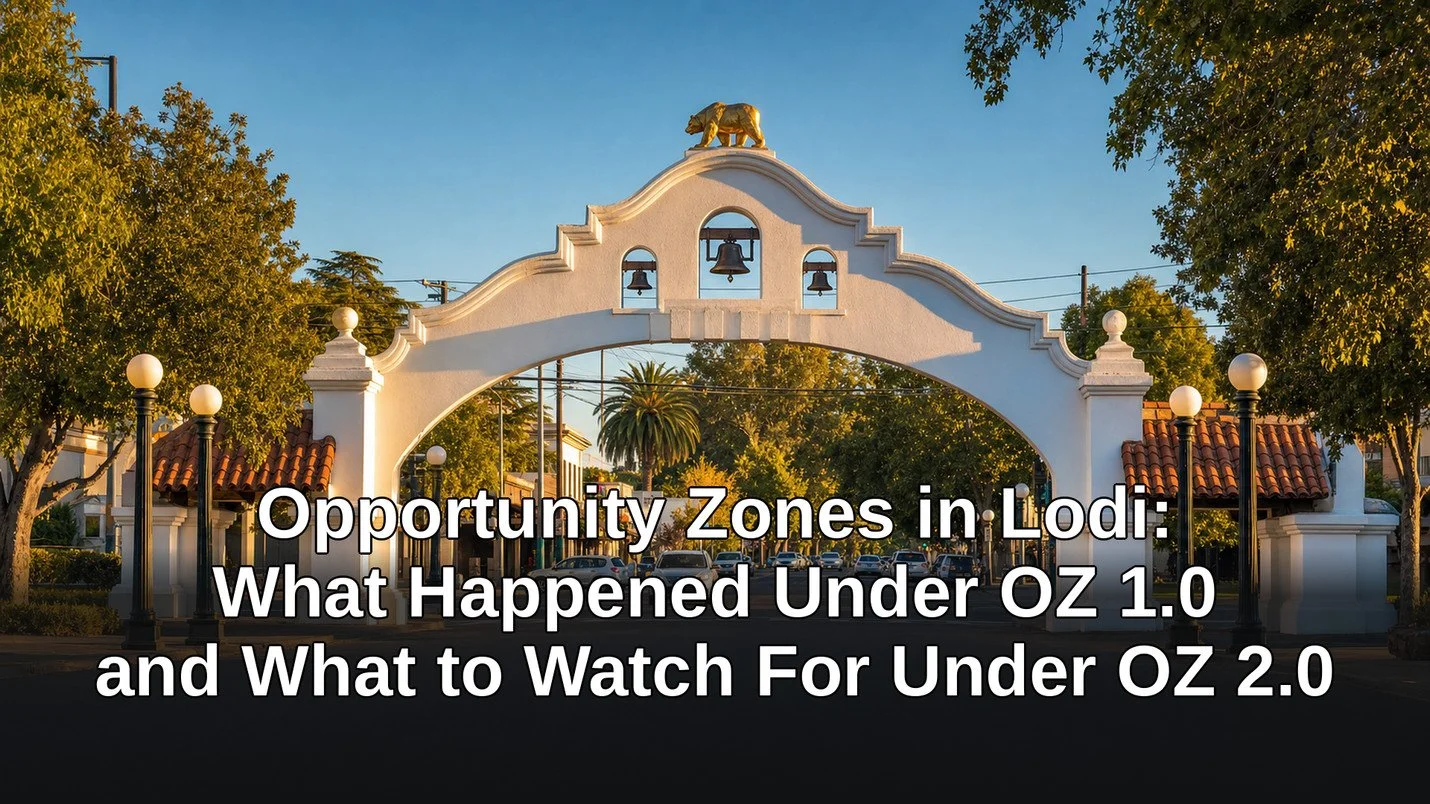
Back in 2018, the federal government designated downtown Lodi (Census Tract 44.03) as an Opportunity Zone — a federal tax break meant to pull private investment into low-income neighborhoods. Eight years later, no documented investment ever arrived. No fund, no project, no dollar. That outcome, detailed in the body of this report, is the direct reason the City shifted its OZ 2.0 nomination to South Lodi (Census Tract 45.02).
Now there is a new round — Opportunity Zones 2.0 — with a redesigned program and a July 25, 2026 application deadline. Whether it brings actual investment to South Lodi depends on a set of concrete steps that residents should know about and watch for.
Lodi City Council Agenda - July 15, 2026
The July 15, 2026 Lodi City Council meeting opens with a lengthy closed session covering the City Attorney and City Clerk recruitments plus two active lawsuits filed by former City Manager Scott R. Carney — a whistleblower/wrongful termination action and a companion Public Records Act suit. The open session moves through a Junior Giants proclamation, a certificate of appreciation for outgoing City Clerk Olivia Nashed, and a consent calendar dominated by two substantial items: TANC Project Agreement No. 3 Amendment No. 1, which zeroes out Lodi's scheduling rights on the California-Oregon Transmission Project, and a three-year $694,600 professional services agreement with West Yost & Associates for wastewater regulatory compliance at White Slough. No public hearings are scheduled.
The regular calendar features an informational presentation on Opportunity Zones 2.0 and a staff recommendation to nominate Census Tract 45.02 in place of the underperforming Tract 44.03, an ad hoc committee to advise on a Government Relations RFP, and appointment of Walfred Solorzano as Interim City Clerk at $70.41/hour. The meeting closes with the second reading and adoption of Ordinance No. 2048, which replaces Lodi's 2022 mobile food-vending framework with an operator-permit model but keeps the controversial food-truck caps.
Lodi Improvement Committee - July 14, 2026
The July 14, 2026 Lodi Improvement Committee (LIC) agenda centers on approving May's minutes, planning a City Council presentation, reviewing Community Development Block Grant (CDBG) funding activity, and updating 2026 annual goals. The Committee's mandate is to support CDBG implementation and improve Lodi's community quality of life through coordinated resident-facing efforts. Public participation is welcome in person at Carnegie Forum, via Zoom, or by written comment submitted at least three hours before the meeting.
Lodi Committee on Homelessness - July 9, 2026
The July 9, 2026 LCOH meeting reviews June 2026 activity from six service providers and six subcommittees, features a special election for a vacant Vice Chair and COC Subcommittee Chair position, and includes a tour of the Reimagined Housing project on Main Street. Combined, reporting service providers logged well over 8,000 meals, showers, and shelter nights, along with dozens of employment placements and housing transitions across the community's homeless service network.

The Fragile Truce: US-Iran Ceasefire, the Strait of Hormuz, and What It Means for Fuel Prices
On July 8, 2026, President Trump told reporters at a NATO summit that the ceasefire with Iran is “over,” hours after the two countries traded strikes across the Persian Gulf. He also said American negotiators could keep talking. That contradiction — a truce declared dead while its talks stay alive — captures where this conflict stands three weeks after both sides signed a memorandum of understanding to end it.
This report lays out the current state of the agreement, the offensive actions each side has taken over the past 30 days, the escalations each is most likely to reach for next, and what all of it means for oil prices and fuel supply — including a data section tracking how many ships are actually moving through the Strait of Hormuz, measured against the January 2025 baseline. The local stakes for San Joaquin County run through diesel: the fuel that moves the county’s farm equipment, its warehouses, and the trucks on Highway 99.

The Fertilizer Emergency: What Trump's Phosphate Declaration Means for U.S. Crops
On June 29, 2026, Trump declared a national emergency over U.S. fertilizer supplies and suspended countervailing duties on Moroccan phosphate fertilizer for up to eight months.
The move follows five months of disruption. The February 2026 Iran war closed the Strait of Hormuz, which normally carries about a third of the world's traded fertilizer and half its sulfur.
USDA projects the suspension will cut phosphate prices 22% and save farmers $1.82 billion a year. Independent analysts and the domestic producer, Mosaic, dispute how fast that relief actually shows up.
San Joaquin County is not a Midwest row-crop county. Milk, almonds, and grapes are its top commodities, not corn and soybeans, so the direct financial effect here is different, and mostly indirect.

AI in Policing: What's Already Here, What's Coming Next
Artificial intelligence already reads license plates, drafts police reports, extracts and analyzes seized phones, mines social media, and flags people as future suspects in California departments, including in San Joaquin County. This report organizes the technology into four categories: surveillance and identification, predictive and risk analysis, records and evidence processing, and the real-time crime centers now fusing all three into a single dashboard.
Surveillance tools like license-plate readers and social-media mining platforms are the most mature and the most widely deployed today.
Predictive and risk-scoring tools are moving from pilots into active use, despite a documented history of flawed data driving them.
AI report-writing tools now draft first-version reports from body-camera audio in minutes, with officers reviewing before signing.
Real-time crime centers are quietly combining all of the above into single dashboards, a convergence point civil liberties groups now consider the biggest emerging risk.
Lodi Police already operate license-plate cameras, a multi-drone program dating to 2018, and a Flock Safety gunshot-detection system; a dedicated section covers what is in use locally and where the department has signaled it is headed.
The Paradox of Plenty: U.S. Dairy and San Joaquin County
The country is making more milk than at any time since the 1990s, and Americans eat more dairy than ever. Yet many of the farms that produce it — especially in California's San Joaquin Valley, just south of Lodi — say this is one of the hardest stretches they can remember. Here is what is driving that gap and what it means for shoppers.
Booming output: U.S. milk production is climbing toward 234 billion pounds in 2026, on the largest cow herd since the 1990s.
Shrinking profits: Most dairies expect a tough year, naming labor and money as their two biggest worries.
California's heavy load: The No. 1 dairy state also carries the toughest rules on water, air, and animal welfare in the country.
New risks: Pricier fuel and feed, plus a flesh-eating parasite — now 25 confirmed U.S. cases, all in Texas livestock — add fresh strain.
For shoppers: Plenty of milk on the shelf today, but butter and cheese prices face upward pressure ahead.

Artificial Intelligence: What It Offers, What It Costs, and How to Respond
Artificial intelligence has become a strategic asset, as important to national power as past leaps in weapons and aviation. It affects military strength, intelligence, and the economy. China and Russia are pouring money into it and racing to put it to use. Washington now treats falling behind as a national-security risk in its own right. That makes staying ahead a real priority, not a talking point.
The costs, though, are just as real, and they land close to home. The benefits of this technology are measurable and growing. So are the burdens: higher electricity bills, heavy water use, and pressure on jobs. Those burdens fall hardest on the towns that host the buildings. Public worry has run ahead of the harm measured so far, but it senses correctly where things are going. That worry deserves a real answer, not a brush-off.
Here is the challenge this report takes up: how can the United States stay ahead in military and technical strength while shaping its AI spending at home to address honest concerns about the environment, the economy, and jobs?
A Rabid Bat in Lodi: How Real Is the Risk in San Joaquin County?
In June 2026, a bat found in a Lodi neighborhood tested positive for rabies — the city's first confirmed case since 2023 and the third in San Joaquin County this year. This report sets that single incident against the longer record: how often rabies turns up locally, why this year's count looks higher than last year's, what the numbers can and cannot tell us about whether rabies is increasing, and how public agencies find and track the disease across wildlife, pets, and people. The short version is that a rabid bat in Lodi is uncommon but not alarming, the apparent rise is real on paper but partly a product of how cases are counted, and the risk to the public remains low.

The AI Race: Who Leads, Who Follows, and Whether Anyone Controls It
The 2024–2026 period produced more concentrated AI advancement than any prior three-year window in computing history. The United States still leads on frontier model performance, raw compute, and private investment. China closed the model performance gap to under 3% by early 2026 and now manufactures roughly 85% of the world’s humanoid robots. The European Union built the world’s first comprehensive AI law. Singapore and the UAE now lead the planet in workforce AI adoption. And no binding global governance framework exists to manage any of it. This report maps the timeline of breakthroughs, scores five nation-state competitors across eight dimensions, and ranks the top companies in large language models, AI chips, and robotics.
The Beef Crunch: California, San Joaquin County & the Global Cattle Squeeze
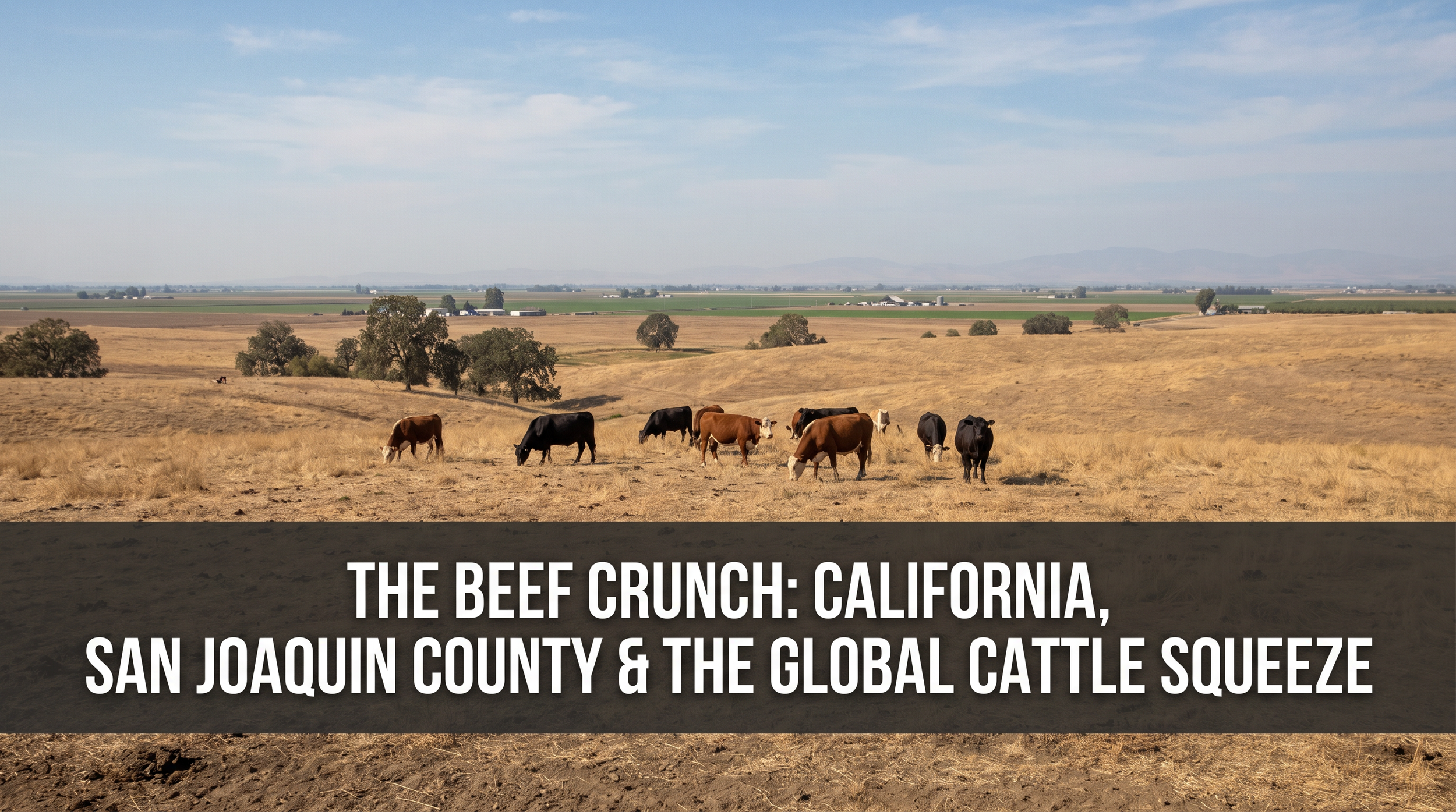
The U.S. cattle herd is at a 75-year low. Retail beef hit record prices in May 2026. New World Screwworm arrived on U.S. soil for the first time since the 1960s. Mexico has kept its border closed to U.S. live cattle imports for over a year. A historic drought is forcing Central Valley ranchers to liquidate breeding females at the worst moment in the price cycle. This report ties together what all of it means for San Joaquin County producers, California agriculture, the national supply chain, and the import market now filling the gap.
What the 2025–2026 Civil Grand Jury Report Means for Lodi
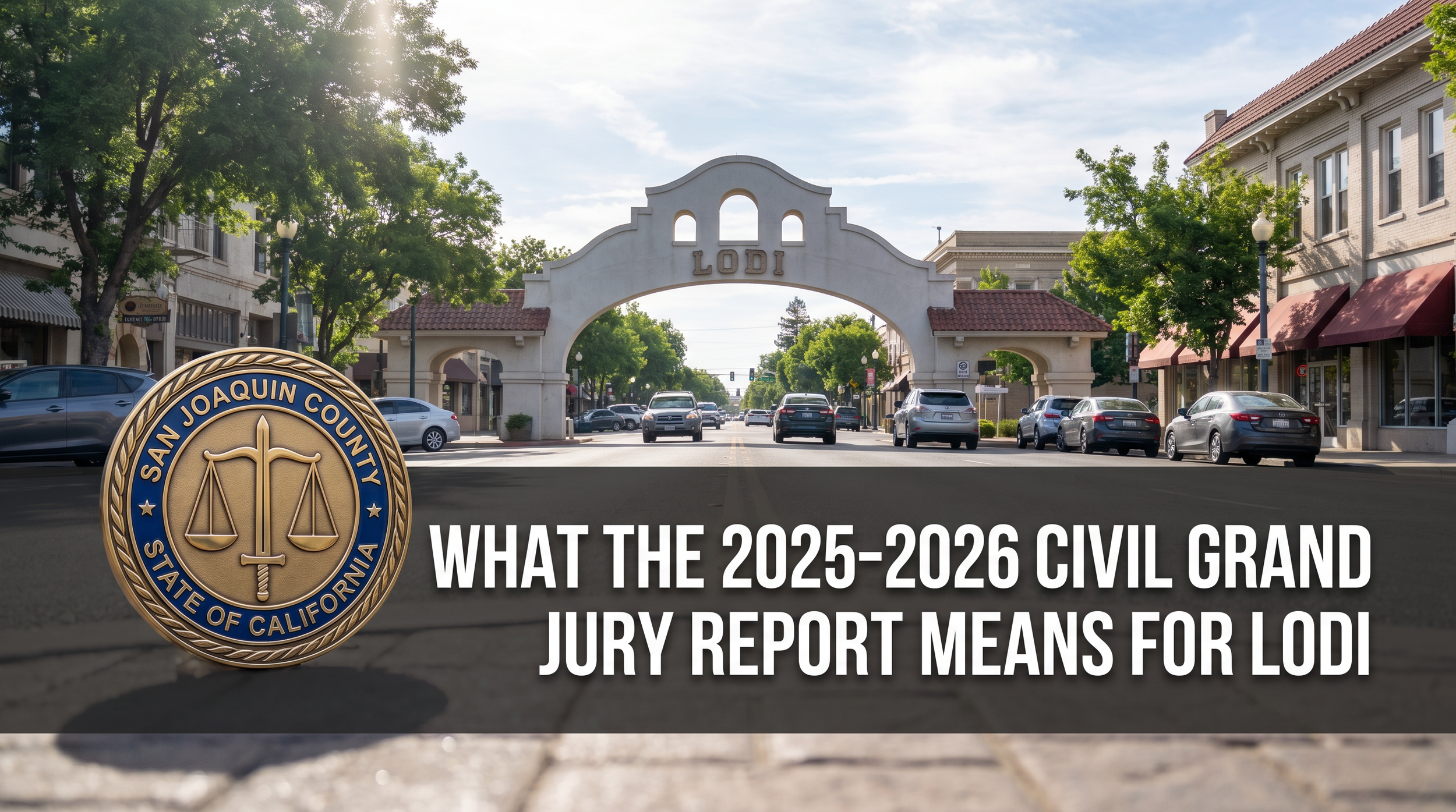
Every year, a panel of volunteer residents — the San Joaquin County Civil Grand Jury — looks into how local governments and public agencies are run and reports what it finds. This is a civil watchdog body, not the kind of grand jury that hears criminal cases. Its 2025–2026 Final Report came out in late June. This year the jury did something new: alongside its usual job of holding government to account, it added an “Impact and Innovation” section that points out what local government is doing well.
The report has five parts. Two are formal investigations — one into the City of Stockton’s government, one into the San Joaquin Local Agency Formation Commission (SJLAFCo). The rest are a check on whether agencies acted on last year’s recommendations, a Law and Justice section built from site visits and ride-alongs, and the new Impact and Innovation section covering homelessness and a rebuilt 9-1-1 ambulance system.
Two parts matter most for Lodi: the oversight of SJLAFCo, the body that decides how and where the city can grow, and the cautionary tale of a fire district that nearly slipped through the cracks. Here are the headline findings.
Lodi City Council Agenda - July 1, 2026
The July 1, 2026 regular meeting is a light public-facing agenda built on a heavy financial foundation. There are no scheduled presentations and the closed session covers a single item: recruitment of a permanent City Clerk. The consent calendar carries the most consequential dollars — two write-off authorizations totaling roughly $3.32 million in uncollectible utility and general-billing accounts (items C.5 and C.6), alongside a no-bid power-cable purchase, a renewed Stockton fire-dispatch contract, and an environmental-remediation reimbursement tied to the downtown Central Plume.
The lone public hearing (F.1) introduces a new mobile food vending ordinance with population-based permit caps and buffer zones. The regular calendar is dominated by labor and finance housekeeping: a rewritten purchasing policy (G.1), a sweep of CalPERS cost-share reductions across bargaining units (G.2–G.6), AFSCME salary-schedule corrections (G.7–G.8), and adoption of an SB 707 meeting-disruption policy due by July 1, 2026 (G.9).
This summary covers every item across the closed session, consent calendar, public hearing, and regular calendar. It includes a dedicated section on the City Clerk transition (and the background of long-serving Clerk Olivia Nashed), an expanded item-by-item consent calendar table, and concludes with a detailed addendum analyzing exactly which departments, revenue streams, and years are driving the $3.32M write-off.