Lodi Eye
LodiEye provides additional information on trending stories / topics published by local media and shared on local social media accounts.
Lodi City Council Agenda — May 6, 2026
The May 6 meeting is a heavyweight transition night for Lodi. After more than a year of acting and interim leadership, the Council is being asked to install three permanent executives in one sitting: Kara Reddig as City Manager ($285,000 base, 3-year term, effective June 22), Jamie Bandy as Director of Administrative Services ($315,000 fully-burdened, effective May 12), and Bandy as City Treasurer. A fourth personnel item brings retired Vacaville economic development director Donald Burrus back to public service as a part-time annuitant under PEPRA's 180-day exception.
Beyond people, the agenda also delivers a first-of-its-kind revenue-share billboard partnership with Rogers Media (greater of $25,000 a year or 25% of net ad revenue), a same-week deadline question about acquiring the State-owned Lodi Armory, a placeholder asking whether the City should formally prevent data centers in Lodi, and the first of three FY 26/27 budget study sessions revealing a structural gap that has forced 37 deferred General Fund positions, a $1.5M cut to fire vehicle replacement, and $2.8M in department-wide reductions. The 22-item Consent Calendar is unusually heavy with end-of-fiscal-year contract resets totaling roughly $15 million.
Jamie Bandy Returns to City Hall as Director of Administrative Services and City Treasurer
The Lodi City Council’s May 6, 2026 agenda includes the appointment of Jamie Bandy as the city’s next Director of Administrative Services, with an effective start date of May 12, 2026 and a fully-burdened compensation package valued at approximately $315,000 per year. The same agenda action designates Bandy as the city’s City Treasurer, the statutory officer responsible for the custody and investment of public funds. The appointment closes a high-profile vacancy that has shadowed the city since the 2025 forensic-audit fallout, returns a Lodi-rooted public-finance professional to City Hall after roughly seventeen years away, and pulls together Finance, Human Resources, and Information Technology under a single executive who has run each of those functions in different forms during her career.
Six Candidates, Three Hometown Names: A Lodi Guide to the 9th Assembly District Primary
The 9th Assembly District spans five counties — from the Elk Grove suburbs through Stockton, Lodi, Manteca, Ripon, and Modesto, into the Amador and Calaveras foothills — but its political center of gravity sits in Lodi. Three of the six candidates on the June 2 primary ballot live in our immediate area: Tami Nobriga in Lodi, Jim Shoemaker in Clements, and Matthew Adams in Woodbridge. Incumbent Heath Flora's official residence is in Ripon, with Brandon Owen of Galt and Michael Perez of Waterford rounding out the largest AD-9 field since Flora first won the seat in 2016.
Lodi Taps Elk Grove's Kara Reddig as New City Manager
After more than a year of acting appointments, interim placeholders, and legal bills approaching seven figures, the City of Lodi has hired Kara Reddig, Deputy City Manager of Elk Grove, as its next City Manager. A seasoned municipal executive with more than two decades of local-government leadership, Reddig arrives to stabilize an office that has cycled through four different managers since April 2025 — and to reset a City Hall still working through the fallout of the Scott Carney removal, an estimated $600,000 in legal costs, and two independent reviews of the city's internal controls.
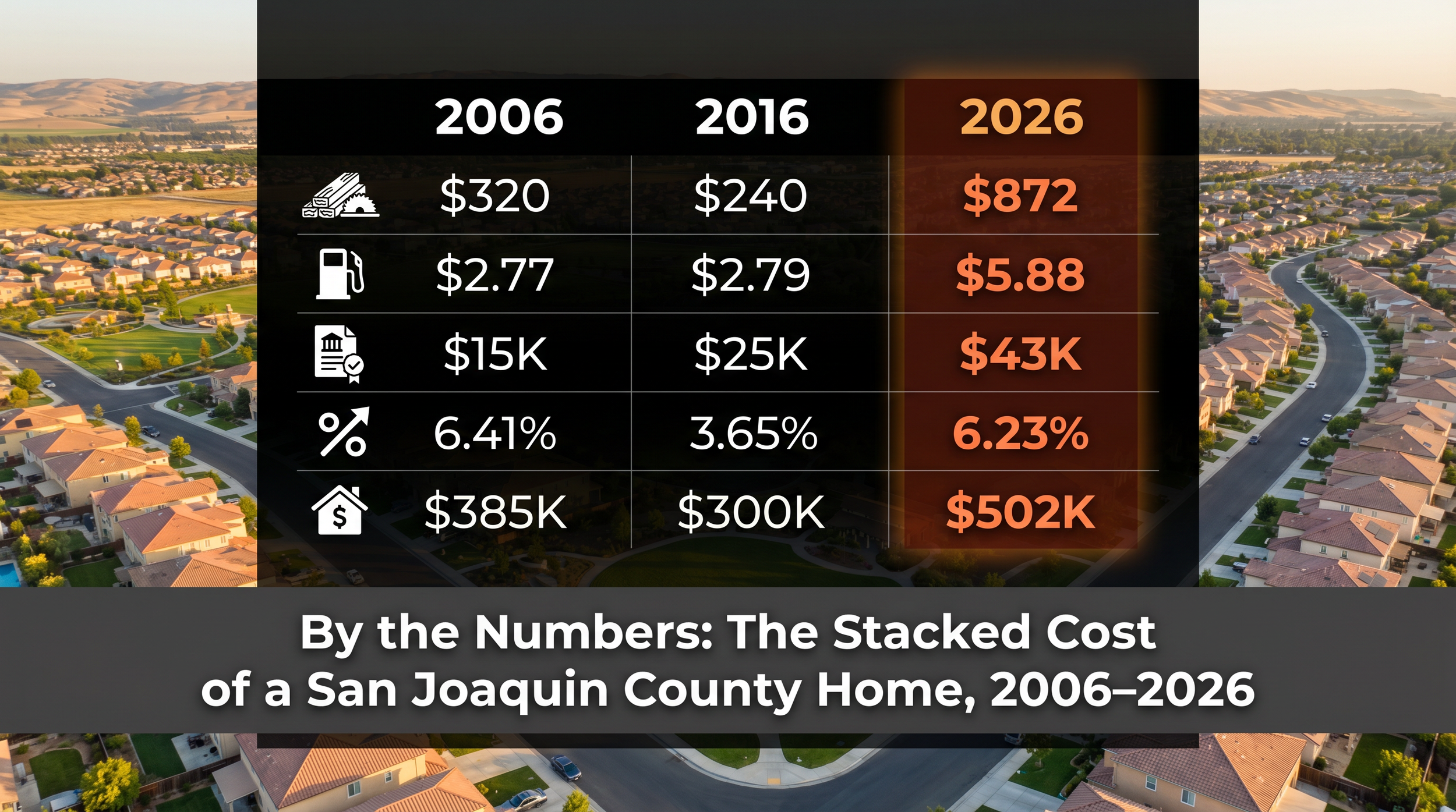
By the Numbers: The Stacked Cost of a San Joaquin County Home, 2006 to 2026
California's housing affordability crisis is usually told as a single story: not enough homes. The data across three reference years — 2006, 2016, and 2026 — shows it is actually six stories layered on top of each other. Mortgage rates have round-tripped to 2006 levels but now create a lock-in effect for the 77% of California homeowners holding sub-5% mortgages. Framing lumber has tripled. California gasoline has more than doubled. Tariffs on building materials, a non-issue in either earlier reference year, now add an estimated $17,500 to a typical new home. Construction labor has contracted under enforcement pressure. Lodi government fees on a typical home now exceed $43,000. And insurance premiums have roughly doubled since 2016, with FAIR Plan enrollment statewide up 445% since 2006.
The compounding is the story. Solving any single headwind helps. Solving none of them — letting the stack compound for another five years — risks a structural housing market that no longer functions for working Valley families.

A Lodi Vintner's Last Hunt: Ernie Dosio, the Elephants of Gabon, and the Quiet Economics of Conservation
On April 17, 2026, 75-year-old Lodi vineyard owner Ernie Dosio was trampled to death by a herd of five forest elephants in Gabon's Lopé-Okanda rainforest while on a $40,000 guided safari. His death — covered by wire services from London to New York — offers Lodi readers a rare window into how sportsmen like Dosio quietly underwrite wetland, refuge, and big-game habitat work in California and around the world. This LodiEye report merges the accident, the man, his business and conservation contributions, and a broader comparison of hunter versus non-hunter dollars that sustain modern wildlife conservation.

Spirit Airlines Bailout: What It Means for California Travelers, Taxpayers, and the Future of US Aviation
President Donald Trump is weighing a taxpayer-funded rescue of bankrupt Spirit Airlines worth up to $500 million, structured as warrants potentially giving the federal government up to 90% ownership. The proposal has drawn bipartisan criticism, pushback from Transportation Secretary Sean Duffy, and comparisons to Trump's own failed Trump Shuttle venture of 1989–1992. For Northern California travelers, Spirit already exited Sacramento, Oakland, San Jose, and San Diego in October 2025. This report examines the bailout plan, historical airline-rescue precedents, alternative uses for $500 million, worker absorption by rival carriers, and the fare impact on US travelers.
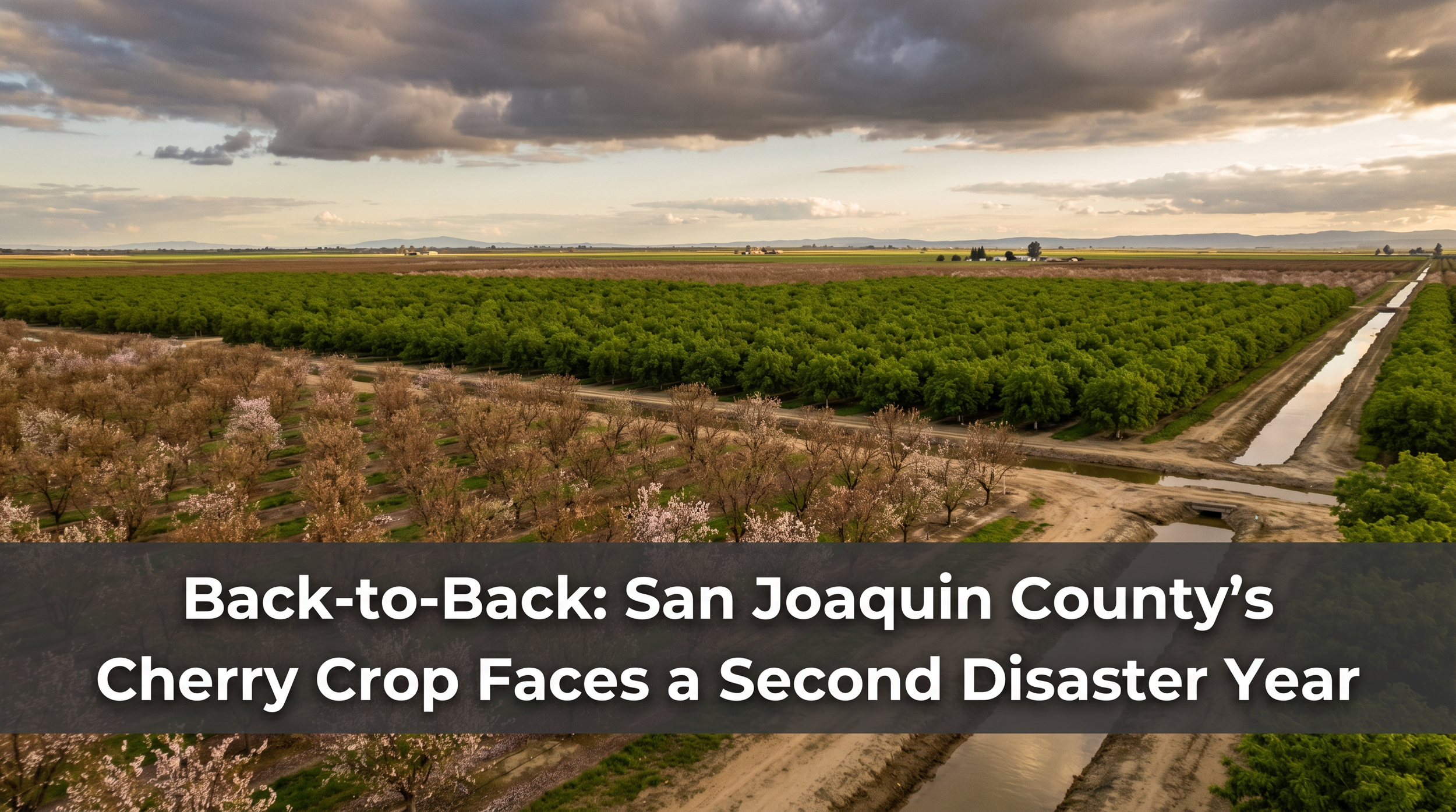
Back-to-Back: San Joaquin County's Cherry Crop Faces a Second Disaster Year
The rain that flooded Lodi strawberry stands in April 2026 is the local-color image of a larger economic story playing out in San Joaquin County's orchards and vineyards. Cherries — the county's fourth most valuable crop and roughly half of California's cherry production — face the possibility of a second consecutive disaster-declaration year after a damaging storm hit during the most vulnerable ripening window.
The structural headline is not the April rain itself. It is what two disaster years in a row would do to a crop economy that has already been trending downward in value since 2022. A quieter walnut subplot and a multi-year Lodi wine-industry pressure round out the real county-level picture.

Lodi's Fuel Tax Is Shrinking. Can EVs Replace It?
Three new fuel retail projects are moving through approvals in the Lodi region. One — the Maverik station being annexed at Kettleman Lane and Beckman Road — will pay into Lodi's General Fund. Two — the Dhanda project at Highway 99 and Liberty Road in unincorporated Collierville, and the Lockeford ExtraMile at Highway 12 and Highway 88 — will not. Near-term, the Maverik adds roughly $280,000 annually to Lodi's books; the two unincorporated projects migrate approximately $340,000 annually from Lodi's tax base to San Joaquin County's as Lodi residents and pass-through traffic fuel up outside the city limits.
But the larger story is structural. California's Advanced Clean Cars II rule phases out new gasoline vehicle sales by 2035; Lodi's own EV Master Plan projects the city's zero-emission fleet will grow from 1,221 vehicles at the end of 2023 to more than 24,000 by 2035. Sustained California retail gasoline prices at $5.88 per gallon and rising accelerate the transition further. Meanwhile, Lodi Electric Utility's existing 10 percent payment-in-lieu-of-taxes transfer — approximately $7 million annually to the General Fund — provides a partial offsetting mechanism that is not widely understood, and whose optimization has not been publicly discussed. This analysis examines the near-term fiscal picture, the structural decline, and the replacement revenue and EV-monetization strategies Lodi can learn from peer California municipal utilities.
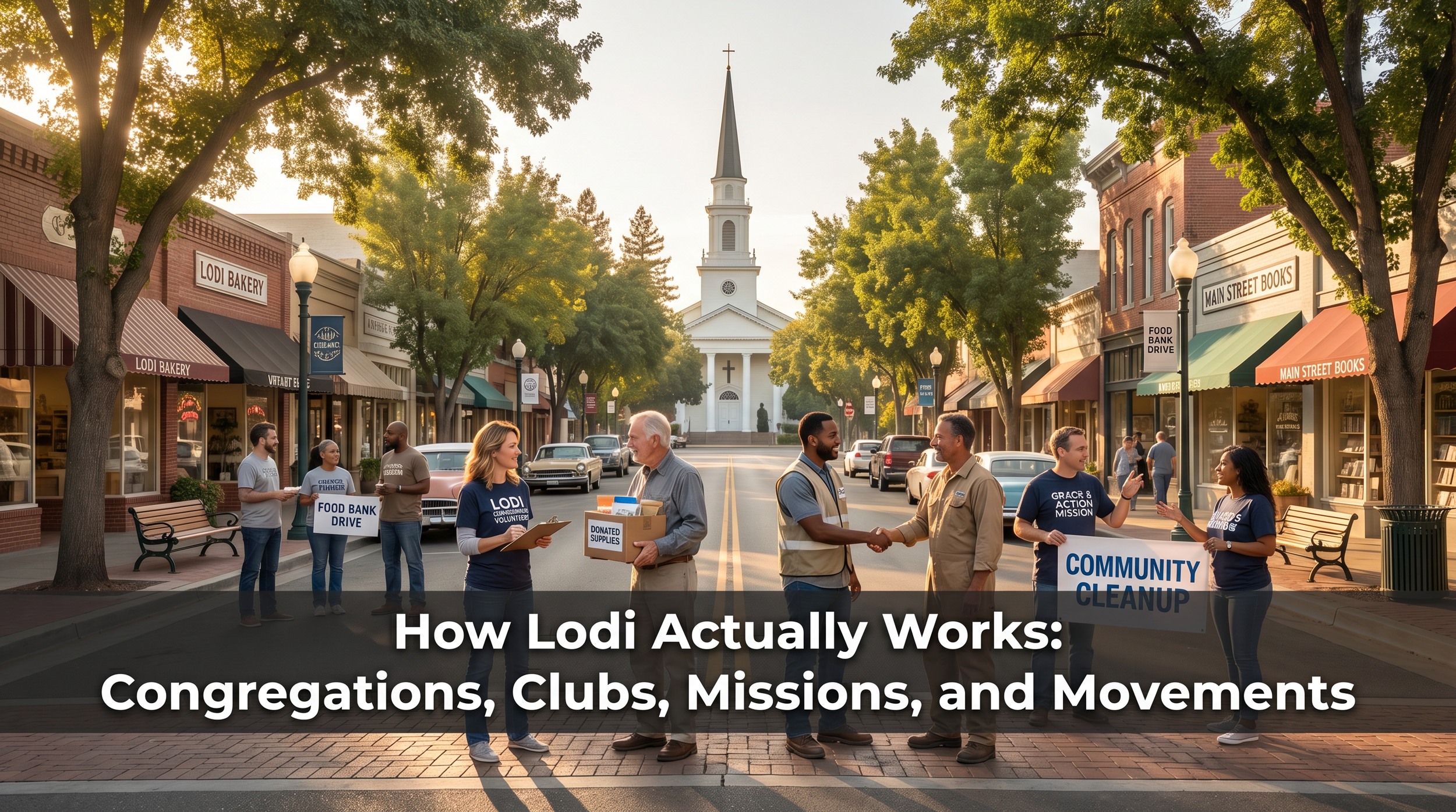
How Lodi Actually Works: Congregations, Clubs, Missions, and Movements
Lodi has roughly 334 registered nonprofits operating across every cause area that shapes daily life in the city. Faith & Religious Organizations form the single largest sector by count at 76 organizations (23%), followed by Youth, Sports & Recreation at 59 (18%) and Housing & Social Services at 41 (12%).
Applying the Lodi411 taxonomy of three civic-life types — Fraternal, Mission, and Civic Movement — and splitting each by religious vs. secular status reveals the structural reason Lodi punches above its civic weight: two organizations, Love Lodi and The Salvation Army Lodi Corps, function as super-connectors between faith, secular, and municipal actors. Several other issue areas — arts, environment, recovery, heritage — remain promising areas for stronger coordination and future partnership.

Strongest El Niño in 140 Years
A rare triple-cyclone cluster near the equator in early April triggered what atmospheric scientists are calling possibly the most powerful westerly wind burst in the equatorial Pacific in a century. The April seasonal forecast from the European Centre for Medium-Range Weather Forecasts (ECMWF) shows near-universal model agreement that El Niño conditions will arrive by mid-to-late summer. A subset of models — about half of the ECMWF ensemble — projects sea-surface-temperature anomalies above 2.5°C by October.
For San Joaquin County and Lodi, the picture is further complicated by this year’s unusual water-year volatility, a record-breaking marine heatwave off the California coast, and a Sierra snowpack currently tied with 2015 for the lowest on record to date. History shows that a strong El Niño label does not guarantee a wet winter here — but when conditions align, the Mokelumne and San Joaquin river systems, the Delta levees, and Lodi’s vineyards absorb the consequences together.

The Three Types of Small-Town Civic Life
American small-town civic life runs on three distinct organizational forms. The fraternal type — Lions, Rotary, Kiwanis, Elks, American Legion — is in national decline, with membership losses of 25 to 70 percent since its mid-1960s peak. The mission type — cause-centered organizations working on specific local issues — can produce sustained decade-scale work on issues that the other two types cannot. The civic movement type — Love Lodi and its peers across the country — mobilizes volunteer participation at a scale the other two cannot reach.
Each type produces distinct civic goods. None of them can replace the others. And the two newer types only realize their full value to a community when they have the digital infrastructure — active social media presence and mailing lists — to cross-pollinate each other. A community that builds all three types, and connects the two newer ones through shared volunteer and follower flow, punches above its civic weight. Lodi, more or less by accident, is one such community.

Who’s Really Leaving California
California has now posted six consecutive years as the nation’s largest net loser of residents to other states, but the pandemic-era exodus is easing, high-income households are returning in rising numbers, and San Joaquin County is quietly doing the opposite of the coastal metros — gaining domestic migrants and net adjusted gross income at a time when the state as a whole is shedding both. The newest IRS Statistics of Income (SOI) migration file, released in 2026 and covering tax year 2023, combined with the July 2025 Census and California Department of Finance estimates, tells a more nuanced story than the “California exodus” headlines suggest.

Lodi's Food Truck Cap Hits the End of the Road
With 10 vendors stuck on a years-long waitlist and neighboring San Joaquin County cities operating cap-free, Lodi's City Council is moving to scrap its 25-truck limit. The debate over where, when, and how trucks can roll is just beginning — and the lessons from Stockton, Manteca, Lathrop, Tracy, and Galt point to a clear blueprint.

The Neo-Primes: Iran's Drones, Washington's Politics, and the Rewiring of American Defense
A cohort of Silicon Valley defense firms the trade press now calls "neo-primes" — Palantir, SpaceX, and Anduril — is displacing the Lockheed-RTX-Northrop Grumman triad from a growing share of Pentagon procurement. Two forces are driving the shift: the brutal cost asymmetry exposed by the Iran war, and an unusually tight political alignment between the Trump administration and the companies themselves.
Two risks sit alongside the opportunity — a potential bipartisan backlash if the alignment starts to look partisan, and the possibility that the Pentagon ends up just as locked into three new vendors as it was into the old ones.

The Retiree Math
Federal, state, county, and city pension systems face the same demographic pressures documented in LodiEye's companion analysis of Social Security and Medicare: an aging population, fertility below replacement since the early 1970s, and an immigration slowdown that reduces the working-age base every pension system assumes it will have. Unlike the federal trust funds, however, public pensions are prefunded in advance against dedicated investment portfolios — which means their near-term pressure shows up as rising required employer contributions rather than insolvency dates.
At the federal level, the Civil Service Retirement and Disability Fund carries a combined unfunded liability near $1 trillion that is projected to gradually decline through FY 2085. At the state level, CalPERS recovered to a 79 percent funded ratio after an 11.6 percent investment return in FY 2024–25, while CalSTRS reached 76.7 percent with the Defined Benefit Program on track for full funding by 2046. In San Joaquin County, SJCERA manages roughly $3 billion to $5 billion in assets across the county and nine other participating employers. In Lodi, CalPERS employer contributions are projected to rise from $20.9 million in FY 2025–26 to $24.6 million by FY 2031–32 — a 17.7 percent increase against a general fund already carrying a projected $4.8 million structural deficit over the next five years.

The Paying-In Generation
The United States now runs three demographic and fiscal clocks simultaneously: an aging population entering retirement at the fastest rate in the nation's history; a working-age population that has depended almost entirely on immigration for growth since 2019; and a federal debt service bill that is the fastest-growing line item in the budget and projected to more than double by 2036.
Current administration policies have contracted the second lever while enlarging the third — a combination that nonpartisan fiscal forecasters, including the Social Security Administration's own actuaries, project will accelerate the depletion of the Social Security and Medicare trust funds. This report documents what the underlying data shows, using primary sources from the Congressional Budget Office, the Social Security trustees, the Federal Reserve research banks, Penn Wharton, the Peterson Institute, the Committee for a Responsible Federal Budget, and ideologically varied policy research institutions.
The New Shape of Gang Activity in San Joaquin County
For three decades, organized crime in San Joaquin County could be explained through one rivalry: Norteños versus Sureños. That framework is no longer sufficient. In 2026, at least five distinct gang ecosystems operate across the county — the legacy Hispanic street gangs, African American sets concentrated in west Stockton, Southeast Asian gangs forged during the refugee era, a newly visible transnational Punjabi-diaspora extortion network directed from Indian prisons, and outlaw motorcycle clubs using the Highway 99 corridor. Lodi, long treated as a safer northern neighbor to Stockton, sits at the intersection of all five. This LodiEye report maps who operates where, documents the recent federal and state cases, and highlights what it means for Lodi residents specifically.

The Canyon Tunnel, a Worker's Death, and San Joaquin County's Water Future
A 35-year-old engineer was killed inside an $84 million bypass tunnel being dug beneath the Stanislaus River canyon this week. The project she was working on — a joint effort of the South San Joaquin Irrigation District and Oakdale Irrigation District — is meant to secure water reliability for three San Joaquin County cities and 50,000 acres of farmland into the next century. Cal/OSHA has opened an inspection. Work is suspended. LodiEye examines what the project is, why the county has tens of millions of dollars riding on it, and what the incident means for the schedule ahead.

The Colorado's Fever Reaches the Delta
The Central Valley doesn't drink a drop of Colorado River water. So why does a standoff over Lake Powell tighten the screws on Delta pumping and squeeze San Joaquin County growers? Because Southern California's biggest water wholesaler treats the two systems as a single checkbook — and when one account runs dry, it draws harder on the other.
Federal intervention: The Trump administration has warned the seven Colorado Basin states to reach a post-2026 deal or face federally imposed rules.
Drastic cuts imminent: The Bureau of Reclamation is preparing emergency actions to protect Lake Powell — holding back releases and tapping upstream reservoirs.