Lodi Eye
LodiEye provides additional information on trending stories / topics published by local media and shared on local social media accounts.
Lodi City Council Agenda - September 2, 2026
This is a housekeeping meeting rather than a policy meeting, and almost all of it is about who gets to decide things at City Hall. Of the ten action items, six either hand new decision-making power to the City Manager or sign off on decisions the City Manager has already made.
Three things make the meeting notable. First, a record minutes backlog: Consent item C.1 asks Council to approve 26 sets of minutes at once, reaching back to March 6, 2024 — and it is the second such batch in seven weeks, following another 26-set catch-up approved July 15, 2026 that reached back to November 2023. The staff report offers no explanation for the delay.
Second, the City Manager's authority continues to expand. Item C.4 would delegate to the City Manager all personnel and administrative matters for the Interim City Clerk — including appointment and termination — two weeks before the ordinance transferring City Clerk appointment authority from Council to the City Manager takes effect on September 18, 2026. Item G.1 asks Council merely to ratify a Public Works Director the City Manager already selected. Item G.2 would let the City Manager award a contract up to $360,000 without returning to Council.
Third, a federal grant report with weak delivery numbers. The public hearing (F.1) is Lodi's yearly report card to the federal government on how it spent its Community Development Block Grant money — the annual federal grant the City uses for neighborhood improvements, housing, and social services. Lodi was guaranteed $655,037 for the year and spent $282,568.19 of it, and it built none of the 54 affordable-housing units it had set as its annual goal.
Council will also meet privately beforehand on five matters, four of them lawsuits — including two separate 2026 suits by former City Manager Scott Carney and one by Christopher Bennitt.
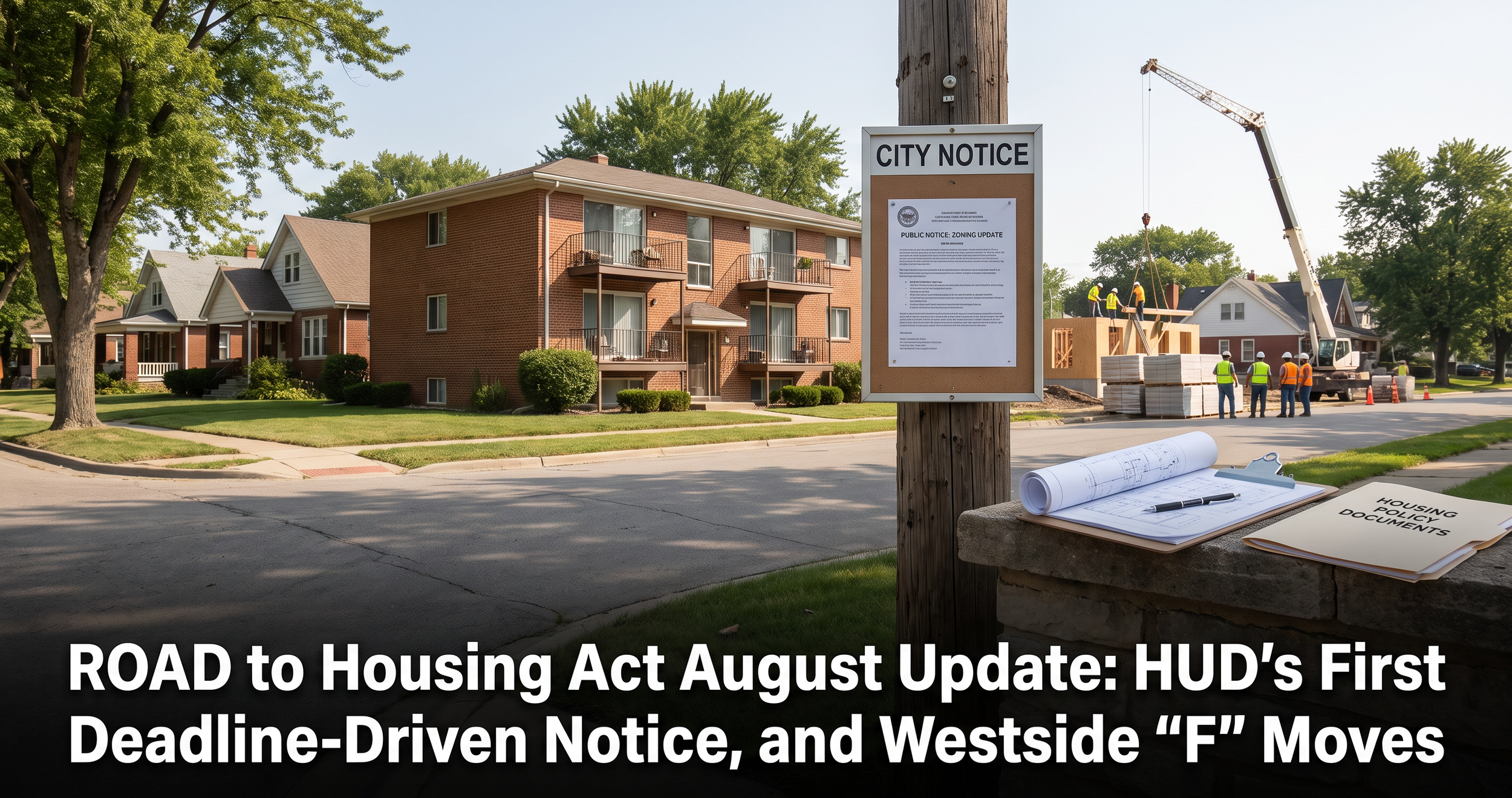
ROAD to Housing Act August Update: HUD's First Deadline-Driven Notice, and Westside "F" Moves
As of August 26, 2026, 6.6 weeks after the 21st Century ROAD to Housing Act took effect, two things have moved. HUD published its first deadline-driven notice under the law on August 13 — the CDBG–Disaster Recovery allocation formula, with a comment window that closes September 14. And on August 12, the Lodi Planning Commission voted 5–0 to recommend that the City Council approve the 95.3-acre Westside "F" annexation and direct staff to file it with San Joaquin County LAFCo. That file is still awaiting Council action; it is not yet at LAFCo.
The rest of the picture is more mixed than it looked on enactment day. HUD faces 88 separate implementation actions with staffing about 27 percent below FY2025 levels and an existing rulemaking backlog, and outside analysts expect full implementation to take years. Several provisions that are effective in statute cannot be used until federal guidance lands, and Congress has appropriated no new money for the Act's new programs.
This update carries the provision-by-provision breakdown forward, resolves several open questions from the July version against the enacted statute, and adds a section on the Opportunity Zone redesignation that will change the entire §201 conversation before Treasury certifies new zones in Q4 2026. It updates The 21st Century ROAD to Housing Act: What It Means for Lodi and San Joaquin County, published July 29, 2026.
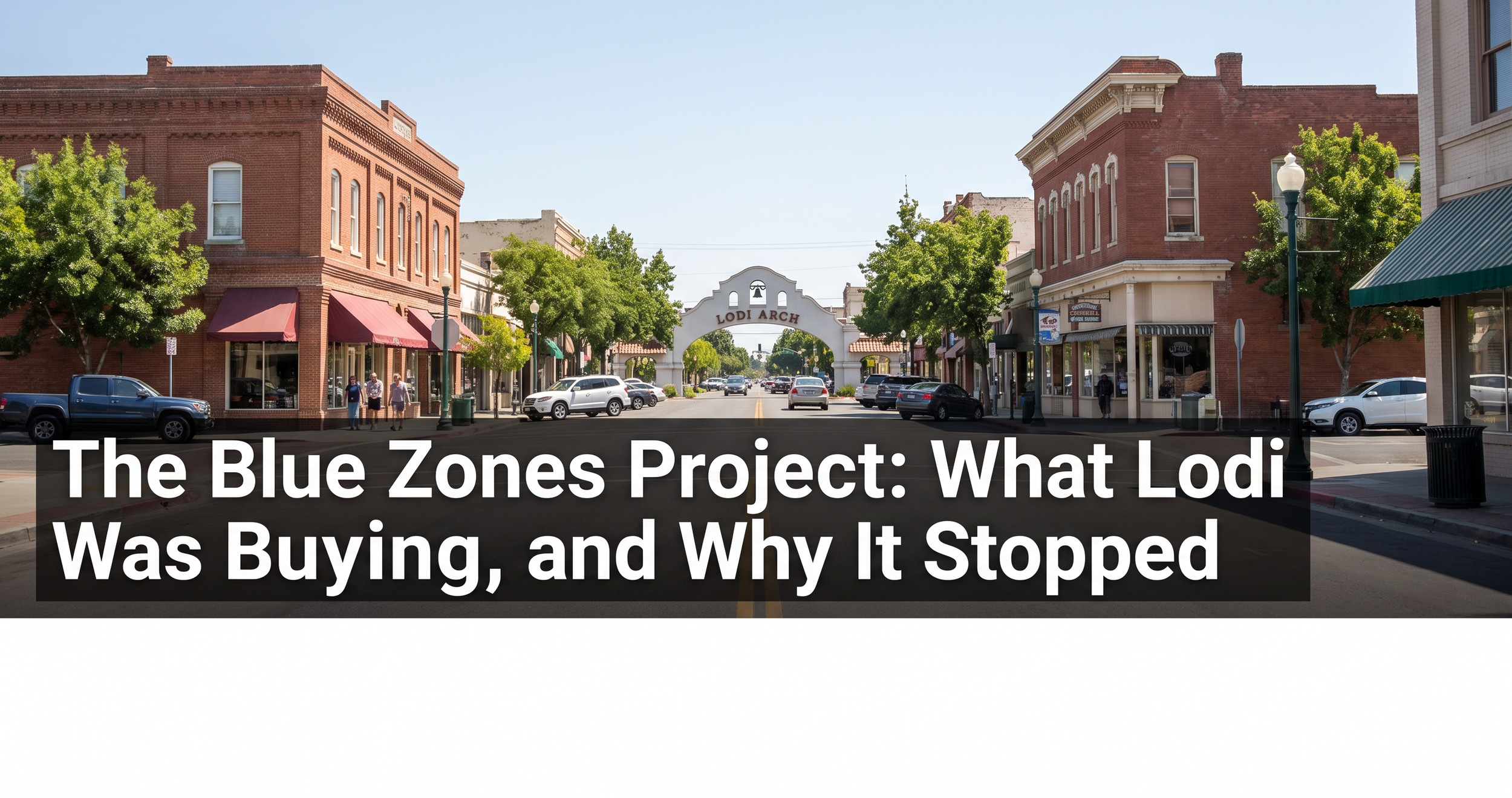
The Blue Zones Project: What Lodi Was Buying, and Why It Stopped
In March 2025, assessors from Blue Zones LLC toured Lodi. It was the field portion of a readiness study San Joaquin County had announced two months earlier. No findings were presented, no report was posted, and the county did not publicly account for the outcome until a spokesperson answered a newspaper columnist seventeen months later.
That explanation — no city sponsorship, no local funding commitment — is accurate. The public record adds four things to it: a $10,000 contract signed at staff level under delegated authority, an order of magnitude below what entry assessments sell for elsewhere; a Lodi City Council that was never asked to vote; a public health plan running a $100 million reinvestment program whose board never took the matter up; and an assessor that was, during the assessment, a wholly owned subsidiary of the corporation that owns Adventist Health Lodi Memorial.
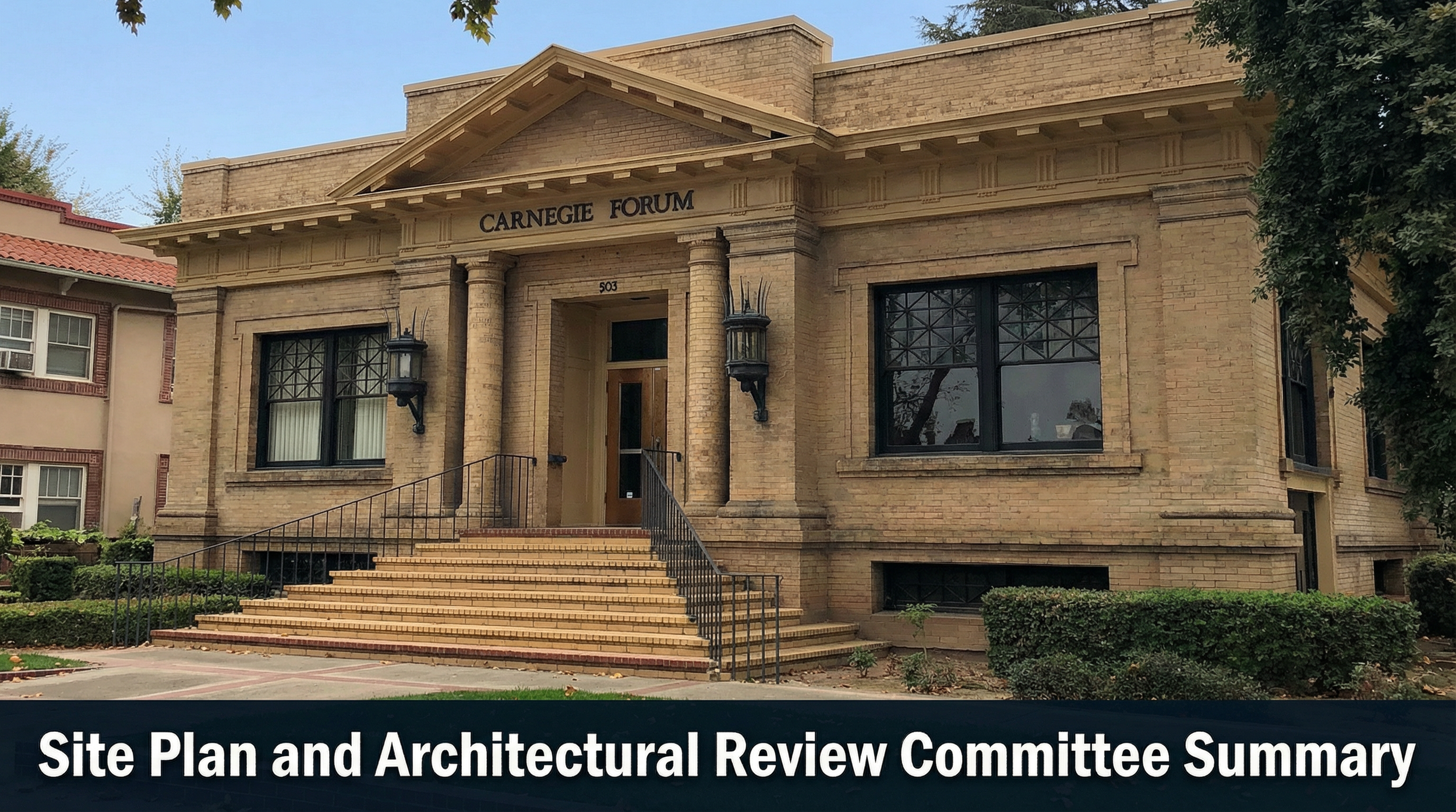
Site Plan and Architectural Review Committee - August 26, 2026
One review item — and it is the design half of the same Rogers Media electronic-sign package the Planning Commission hears at 7:00 p.m. the same night. SPARC meets at 5:15 p.m., decides placement, height, materials, and pole design for three 78 sq ft LED signs on City land, and the Commission's report is written assuming that approval already happened.
The larger story is timing and record quality. The Development Agreement Council adopted June 3 remains unexecuted and is already being reopened by the applicant. Attachment B is still the March 25 draft, with a blank effective date and a body captioned for two signs. The three site plans state three different sign heights while the report says all three are identical. Sign area at 78 sq ft sits inside a 79.2 sq ft administrative ceiling before counting a 12-inch stainless steel skirt. The pole-width deviation is unquantified in the record. Location 3 sits inside multiple future public reservations, and the mounting type is expressly undecided. Two sites front State Route 12 and no Caltrans approval is discussed. And the January 14, 2026 minutes listed for adoption are not in the packet.
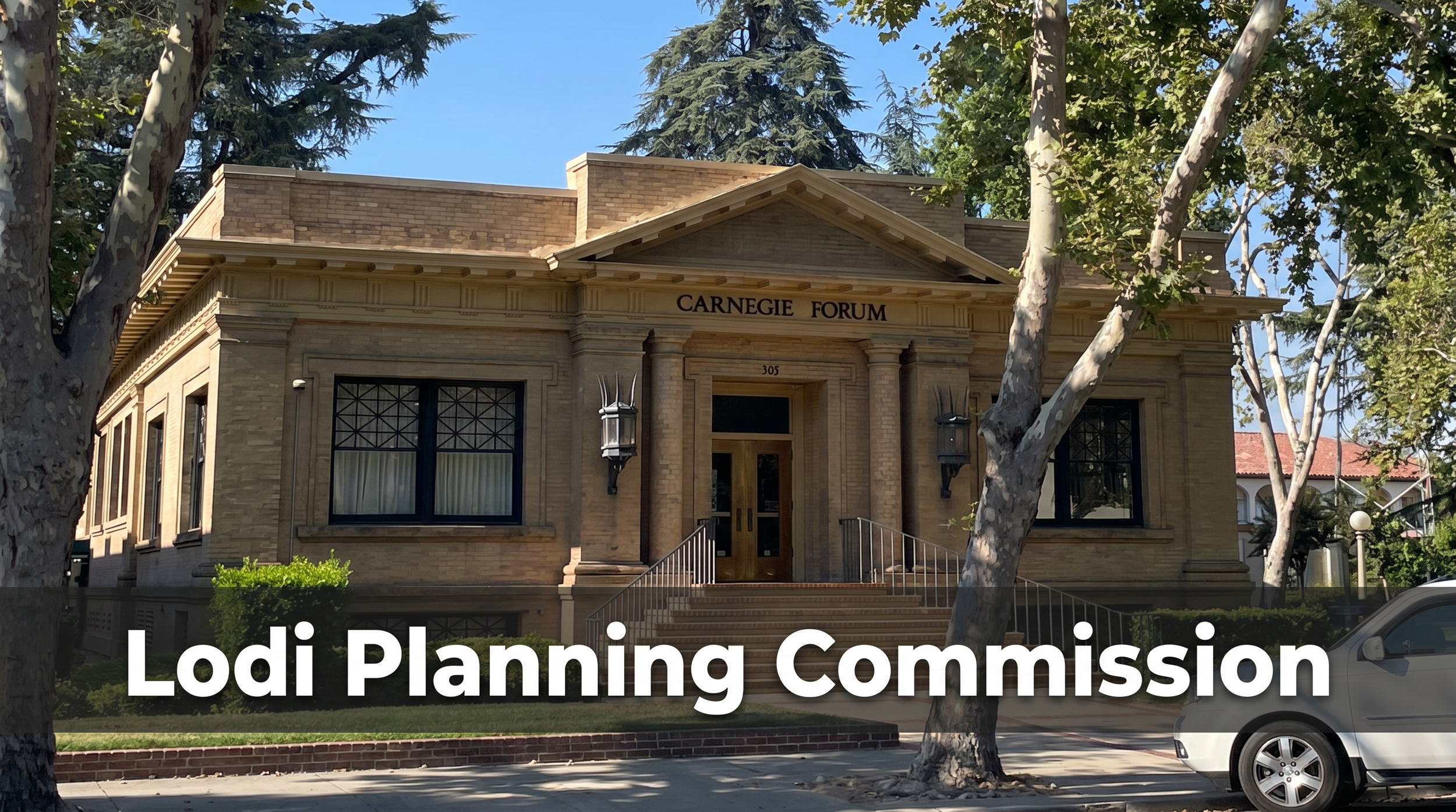
Lodi Planning Commission - August 26, 2026
A short agenda with two public hearings, both quasi-judicial and both requiring ex parte disclosure under Resolution No. 2006-31, plus Government Code §84308 campaign-contribution disclosure, since both items are discretionary land use permits.
Item 4a splits a City-origin parcel on South Stockton Street so each phase of the 110-unit Lodi Commons at Salas Park affordable senior housing project gets its own building site. Item 4b would let Rogers Media install three programmable LED signs on City land — a program whose staff justification is City revenue that the draft Development Agreement never actually quantifies.

Before the Storms: Where Flood Protection Stands in Lodi, Stockton, and the North Delta
NOAA now puts the odds of a very strong El Niño at greater than 90% for fall and winter 2026-27, and gives a 69% chance the October–December 2026 season sets a record for its three-month tropical Pacific temperature index dating back to 1950. The August 2026 Copernicus/ECMWF seasonal outlook calls wetter-than-average conditions likely across southern North America. A companion Lodi411 forecast report covers the atmospheric signal. This brief asks the next question: is the region's flood protection ready?
The answer sorts by clock. One project — the Tenmile Slough levee in west Stockton, described by San Joaquin County as the most critically deficient among those to be improved in the Central Valley system — is racing to finish by late October, weeks before the wet signal arrives. One asset — the Smith Canal Gate — is built, tested once in real weather, and about to face the busiest closure season of its short life. The rest of Stockton's $1.95 billion levee program runs on a design-and-construction schedule stretching into the late 2030s, and no comparable capital project exists on the Mokelumne corridor that runs past Lodi. For every reach that concrete cannot cover by December, this winter's protection is operational: reservoir flood space, district maintenance, levee patrols, and pre-positioned flood-fight supplies. Knowing which category each piece of the map falls into — and what to watch for each — is the point of this report.

From Very Strong to Historic: The August El Niño Forecast and What It Means for Lodi
In April, El Niño was a forecast NOAA handicapped at 61%. By early July it was a fact, with an 81% chance of a very strong peak. The August 13 diagnostic discussion moved the goalposts again — twice. NOAA now puts the chance of a very strong El Niño this fall and winter above 90%, and for the first time assigns a probability to something it calls a historic event: a 69% chance that the October–December peak exceeds every El Niño in the record back to 1950. The mid-August IRI/Columbia model ensemble goes further still, with 15 of its models forecasting peak anomalies at or beyond +3.0°C — past the top of the IRI's own intensity scale.
The California translation arrived the same week. Citing the August ECMWF ensemble, UCLA climate scientist Daniel Swain reports 70–100% odds of above-average winter precipitation statewide — and the same odds that December–February lands among the top 20% of California's wettest winters on record. For Lodi, the preparation questions the April report framed as contingencies — Mokelumne flood-control releases, harvest-season rain, flood insurance — are now the base-case planning scenario. The core caveat survives: probability is not destiny, and 2015–16 proved a monster label can deliver an ordinary winter. But every forecast revision since April has moved one direction.
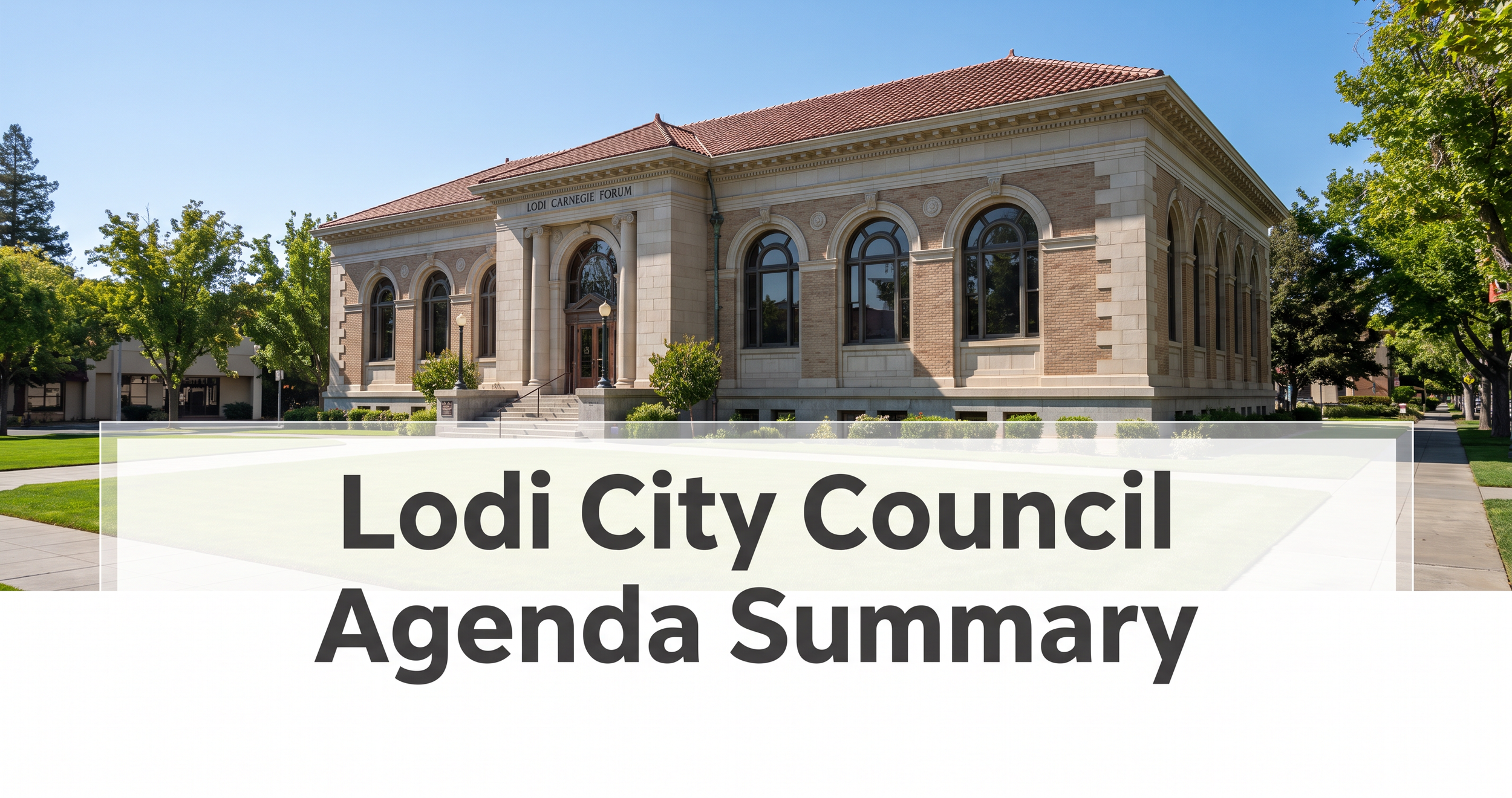
Lodi City Council Agenda - August 19, 2026
This is a governance-heavy agenda dressed up as a routine August meeting. There are no public hearings. Five threads run through the 291-page packet: a twice-deferred, formally protested $616,700 citywide tree maintenance award (G.3) that will determine who operates Lodi's street-tree inventory for the next two to four years; a no-bid $115,000 consulting contract (G.2) to CityWise Strategies, LLC — the firm of Aaron Busch, Lodi's Interim City Manager through June 22, 2026; a first-reading ordinance moving City Clerk appointment and removal authority from the Council to the City Manager (G.6), introduced two days after the incumbent Clerk's last day; a single consent vote clearing a two-year backlog of 18 sets of minutes (C.1), ten of which record canceled meetings; and continued fiscal strain visible in a boiler award 57% over the Engineer's Estimate funded by draining two other capital accounts (C.6) alongside the elimination of executive CalPERS employee cost-sharing (G.5).
Also on the agenda: ratification of David Hanham as Community Development Director at $201,619.47, filling a vacancy open since February 24, 2026 (G.4); an informational report restoring Friday library service and ending Sunday hours for a net gain of four weekly public service hours at no added cost (G.1); a countywide free bus transfer pilot including Lodi GrapeLine (C.7); and recognition of Lodi as America's Favorite Small Town 2026.
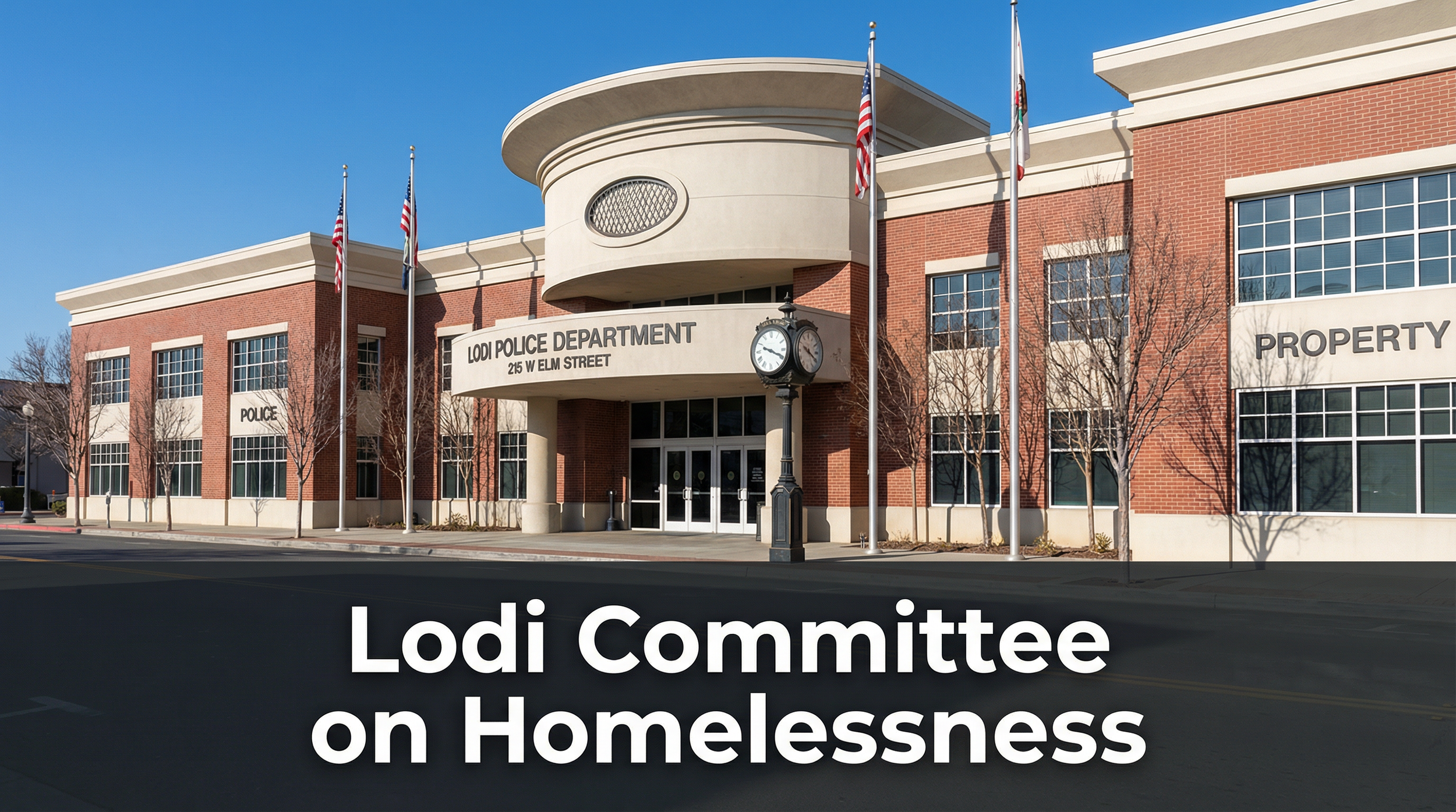
Lodi Committee on Homelessness - August 13, 2026
The August 13 packet carries July 2026 activity from nine reporting bodies, the summary tables the Data Enhancement subcommittee is building, and the July 9 minutes awaiting approval. Committee-wide, July recorded 10 employment placements, 20 transitions to programs, and 21 transitions to housing.
Volume across the system held steady, but throughput did not. The Lodi Access Center's emergency shelter exit rate fell to 8.9%, below the 9.2% countywide figure and down from 14.3% in April. Chronic homelessness among LAC outreach clients continued a three-month decline to 54%. The Lodi Police Department liaison logged 50 outreach contacts and 50 resource offers with zero acceptances, and changed its RV approach from abatement to California Vehicle Code towing. Salvation Army reports every family bed full and families turned away; Lodi House reports five of ten transitional apartments vacant.
Lodi Planning Commission - August 12, 2026
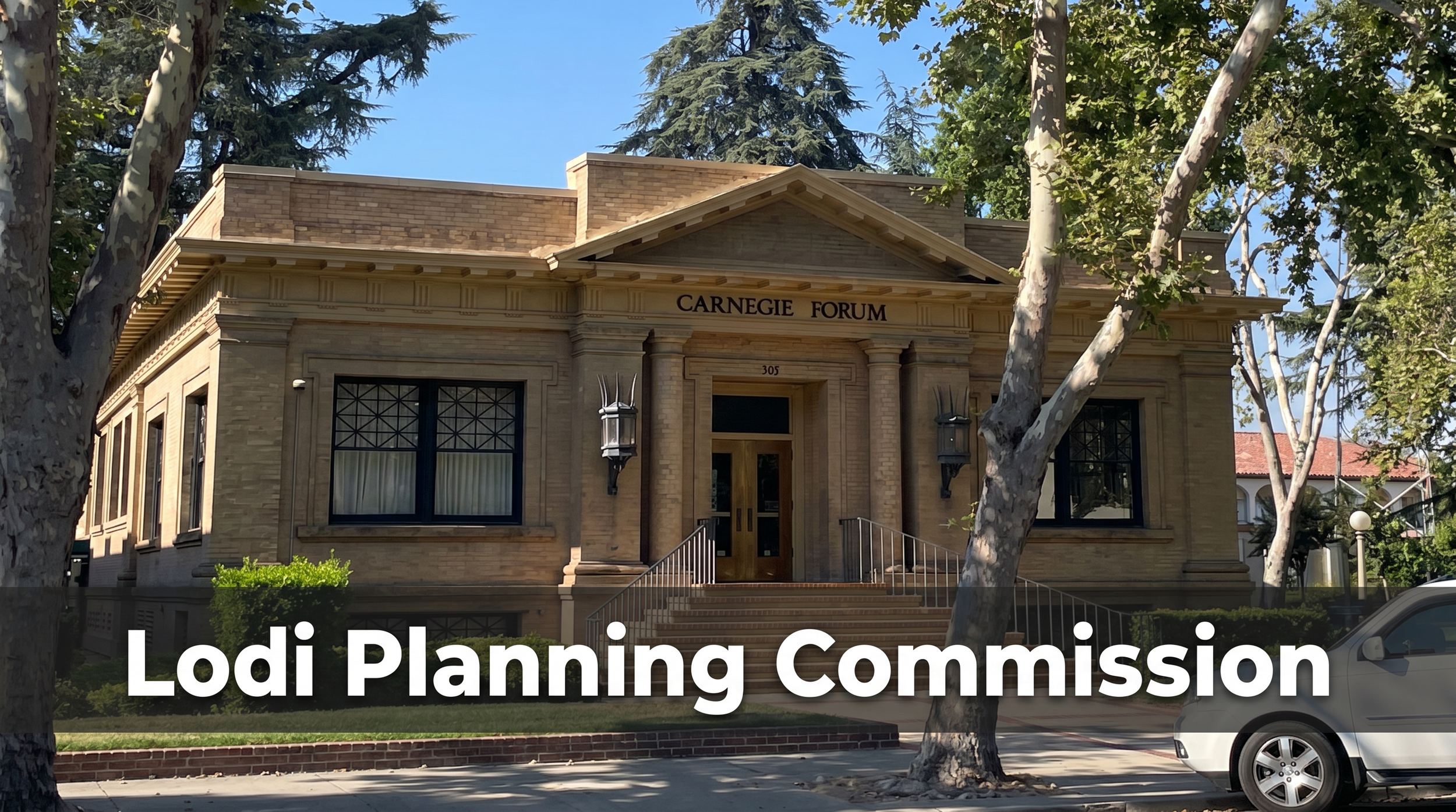
The Lodi Planning Commission meets Wednesday, August 12, 2026 at 7:00 p.m. at the Carnegie Forum, with Zoom and YouTube participation available and written comment accepted at pccomments@lodi.gov until 3:00 p.m. that day. The agenda is short but consequential: two linked public hearings that together set up Lodi’s next major westward expansion — a Phase 4 Development Code overhaul governing annexation, and the 95.3-acre Westside “F” Annexation itself.
This is the Commission’s first meeting since June 10, 2026. June minutes are up for approval. Staff had previously indicated that this meeting would cover an annexation, related code amendments, a car wash, and electronic signs on city property. The car wash and electronic sign items do not appear on the posted agenda.
Lodi Improvement Committee - August 11, 2026
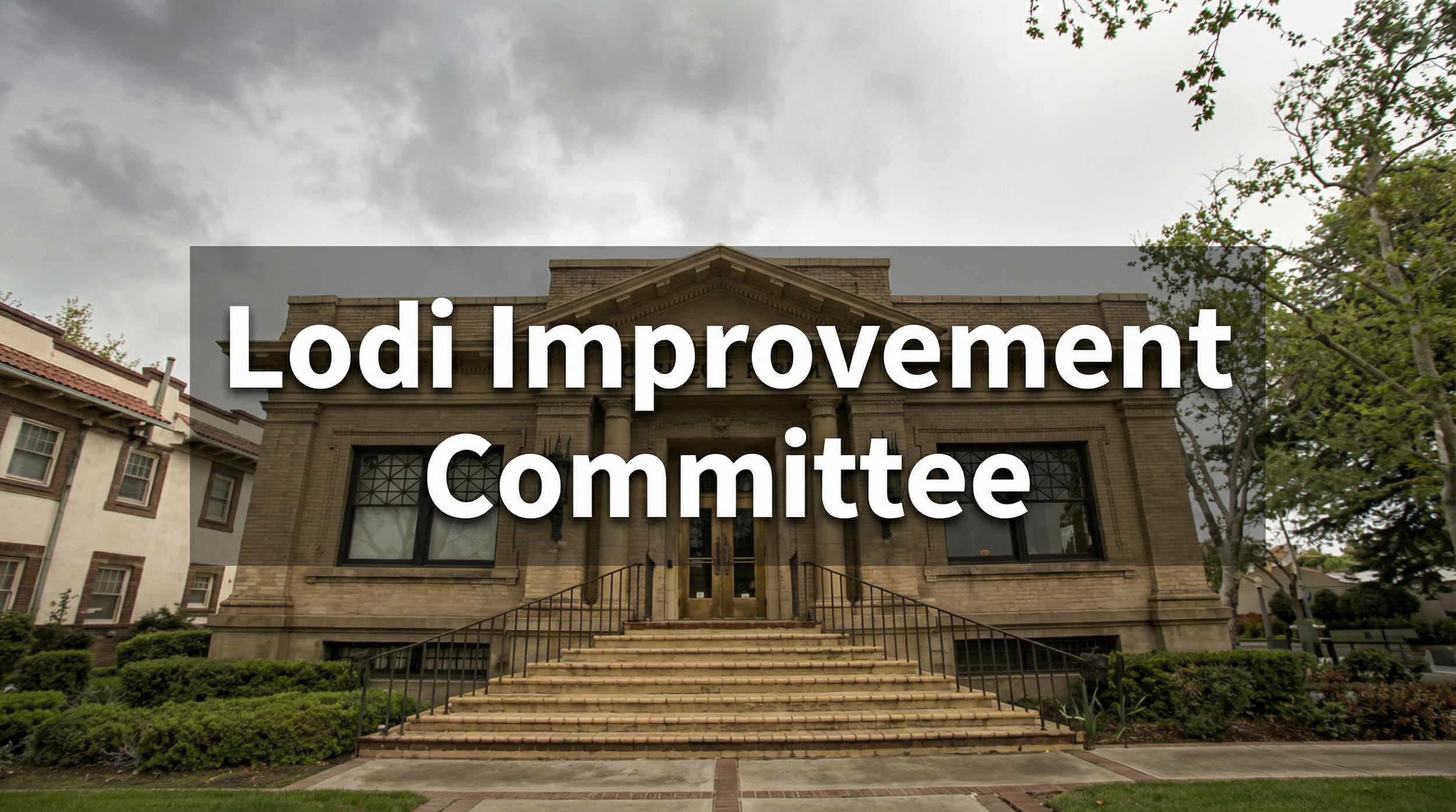
The Lodi Improvement Committee meets Tuesday, August 11, 2026 at 6:00 p.m. at the Carnegie Forum, with Zoom and YouTube access. The posted agenda is procedurally light - no minutes to approve and no action items carrying a fiscal vote - but the packet includes a three-page Community Development Block Grant staff report and the full 2026 goals matrix. Staff contact is Kari Chadwick, CDD Program Specialist, (209) 333-6711; the agenda was signed by Interim Community Development Director Cynthia Marsh.

Heath Flora's Decade in the Assembly, and the Two Ethics Cases That Cost Him the Leadership
Assemblyman Heath Flora, the Ripon Republican who has represented Lodi and the surrounding communities in Sacramento for nearly a decade, was removed as leader of the Assembly Republican Caucus on Monday, August 3 — eleven months after he took the job and one day after national reporting revealed that he is the subject of two open enforcement cases at the Fair Political Practices Commission, the state's political ethics watchdog. Flora remains a member of the Assembly and remains on the November ballot, where he faces Woodbridge Democrat Matthew Adams in the race for the 9th Assembly District. This report lays out Flora's full history in the Legislature, his legislative record, the documented facts of both FPPC cases — including the case numbers and filing records behind them — and the leadership transition now underway. Throughout, it distinguishes between what is established in official records, what has been reported and attributed, and what remains unproven allegation.

The Delivery Decade: How Food Delivery Apps Reshaped Lodi Restaurants, Wages, and Tasting Rooms
Between 2020 and 2025, third-party delivery apps went from a pandemic stopgap to permanent plumbing in the Lodi restaurant economy. Sales rose. Margins did not. Payroll hours moved off the books and onto gig platforms, and the tipped-wage model that supported front-of-house workers lost most of its base.
Five findings drive this report:
Off-premise is the default. Roughly 75 percent of US restaurant traffic now leaves the building — three of every four orders.
Only 30 to 50 cents of each delivery dollar is new demand. The rest converts higher-margin dine-in spending into lower-margin delivery.
San Joaquin County's 15 percent fee cap is the strongest local protection. It is worth about $4.50 per $30 order against uncapped 30 percent commissions.
Real wages barely moved. Stockton–Lodi food-service pay rose about 51 percent in nominal terms from 2020 to 2025. Inflation took nearly all of it.
Lodi tasting rooms split from the state in 2025 — up 12 percent while Napa fell 18 percent — on walk-in access and low tasting fees.
Projected to 2030: delivery reaches about 30 percent of Lodi restaurant volume, median pre-tax margin drifts from 2.8 percent toward roughly 1.35 percent, and the mean food-service wage hits $23.66 nominal but only $20.61 in constant 2025 dollars.

Under the Surface: The 2026 Water-System Cyberattacks and Where Lodi Stands
In the last week of July 2026, hackers reached into the control systems of water utilities in at least seven states, locked operators out of their own equipment, and forced treatment plants to run by hand. Minnesota took the brunt of it — more than thirty community water systems in a single 48-hour window. No ransom was demanded, no one's drinking water was contaminated, and in the towns hit hardest, the taps kept running.
Lodi runs the same kind of automated, widely dispersed water system these attackers target. It also has the redundancy and manual fallback that kept water flowing everywhere the attacks landed: two independent sources, dozens of wells, local storage, and deep upstream reserves. This report explains the attacks, how long they actually disrupted service, how Lodi's water and its upstream sources are built, where Lodi fits the target profile, and what residents can watch for and do now.

It's Here: El Niño Arrives Ahead of Schedule — and the Forecast Keeps Climbing
When LodiEye published its April climate brief, El Niño was a forecast — a near-universal model signal that NOAA still handicapped at 61%. Four months later, the question mark is gone. El Niño conditions are present in the equatorial Pacific, NOAA has upgraded from El Niño Watch to a full El Niño Advisory, and its July 9 diagnostic discussion gives the event a 97% chance of persisting through early spring 2027 — with an 81% chance of reaching "very strong" status during October–December, which would place it among the largest El Niño events in the record going back to 1950.
The local stakes have sharpened, too. California's reservoirs enter fall in good shape — welcome news that also means the flood-control buffer is thinner than it would be coming out of a deep drought. The record marine heatwave off the coast has persisted and intensified, tropical moisture is already reaching Southern California, and the state has begun stockpiling flood-fight supplies at a scale that signals how seriously Sacramento is taking the winter ahead. The April caveats still hold — a strong El Niño label describes the ocean, not California's rainfall — but the probability needle has moved decisively since spring.
Lodi City Council Agenda - August 5, 2026
This is a governance-heavy agenda dressed up as a routine August meeting. There are no public hearings. Five threads run through the 291-page packet: a twice-deferred, formally protested $616,700 citywide tree maintenance award (G.3) that will determine who operates Lodi's street-tree inventory for the next two to four years; a no-bid $115,000 consulting contract (G.2) to CityWise Strategies, LLC — the firm of Aaron Busch, Lodi's Interim City Manager through June 22, 2026; a first-reading ordinance moving City Clerk appointment and removal authority from the Council to the City Manager (G.6), introduced two days after the incumbent Clerk's last day; a single consent vote clearing a two-year backlog of 18 sets of minutes (C.1), ten of which record canceled meetings; and continued fiscal strain visible in a boiler award 57% over the Engineer's Estimate funded by draining two other capital accounts (C.6) alongside the elimination of executive CalPERS employee cost-sharing (G.5).
Also on the agenda: ratification of David Hanham as Community Development Director at $201,619.47, filling a vacancy open since February 24, 2026 (G.4); an informational report restoring Friday library service and ending Sunday hours for a net gain of four weekly public service hours at no added cost (G.1); a countywide free bus transfer pilot including Lodi GrapeLine (C.7); and recognition of Lodi as America's Favorite Small Town 2026.

Gold Runner: Lodi's Rail Service, Station by Station
Lodi's intercity rail service runs under a new name, on a restored daily schedule, and toward a future in which the city is planned to have two stations six miles apart, on two different rail lines, reaching two different parts of Sacramento — now delayed well past its original target. This report walks through the current Gold Runner schedule connecting Bakersfield, Stockton, Lodi, and Sacramento, what the ridership numbers actually show, and the newly disclosed 2031 timeline for Lodi's second station.
The 21st Century ROAD to Housing Act: What It Means for Lodi and San Joaquin County
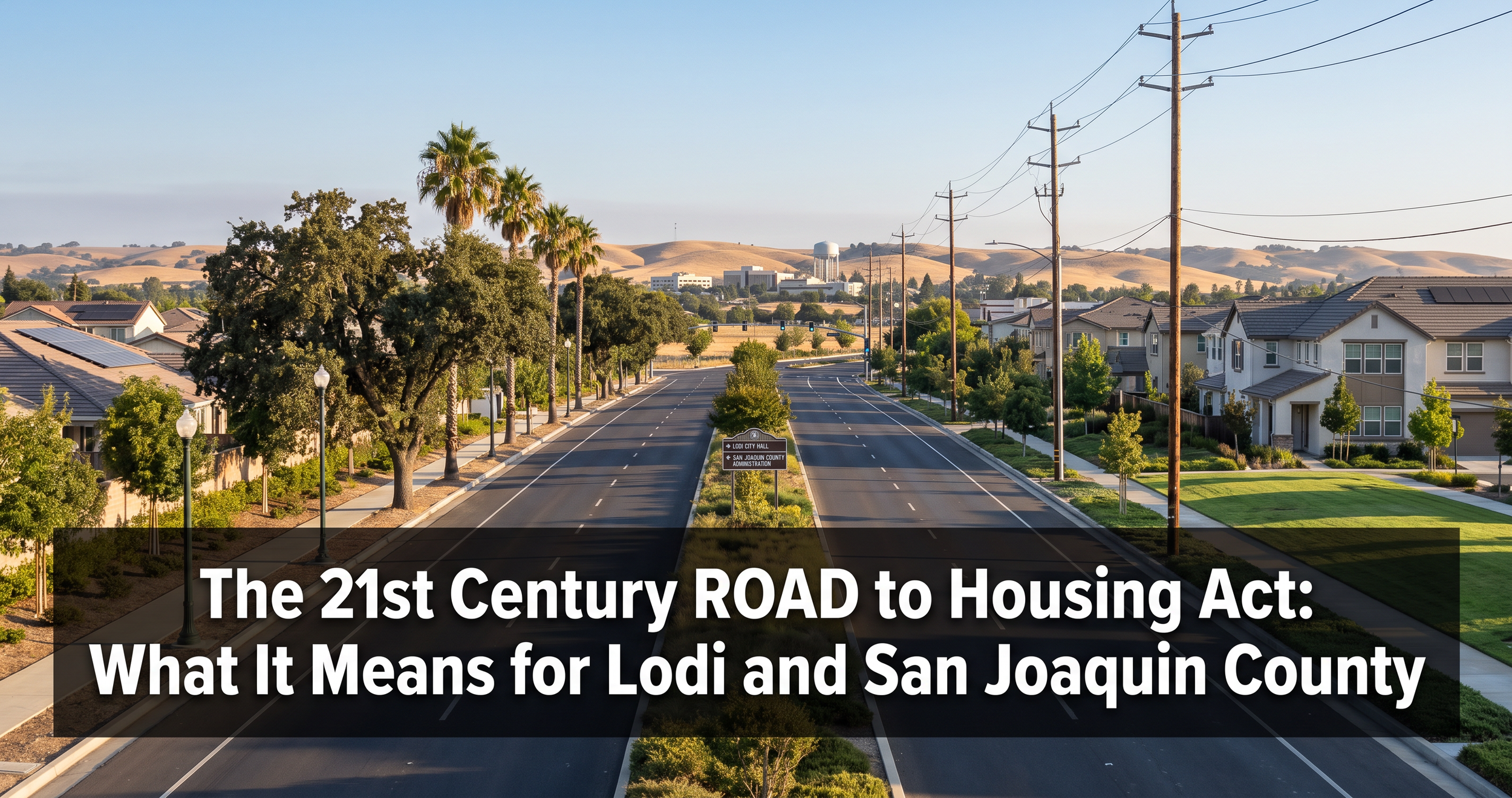
On July 11, 2026, the most significant federal housing law in roughly 50 years took effect. Rep. Josh Harder (CA-09) authored two of its provisions and calls it "the most important housing legislation since 1974." For Lodi and San Joaquin County, the law unlocks new financing tools, rewires federal grant formulas, and creates direct financial incentives — and penalties — tied to local housing production. This report breaks down every provision that touches our region, the specific projects it affects, and when each program activates.

Gas Station Opioids: Kratom, 7-OH, and San Joaquin County's Missing Data
Products containing kratom and its lab-made derivative 7-OH have been illegal to sell for human consumption in California since October 24, 2025. On July 1, 2026, the U.S. Drug Enforcement Administration moved to place 7-OH and three related substances temporarily into Schedule I of the Controlled Substances Act — the same schedule as heroin.
These products have been sold openly in Lodi. San Joaquin County has passed no ordinance, issued no retailer notice, published no consumer advisory, and released no data on kratom-related deaths, emergency visits, or store seizures.
This report does not claim San Joaquin County has a kratom crisis. It shows the county has built no way to find out. Counties that tested for the compound found it in their morgues. Ventura County linked 46 overdose deaths to kratom's main alkaloid since 2018. Los Angeles County confirmed six 7-OH deaths in adults aged 18 to 40 between April 2025 and January 2026. Yolo County counted seven since 2017. Mitragynine does not appear on a standard toxicology screen. A medical examiner has to order the test.

The Future of Navigation and Positioning: GNSS, Alternative PNT, and the Contest for Space-Based Timekeeping
Positioning, Navigation, and Timing (PNT) is the invisible substrate of the global economy. It synchronizes cellular networks, financial trades, power grids, container ports, aircraft approaches, and precision munitions. Four global constellations now compete for that substrate: the U.S. GPS, China's BeiDou, Russia's GLONASS, and the European Union's Galileo. Two decades of quiet Chinese investment, one American humiliation of a Chinese commercial ship in 1993, and two wars in the mid-2020s have reshaped the field in ways the founders of GPS could not have anticipated.
Three simultaneous trends now define the future of navigation:
The commercial world is drifting toward multi-constellation, multi-frequency, LEO-augmented PNT. No single system will be trusted alone for aviation, maritime, or autonomous ground applications by 2030.
The military world is decoupling from GNSS entirely. The next generation of missiles, drones, and bunker-busters is designed to fight through denial, spoofing, and constellation loss using inertial, visual, magnetic, and terrain-matching aids.
The geopolitical world is fragmenting into GNSS blocs. Iran's stated 2025 move toward BeiDou, alongside continued reliance on multi-constellation civilian receivers, illustrates how states under GNSS-denial pressure are hedging away from GPS. It will not be the last such case.