Lodi Eye
LodiEye provides additional information on trending stories / topics published by local media and shared on local social media accounts.

Now It's 75 Percent: The September El Niño Forecast and the Mokelumne Clock
Updated with NOAA CPC, IRI, ECMWF, and Weather West data through August 19. This brief updates our April 22 report, "Strongest El Niño in 140 Years?", and our early-August follow-up, "It's Here: El Niño Arrives Ahead of Schedule — and the Forecast Keeps Climbing".
In April, El Niño was a forecast NOAA handicapped at 61%. By early July it was a fact, with an 81% chance of a very strong peak. The August 13 diagnostic discussion moved the goalposts again — twice. NOAA now puts the chance of a very strong El Niño this fall and winter above 90%, and for the first time assigns a probability to something it calls a historic event: a 69% chance that the October–December peak exceeds every El Niño in the record back to 1950. The mid-August IRI/Columbia model ensemble goes further still, with 15 of its models forecasting peak anomalies at or beyond +3.0°C — past the top of the IRI's own intensity scale.
The California translation arrived the same week. Citing the August ECMWF ensemble, UCLA climate scientist Daniel Swain reports 70–100% odds of above-average winter precipitation statewide — and the same odds that December–February lands among the top 20% of California's wettest winters on record. For Lodi, the preparation questions the April report framed as contingencies — Mokelumne flood-control releases, harvest-season rain, flood insurance — are now the base-case planning scenario. The core caveat survives: probability is not destiny, and 2015–16 proved a monster label can deliver an ordinary winter. But every forecast revision since April has moved one direction.

Before the Storms: Where Flood Protection Stands in Lodi, Stockton, and the North Delta
NOAA now puts the odds of a very strong El Niño at greater than 90% for fall and winter 2026-27, and gives a 69% chance the October–December 2026 season sets a record for its three-month tropical Pacific temperature index dating back to 1950. The August 2026 Copernicus/ECMWF seasonal outlook calls wetter-than-average conditions likely across southern North America. A companion Lodi411 forecast report covers the atmospheric signal. This brief asks the next question: is the region's flood protection ready?
The answer sorts by clock. One project — the Tenmile Slough levee in west Stockton, described by San Joaquin County as the most critically deficient among those to be improved in the Central Valley system — is racing to finish by late October, weeks before the wet signal arrives. One asset — the Smith Canal Gate — is built, tested once in real weather, and about to face the busiest closure season of its short life. The rest of Stockton's $1.95 billion levee program runs on a design-and-construction schedule stretching into the late 2030s, and no comparable capital project exists on the Mokelumne corridor that runs past Lodi. For every reach that concrete cannot cover by December, this winter's protection is operational: reservoir flood space, district maintenance, levee patrols, and pre-positioned flood-fight supplies. Knowing which category each piece of the map falls into — and what to watch for each — is the point of this report.

From Very Strong to Historic: The August El Niño Forecast and What It Means for Lodi
In April, El Niño was a forecast NOAA handicapped at 61%. By early July it was a fact, with an 81% chance of a very strong peak. The August 13 diagnostic discussion moved the goalposts again — twice. NOAA now puts the chance of a very strong El Niño this fall and winter above 90%, and for the first time assigns a probability to something it calls a historic event: a 69% chance that the October–December peak exceeds every El Niño in the record back to 1950. The mid-August IRI/Columbia model ensemble goes further still, with 15 of its models forecasting peak anomalies at or beyond +3.0°C — past the top of the IRI's own intensity scale.
The California translation arrived the same week. Citing the August ECMWF ensemble, UCLA climate scientist Daniel Swain reports 70–100% odds of above-average winter precipitation statewide — and the same odds that December–February lands among the top 20% of California's wettest winters on record. For Lodi, the preparation questions the April report framed as contingencies — Mokelumne flood-control releases, harvest-season rain, flood insurance — are now the base-case planning scenario. The core caveat survives: probability is not destiny, and 2015–16 proved a monster label can deliver an ordinary winter. But every forecast revision since April has moved one direction.

The Bill That Could Price Lodi Out of Its Own Public Records
UPDATE — JULY 11, 2026
The provisions this report warned about are out of the bill — for the second time.
At the June 30 Senate Judiciary Committee hearing, Assemblymember Blanca Pacheco again stripped AB 1821 of its fees, its purpose test, and its "malicious intent" lawsuit provision. The committee passed the reduced bill and sent it to the Senate floor. What remains is the narrow, original-intent version the Assembly approved in May: the initial response window would shift from 10 calendar days to 10 business days, and the "unusual circumstances" extension from 14 calendar to 14 business days. The three structural changes this analysis examines below — charging by the hour for "commercial" requests, letting agencies ask why you want records, and suing requesters for "malicious intent" — are no longer in the text.
Assembly Bill 1821, moving quickly through the Legislature, would rewrite California's 58-year-old Public Records Act — letting government agencies ask why you want records, charge by the hour for requests they label "commercial," and sue requesters they judge to be acting with "malicious intent." This analysis explains what the bill does, which Lodi and San Joaquin County records it would put at risk, and how its "representative of the news media" exemption would land on the small, shrinking set of outlets that still cover this region.
AB 1821 cleared the Assembly 55–12 on May 27 in a narrow form, then was rewritten in the Senate. The far-reaching provisions face their first vote today, June 30, in the Senate Judiciary Committee (9:30 a.m., 1021 O Street, Room 2100). No Senate floor vote is scheduled; a floor vote — and a return to the Assembly to concur in the Senate's changes — would follow only if the bill clears committee. The provisions described below are the current amended text and may still change.

AI in Policing: What's Already Here, What's Coming Next
Artificial intelligence already reads license plates, drafts police reports, extracts and analyzes seized phones, mines social media, and flags people as future suspects in California departments, including in San Joaquin County. This report organizes the technology into four categories: surveillance and identification, predictive and risk analysis, records and evidence processing, and the real-time crime centers now fusing all three into a single dashboard.
Surveillance tools like license-plate readers and social-media mining platforms are the most mature and the most widely deployed today.
Predictive and risk-scoring tools are moving from pilots into active use, despite a documented history of flawed data driving them.
AI report-writing tools now draft first-version reports from body-camera audio in minutes, with officers reviewing before signing.
Real-time crime centers are quietly combining all of the above into single dashboards, a convergence point civil liberties groups now consider the biggest emerging risk.
Lodi Police already operate license-plate cameras, a multi-drone program dating to 2018, and a Flock Safety gunshot-detection system; a dedicated section covers what is in use locally and where the department has signaled it is headed.
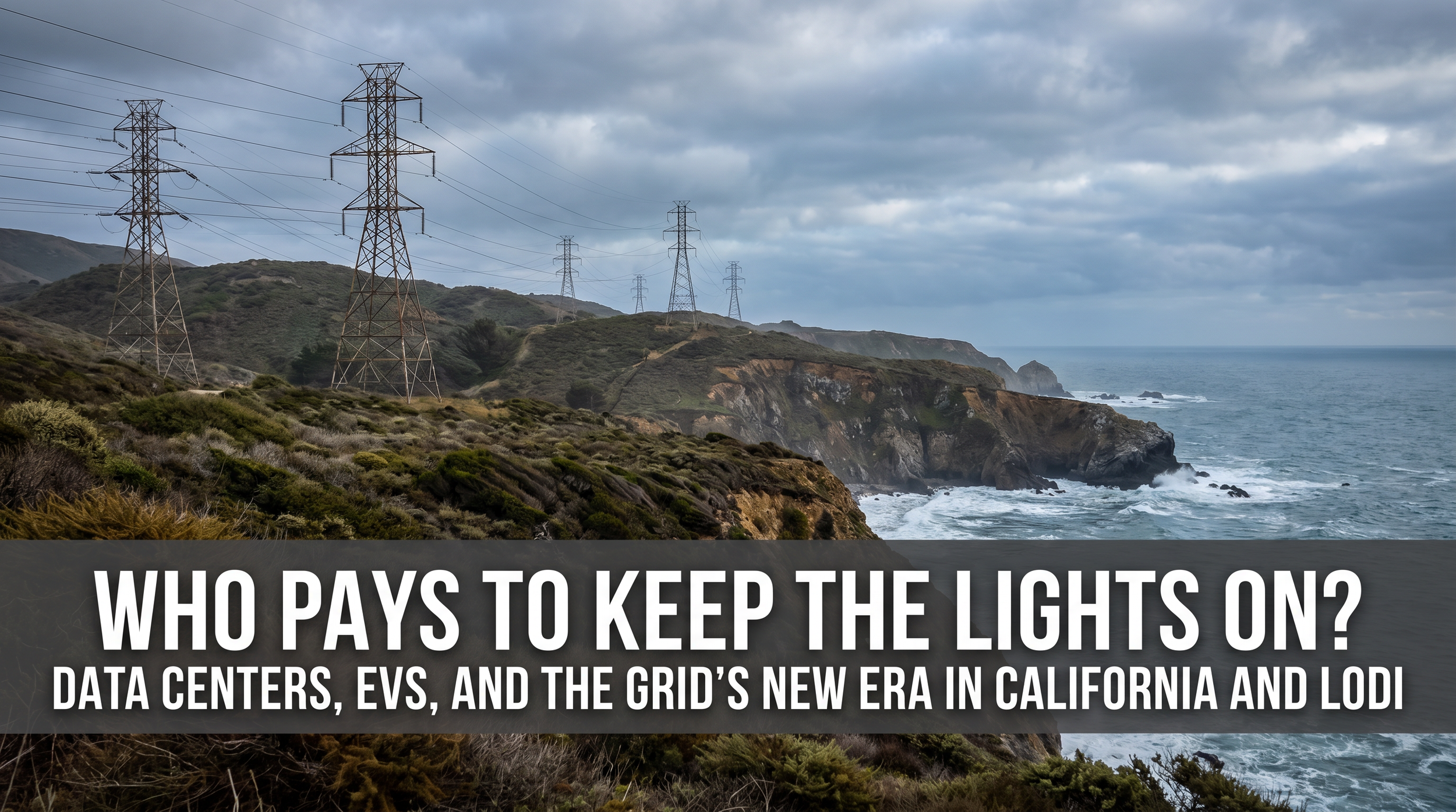
Who Pays to Keep the Lights On? Data Centers, EVs, and the Grid's New Era in California and Lodi
After two decades of flat electricity demand, the American power grid has hit an inflection point. Artificial-intelligence data centers, a wave of electric vehicles, and a generation mix tilting toward solar and wind are changing both how much power the country needs and the architecture of the system that delivers it. The hardest question is not whether the lights stay on, but who pays to keep them on — and whether ordinary households can still afford the bill. Nowhere is that question sharper than in California, and the answer looks different depending on which side of a city limit you live on.

Newsom's 2026-27 May Revision: What It Means for San Joaquin County and Lodi
Governor Gavin Newsom released his May Revision to the 2026-27 California state budget on May 14, 2026, proposing $246.6 billion in General Fund spending and claiming a $0 structural deficit through July 2028. For San Joaquin County and the City of Lodi, the picture splits cleanly: meaningful gains for local schools through an upgraded Local Control Funding Formula (LCFF) "super COLA" of 4.31% and a record $2.4 billion special education investment, but a deepening healthcare funding crisis as state Medi-Cal policy changes compound federal H.R. 1 cuts already projected to drain $50.9 million to $76.9 million annually from county coffers. The Homeless Housing, Assistance, and Prevention (HHAP) program is held at $500 million — half its prior level — threatening the funding pipeline for Lodi's Access Center. Property tax growth in San Joaquin County is forecast to slow from 7% to 2%, and labor costs are rising by more than $22 million, leaving the County entering FY 2026-27 in a "compression" scenario heading into its June 2 budget presentation.

The Three-Sided Squeeze on California Orchards
California's tree-fruit orchard system is taking simultaneous hits from three different directions. The Del Monte bankruptcy has cancelled more than half a billion dollars in long-term cling peach contracts and is forcing growers to bulldoze roughly 420,000 trees. Back-to-back weather disasters have cut San Joaquin County's cherry crop by more than 40 percent in 2024 and roughly 30 percent again in 2026. And input and trade shocks — tariffs on can steel, the Strait of Hormuz fertilizer disruption, and continued cheap imports — are compressing margins across every orchard crop at once.
The federal response to date is $9 million in tree-removal aid targeted at one commodity in one bankruptcy. This piece looks at how the three pressures interact, what the San Joaquin County data shows about the local exposure, and why "just plant something else" is not a real answer.
2025 Lodi Crush Report: The Final Numbers
The USDA/CDFA Final 2025 California Grape Crush Report, released April 30, 2026, confirms District 11 crushed 532,409 tons — 14.1% below the August moderate forecast of 620,073 tons and 9.8% below the 2024 D11 total. Statewide, the Final crush settled at 2,761,914 tons, down 6.1% from 2024.
The Final report supersedes the Preliminary numbers analyzed in March. The most consequential revision: the table-grape-to-crush surge that appeared to be reaching District 11 in the Preliminary data turned out to be a District 13 phenomenon all along. D11 ended 2025 with just 2.4 tons of table grapes diverted to crush — essentially zero.
What remains unchanged: a Zinfandel collapse, a cooler-than-normal vintage that delivered exceptional fruit quality, and a widening price chasm between coastal and interior California. What changes: Lodi's exposure to the table-grape-diversion economy is far smaller than the Preliminary suggested.
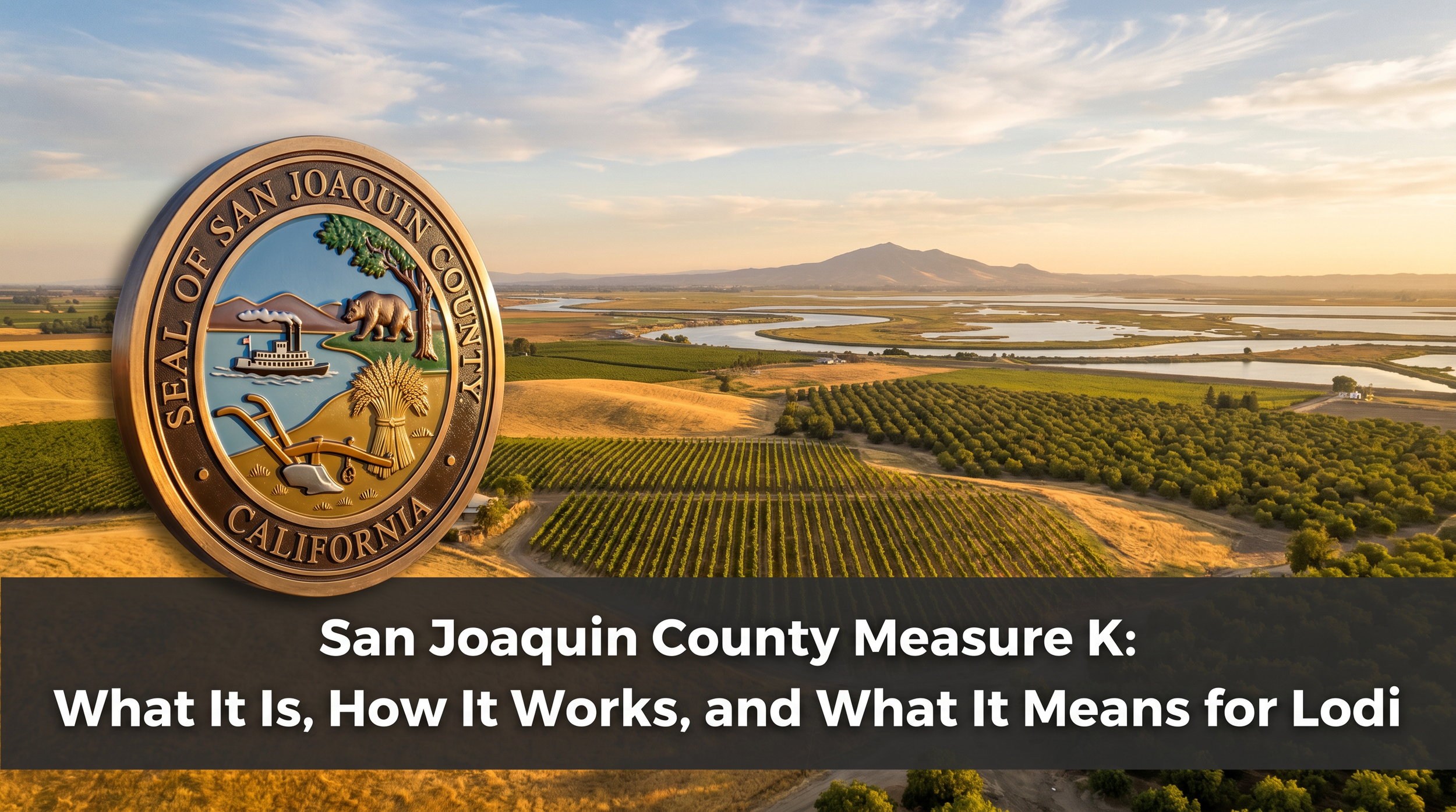
San Joaquin County Measure K: What It Is, How It Works, and What It Means for Lodi
Measure K is San Joaquin County's dedicated half-cent (0.5%) transportation sales tax, first approved by voters in November 1990 and renewed for a 30-year extension through March 2041 when nearly 78% of county voters approved the renewal in November 2006. Every taxable retail purchase made in Lodi contributes a half-penny per dollar to this fund, which is distributed to local street repair, highway improvements, public transit (including GrapeLine), bicycle and pedestrian infrastructure, and railroad crossing safety. Over the 30-year renewal period, Measure K is projected to generate approximately $2.64 billion in transportation investment for San Joaquin County.
For Lodi specifically, Measure K is the single most important non-federal source of transportation funding. It directly pays for GrapeLine bus service, annual street repaving, the SR 99/Turner Road interchange reconstruction, active transportation trails, and a pipeline of planned highway, arterial, and bike/pedestrian projects. This report explains the program's origins, funding mechanics, expenditure categories, administration, oversight, and Lodi-specific project history and pipeline.

Strongest El Niño in 140 Years
A rare triple-cyclone cluster near the equator in early April triggered what atmospheric scientists are calling possibly the most powerful westerly wind burst in the equatorial Pacific in a century. The April seasonal forecast from the European Centre for Medium-Range Weather Forecasts (ECMWF) shows near-universal model agreement that El Niño conditions will arrive by mid-to-late summer. A subset of models — about half of the ECMWF ensemble — projects sea-surface-temperature anomalies above 2.5°C by October.
For San Joaquin County and Lodi, the picture is further complicated by this year’s unusual water-year volatility, a record-breaking marine heatwave off the California coast, and a Sierra snowpack currently tied with 2015 for the lowest on record to date. History shows that a strong El Niño label does not guarantee a wet winter here — but when conditions align, the Mokelumne and San Joaquin river systems, the Delta levees, and Lodi’s vineyards absorb the consequences together.

Who’s Really Leaving California
California has now posted six consecutive years as the nation’s largest net loser of residents to other states, but the pandemic-era exodus is easing, high-income households are returning in rising numbers, and San Joaquin County is quietly doing the opposite of the coastal metros — gaining domestic migrants and net adjusted gross income at a time when the state as a whole is shedding both. The newest IRS Statistics of Income (SOI) migration file, released in 2026 and covering tax year 2023, combined with the July 2025 Census and California Department of Finance estimates, tells a more nuanced story than the “California exodus” headlines suggest.

Drug Crisis in San Joaquin County & Lodi, California
San Joaquin County (SJC) continues to confront one of the most severe drug crises in California's Central Valley. Fentanyl — primarily linked to Sinaloa Cartel trafficking networks — remains the dominant threat, responsible for 92% of opioid-related deaths in the county as of the most recent complete data (2023). However, early indicators from 2024 and the national trend through 2025 suggest the region may finally be turning a corner, with preliminary death counts tapering and U.S. overdose fatalities declining roughly 17–21% year-over-year.

The State of Newspapers in California's Smaller Markets
California's small-market newspapers—those serving communities under 75,000 people—are in an accelerating crisis. The convergence of declining advertising revenue, rising operational costs, hedge fund consolidation, and shifting consumer behavior has left most of these publications financially fragile. Of the estimated 200+ newspapers and community publications still operating in California's smaller markets, the research paints a stark picture…
California 2025-26 Legislative Session: Impact Report for San Joaquin County and Lodi
This report analyzes California state legislation from the 2025-26 Regular Session and its specific impacts on San Joaquin County and the City of Lodi. As of mid-March 2026, the Legislature has passed and the Governor has signed dozens of bills into law during 2025, with additional measures moving through the 2026 legislative process. A small number of bills have been vetoed or had their vetoes sustained in early 2026.
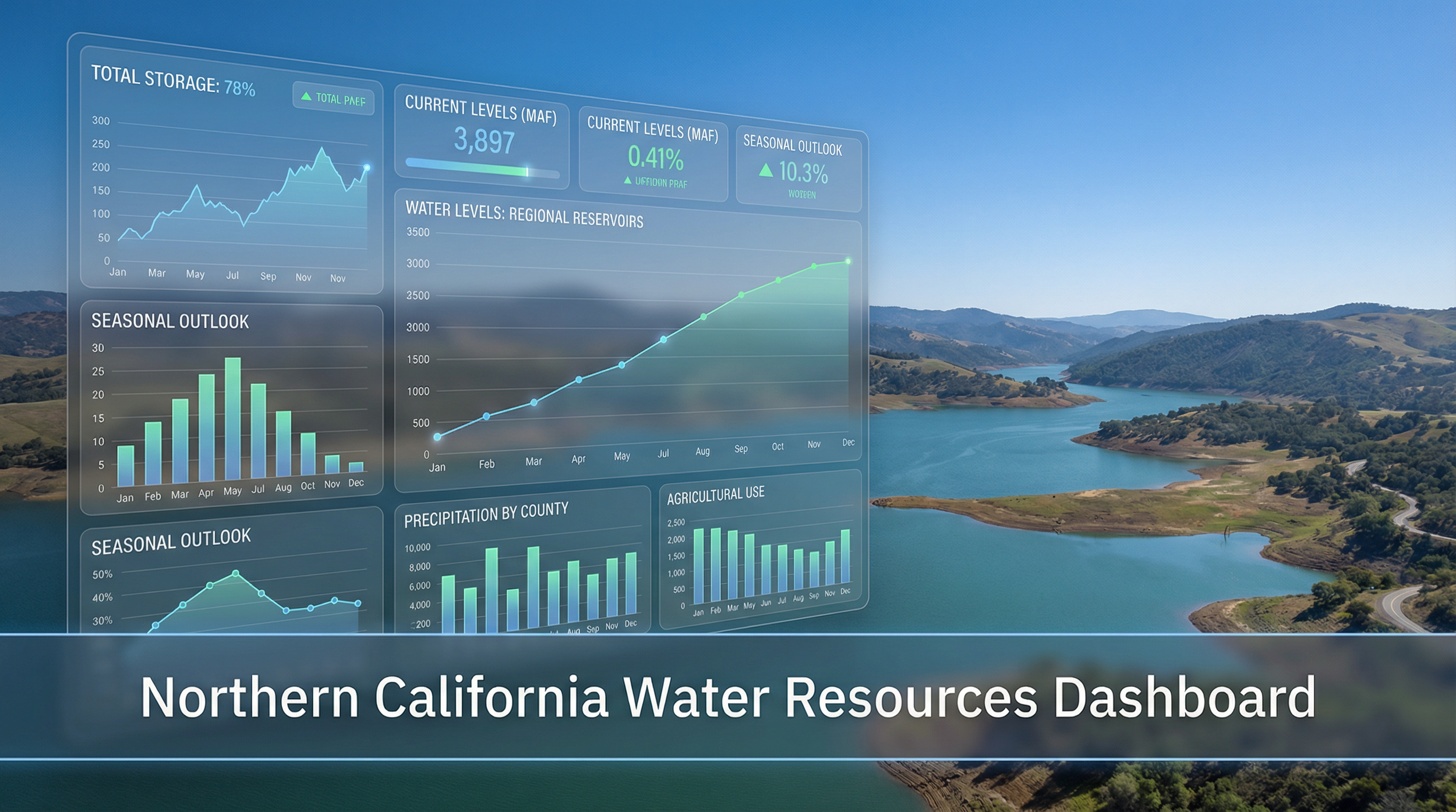
Northern California Water Resources Dashboard
The 2025–26 water year in Northern California tells a story of dramatic swings — a pattern scientists call weather whiplash. The season opened slowly with scant October–November precipitation, then atmospheric rivers in late December sent reservoir levels surging. A bone-dry January eroded snowpack gains, dropping the statewide pack from 89% to 59% of average in three weeks. Mid-February brought the third-snowiest 5-day period on record at the UC Berkeley Central Sierra Snow Lab (111 inches), pushing statewide snowpack back toward ~97% of average by late February.

OPEB Funding in California Pensions
Other Post-Employment Benefits (OPEB) represent a significant long-term financial obligation for California public agencies. This report examines the regulatory framework governing OPEB in California, the approach taken by San Joaquin County, and the City of Lodi's unique sick leave conversion-based OPEB program.
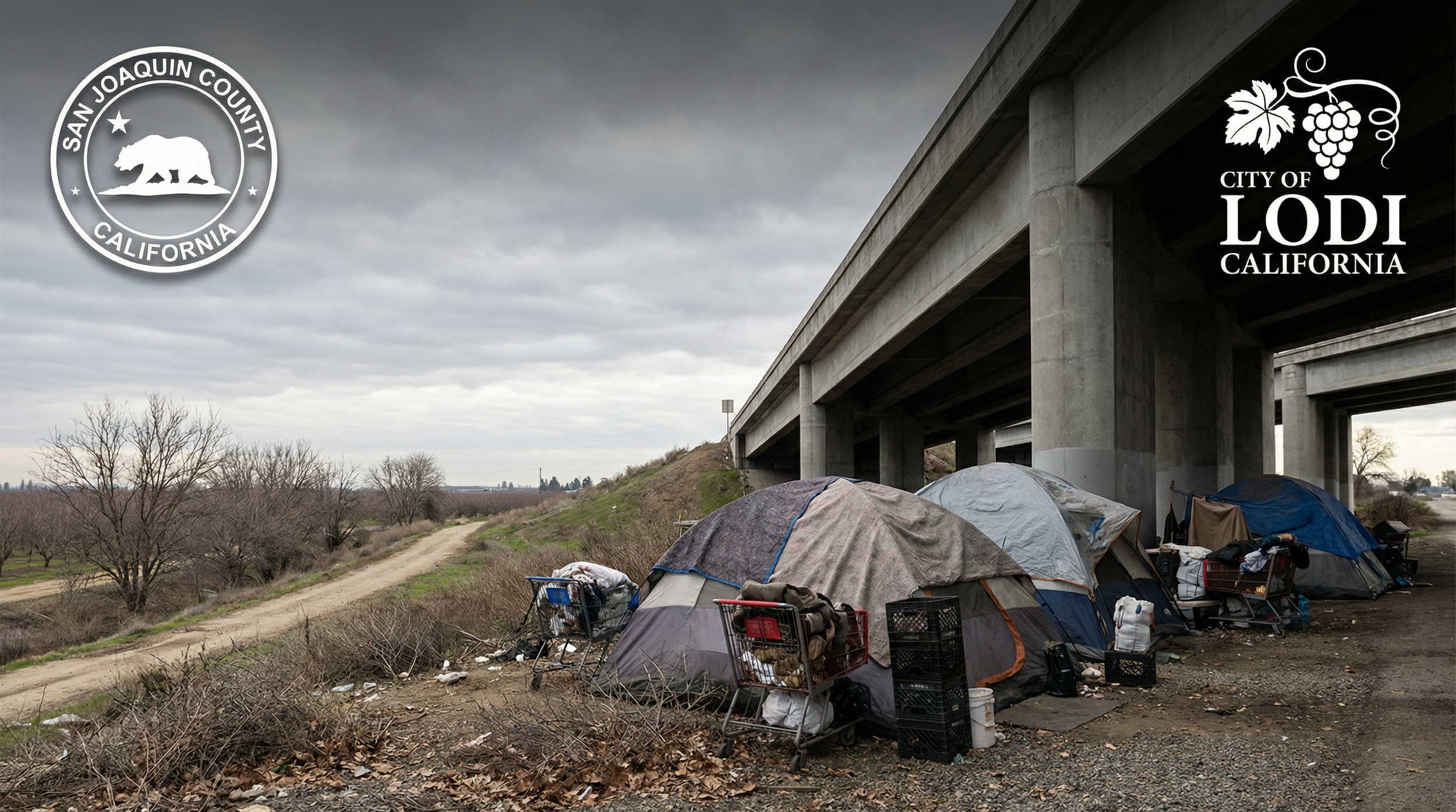
Emerging Trends in San Joaquin County and Lodi - January 2026
San Joaquin County and the city of Lodi face a confluence of intensifying social and economic pressures that reflect broader Central Valley dynamics. The region is experiencing a homelessness crisis of unprecedented magnitude, with the county's unhoused population more than doubling between 2022 and 2024.

California Traffic Death Crisis
California is experiencing a devastating surge in traffic deaths that has gone largely unaddressed by state leaders. According to CalMatters' comprehensive investigation documented in their "License to Kill" series, fatalities on California roads have increased by more than 60% since 2010, reversing decades of progress in road safety

Thanksgiving Dinner Prices: 2024 vs 2025
Overall, Thanksgiving dinner costs have decreased by approximately 3-5% in 2025 compared to 2024, bucking recent inflationary trends. However, California families continue to pay 31-32% more than the national average.. A traditional Thanksgiving dinner for 10 people in the Lodi area costs approximately $72-74 in 2025, down from $75-77in 2024.